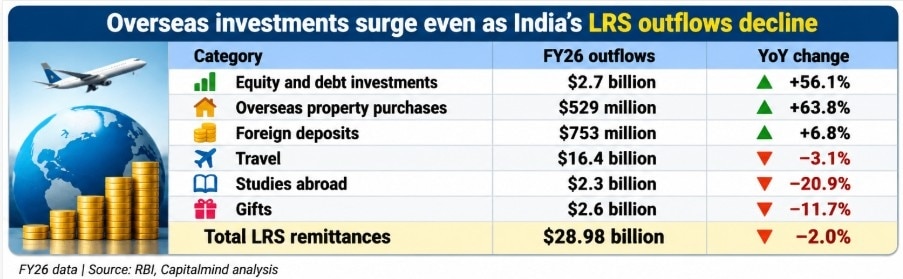



 Overseas equity and debt investments rose 56.1% in FY26 despite a 2% decline in overall LRS remittances, indicating growing interest in international diversification.
Indian investors are increasingly looking beyond domestic markets to diversify their portfolios, with overseas investments in equities and debt securities rising sharply even as overall outward remittances decline. RBI data shows that remittances for foreign equity and debt investments jumped 56.1% year-on-year to $2.7 billion in FY26, highlighting growing interest in international assets.
The increase comes despite total outward remittances under the Liberalised Remittance Scheme (LRS) falling 2% to $28.98 billion in FY26, from $29.56 billion in FY25. Overall remittances have declined for two consecutive years after peaking at $31.74 billion in FY24.

 Gold at $3,800–4,000: Could an AI spending crash trigger the next bullion rally? Jefferies explains
 'Emergency was a mistake...': Sonia Gandhi says Indira Gandhi eventually regretted 1975 decision
 Coca-Cola India bottler files IPO papers with SEBI; nearly 100 crore shares on offer, revenue rises 20%
 E20 petrol row: Centre rejects Karnataka's 31% ethanol claim, says all 893 samples passed quality tests
 LK Advani turns 99 on November 8; BJP to hold special hawan at Delhi headquarters
 PROMO | Muhurat Trading Special: Top Experts Share Market Insight & Investment Tips For Samvat 2083
 Agniveer Scheme Gets 2-Year Extension | What Changes For Agniveers?
 Gold Price Target ₹2 Lakh By Next Dhanteras? Ajay Kedia Expects Fresh Rally Despite Volatility
 Gold Prices Down 30%: Why Ajay Kedia Sees A New Bull Run Ahead | Gold & Silver Outlook
 Samvat 2083 Outlook: Why Investors Should Focus on the Next 10 Years, Not 6 Months
 Gold at $3,800–4,000: Could an AI spending crash trigger the next bullion rally? Jefferies explains
 South Korea crashed 15.57%, China fell 7.17% in October: Are emerging-market funds getting riskier?Coca-Cola India bottler files IPO papers with SEBI; nearly 100 crore shares on offer, revenue rises 20%
 SEBI's new settlement rules effective November 7: Online applications, revised fees, fast-track process explained
 Zerodha Fund House becomes Zerodha CASE Funds as investor base crosses 12 lakh in three years
 Financial Horoscope Today, November 8, 2026: Gemini natives will have good income, know what your zodiac sign says
 UK to use facial recognition technology in wider immigration enforcement drive
 Spain's unstable volcano raises megatsunami fears: Could 65-foot waves hit the US East Coast?PROMO | Muhurat Trading Special: Top Experts Share Market Insight & Investment Tips For Samvat 2083Gold at $3,800–4,000: Could an AI spending crash trigger the next bullion rally? Jefferies explains