












 Omitting F&O gains or losses in your ITR could lead to a notice from the Income Tax Department.
Futures and Options (F&O) trading in India offers immense opportunities for traders. The Income Tax Act classifies F&O income as Non-Speculative Business Income and requires it to be mandatorily reported in the Income Tax Returns (ITR).
As per Section 43(5) of the Income Tax Act, 1961, F&O income or loss is treated as non-speculative business income and must be declared under the head "Profits and Gains of Business or Profession" (PGBP). This income is taxed at the slab rates applicable to the individual. This differs significantly from capital gains tax rules that apply to equity investments or speculative business rules that apply to intraday equity trades.
The distinction matters because non-speculative business income allows for broader and more flexible loss set-off and carry-forward provisions under Sections 70, 71, and 72 of the Act. Speculative losses, on the other hand, can only be set off against speculative gains and have more restrictive carry-forward rules.
A total of 95.75 lakh individuals traded in futures and options (F&O) derivatives in FY24, according to a report by market regulator SEBI. However, 91.1% of them incurred losses on a net basis — highlighting the importance of understanding tax treatment not just on profits, but also on losses.
A real-life case highlighted by Sujit Bangar, founder of TaxBuddy.com and a former IRS officer, sheds light on the significance of proper tax strategy in such cases.
Take Priya’s case:
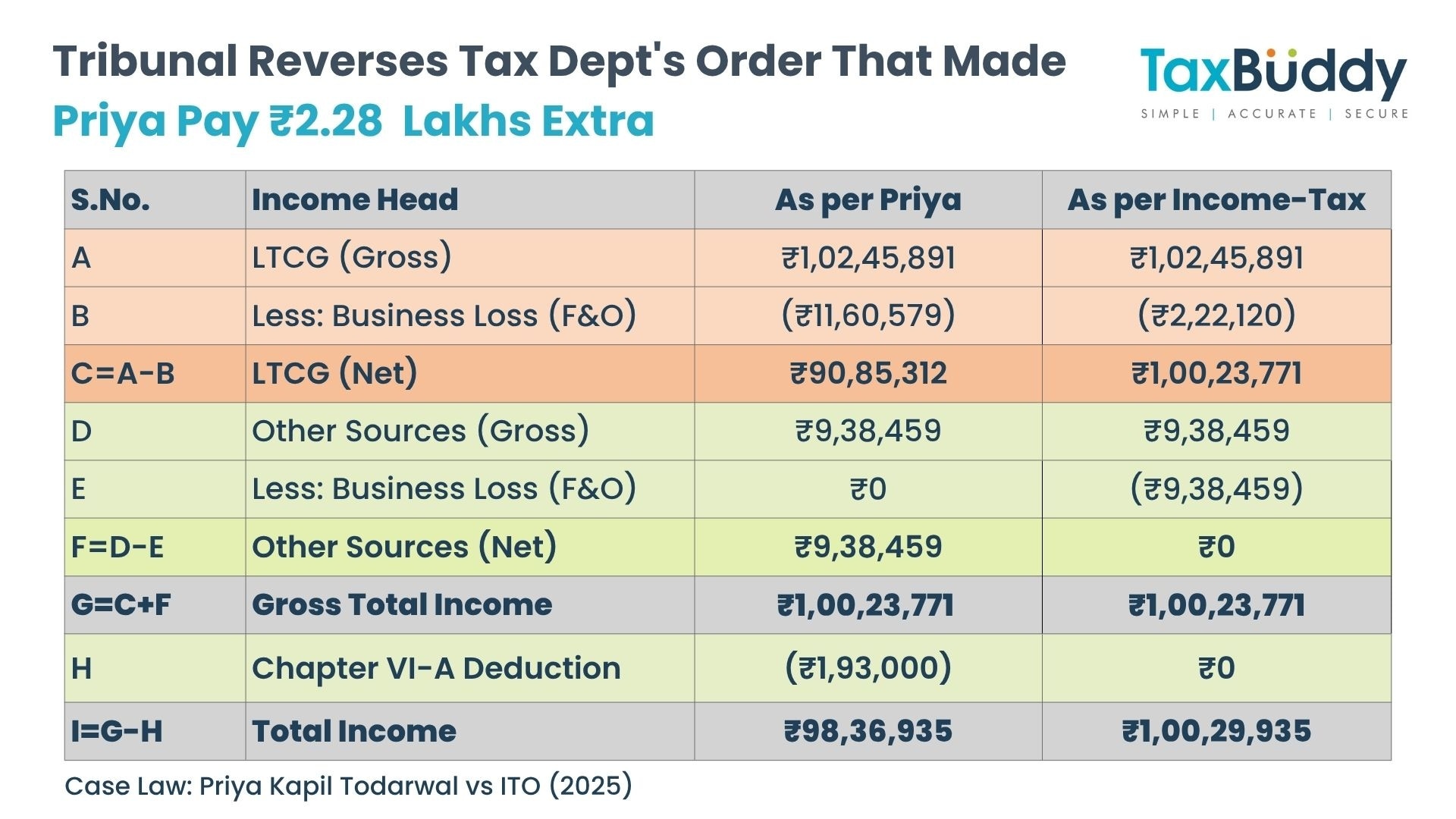
She reported the following income in a given financial year:
Business Loss (F&O): ₹11.6 lakh
Long-Term Capital Gains (LTCG): ₹1.02 crore
Interest Income: ₹9.38 lakh
Deductions claimed under Chapter VI-A: ₹1.93 lakh
Priya set off her F&O loss against LTCG, preserving her interest income from the “Income from Other Sources” head. This move allowed her gross total income (GTI) to include non-capital gains income — a prerequisite for claiming deductions under Chapter VI-A (like 80C, 80D etc.).
However, the Centralised Processing Centre (CPC) disallowed her ₹1.93 lakh deduction. Their reason? Her gross total income consisted only of capital gains, which is ineligible for such deductions.
But the Income Tax Appellate Tribunal (ITAT) ruled in her favour. Key observations:
Section 71(2) permits business losses to be set off against any other head of income, including capital gains.
The law does not mandate a specific sequence for setting off losses.
As her “Other Sources” income remained untouched, her GTI validly included income eligible for Chapter VI-A deductions.
The ₹1.93 lakh deduction was therefore allowed, and the ₹2.28 lakh demand raised by CPC (tax + penalty + interest) was quashed.
This judgment sets a precedent for how sequence of set-off can influence deduction eligibility and overall tax liability.
Understanding intra-head set-off for F&O losses
Intra-head set-off means adjusting losses against gains from other sources within the same income head. Since F&O income is business income, a trader can offset F&O losses against profits from any other business activity in the same year under PGBP. This is allowed under Section 70 of the IT Act.
For instance, if an F&O loss of ₹1 lakh is matched with ₹1.5 lakh profit from a small business, the net taxable income becomes ₹50,000 under PGBP.
This helps traders avoid unnecessary tax outgo in years of mixed performance across ventures.
Conclusion
With most F&O traders booking losses, knowing how to report, set off, and sequence income can make a significant difference. Proper application of the Income Tax Act provisions can reduce your taxable income, preserve deductions, and avoid litigation — turning an otherwise painful loss into strategic tax planning.

 Tata Consumer stock: Tata Group's FMCG arm reacts to Q1 earnings show
  Sterlite Technologies: What every investor should know about the stock post Q1 earnings
  NEET to be conducted through a computer-based model? Here’s what we know
 ‘Merely because there is agitation…’: Supreme Court says right to peaceful protest is guaranteed
 BT Explainer | PVR Inox shares: Analysts bet big on Odyssey, Ramayana, Avengers & others post solid Q1
 Nirmala Sitharaman Slams Govt Apathy After Tax Dept's 50-Year Land Struggle In Mumbai
 PM Modi’s Big Message To Youth: Border Villages Are India’s First Villages
 Pralhad Joshi At Davos 2026, Exclusive Conversation Resurrected With New Education Minister
 Should You Buy The Echo Dot Max? Full Review & Honest Verdict
 Smartphone Brain: How Excessive Screen Time May Harm Children's Health | Sneha Mordani Explains
 Infosys fined €175,000 by French authority over employee time tracking system; says no material business impactTata Consumer stock: Tata Group's FMCG arm reacts to Q1 earnings show
  Why KFin Technologies shares surged 9% today
 Sagility shares surge 8%; brokerages retain 'Buy' despite Q1 revenue dip QoQ; check target pricesSterlite Technologies: What every investor should know about the stock post Q1 earnings
  Where are the jobs: Youth unemployment remains high; fewer jobs for those with higher education in IndiaNirmala Sitharaman Slams Govt Apathy After Tax Dept's 50-Year Land Struggle In Mumbai
 Bihar cop who fired AK-47 at NEET protesters suspended; 15-year-old shot in neck, now stablePM Modi’s Big Message To Youth: Border Villages Are India’s First VillagesPralhad Joshi At Davos 2026, Exclusive Conversation Resurrected With New Education Minister