Several proposals under discussion focus on selective relief rather than broad-based rate cuts. These include investment-linked LTCG exemptions or deductions tied to long-term holdings in equities, infrastructure assets or other notified instruments. Advocates argue such measures could raise post-tax disposable income for compliant taxpayers and promote disciplined investment behaviour without materially denting revenues.
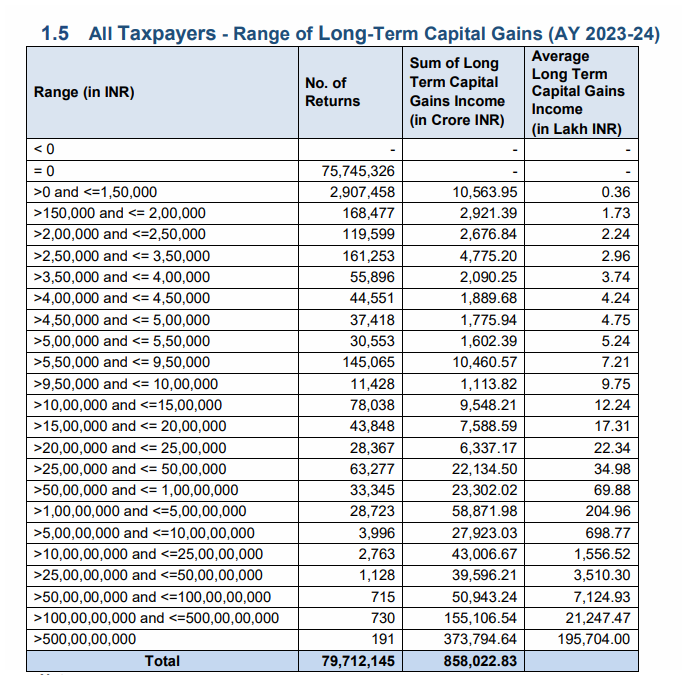
Income-tax data suggests that the burden of LTCG tax is highly concentrated among top earners. According to Income-tax Return Statistics for Assessment Year 2023–24, individuals earning between Rs 1.5 lakh and Rs 25 lakh contribute a relatively small share of total LTCG collections. High-income and ultra-high-net-worth individuals pay most long-term capital gains tax. As chartered accountant Ajay Rotti noted in a December 2025 post, the data shows that LTCG is “overwhelmingly paid by the rich and the super rich,” cautioning against framing the issue as a middle-class burden.
Detailed figures from the Income Tax Department reinforce this concentration. While around 7.57 crore returns reported zero LTCG, and millions of taxpayers declared gains below Rs 1.5 lakh, these segments account for only a marginal portion of aggregate gains. By contrast, taxpayers reporting LTCG above Rs 1 crore represent a tiny fraction of filers but contribute a disproportionately large share of the Rs 8.58 lakh crore in total LTCG reported for the year.
The skew becomes even more pronounced at the top end. Fewer than 1,000 taxpayers reported LTCG exceeding Rs 100 crore or Rs 500 crore, yet together they account for a significant share of total gains. Average LTCG rises sharply across income slabs, climbing from under Rs 1 lakh in lower brackets to over Rs 212 crore in the Rs 100–500 crore range, and nearly Rs 1,957 crore in the highest category. The data underscores the sharp inequality in capital gains distribution and highlights that India’s LTCG tax base is driven by a very narrow cohort of ultra-wealthy investors.
LTCG and salaried taxpayers
Still, supporters of reform argue that the issue is less about who pays LTCG tax and more about incentives for long-term investing. For salaried and middle-income taxpayers, salary income remains the primary source of earnings and is taxed at relatively high marginal rates. “For these investors, long-term investing is often the only viable route to wealth accumulation,” Abheet Sachdeva, Partner at Nangia Global, told the Economic Times, adding that meaningful deductions under the new tax regime remain limited, making LTCG relief particularly relevant.
One proposal gaining traction is an investment-linked incentive under the new tax regime, allowing deductions or exemptions for taxpayers who allocate a defined share of income to long-term investments and hold them beyond a specified period. However, not all experts are convinced.
CA Dr Suresh Surana argues that since the definition of “long term” is uniform across income levels, the existing framework already ensures tax neutrality. He cautions that income-linked LTCG relief could undermine consistency, noting that higher gains among wealthy taxpayers reflect greater investment capacity rather than preferential treatment.
Investors and capital gains tax structure
Industry bodies and market participants have also flagged structural issues. AMFI has argued that the current Rs 1.25 lakh LTCG exemption threshold on equity investments is too low and encourages early redemptions. It has proposed higher thresholds and enhanced incentives for holdings beyond five years to promote stable, long-term capital.
Others are pushing for broader rationalisation. Aditya Agrawal, CFA, Chief Investment Officer at Avisa Wealth Creators, said: "The 2026 Budget is expected to be pivotal for financial markets, with a focus on stability and tax parity. Key expectations include steps to improve investor sentiment by reducing LTCG tax to 10% and rolling back STT to encourage higher FII participation. Additionally, the industry is advocating tax parity for debt instruments and structured products, many of which are currently taxed at marginal slab rates—often exceeding 40% including surcharge and cess—towards a more equitable framework that supports conservative and long-term wealth creation."
CA Ruchika Bhagat, MD, Neeraj Bhagat& Co., said: "With the Union Budget 2026–27 approaching, equity investors and market participants are seeking greater policy certainty and structural clarity in the taxation of capital market instruments. From a tax planning and compliance perspective, the frequent amendments to capital gains provisions in recent years have led to interpretational challenges, increased litigation, and reduced predictability for long-term investors."
Bhagat added: "A key expectation is the rationalisation of capital gains taxation, particularly the alignment of holding periods and tax rates across equity shares, equity-oriented mutual funds, and other market-linked instruments. Investors and advisors alike seek a clearly articulated long-term roadmap that balances revenue considerations with the need to incentivise long-term capital formation. Reintroduction of indexation benefits for long-term holdings or a graded tax structure based on holding period could bring much-needed stability."
Together, these debates suggest that while sweeping LTCG cuts remain unlikely, Budget 2026 could mark a shift toward more targeted, stability-oriented reforms aimed at strengthening long-term investment behaviour.














 Supporters of capital gains tax relief argue that the issue is less about who pays LTCG tax and more about incentives for long-term investing.
 Eyeing foreign shores? Adani Ports considers controlling stake in UK’s Associated British Ports
 Why market is rising today: Sensex surges 800 pts, Nifty tops 24,200 despite spike in oil prices
 N Chandrasekaran's ₹685 crore pay in 5 years: The figure that stands out in Tata Sons' latest annual report
 Tata Capital Q1 effect: NBFC stock nears record high, brokerages share price targets
  Commerce through international waterways must be restored: India condemns attacks on vessels in Hormuz at UNSC
 7.1 Quake Shakes Southern Japan: Roads Split, Buildings Burn, Hundreds Of Thousands Evacuated
 How Mohammad Irfan Went From Street Hawker To India's Most Viral Protest Voice
 Congress Vs BJP Clash In Lok Sabha Over Anti-Paper Leak Bill 2026 As Opposition Questions Police
 "Justice Delayed Is Justice Denied": Bansuri Swaraj Hails Anti-Paper Leak Bill Strict Penalties
 CM Rekha Gupta Approves ‘Delhi Lakshmi Yojana’; Women To Get ₹2,500 Monthly Financial Assistance
 Waaree Energies shares up ahead of Q1 results: Key expectations, concall date and time
 Ardee Industries IPO opens on August 5; check price band, lot size & other key details
 Manipal Health IPO opens today: Should you apply or avoid? Check reviews, ratings & GMP
 From 'clock it' to 'waste-guna-huiya': Gen Z slang rules the roost in Parliament's Anti-Paper Leak Bill debate
 Delhi to Karnal, Jewar Airport by Namo Bharat? 4 proposed routes could reshape NCR travel
 Golden Visa dispute: Abu Dhabi court rejects Dh100,000 wrongful termination claim by employee
 'The Odyssey' box office collection day 12: Christopher Nolan's epic maintains strong hold, crosses ₹6,600 crore worldwide