








 The new equation also has applications for mapping distant regions of space.
 The new equation also has applications for mapping distant regions of space.
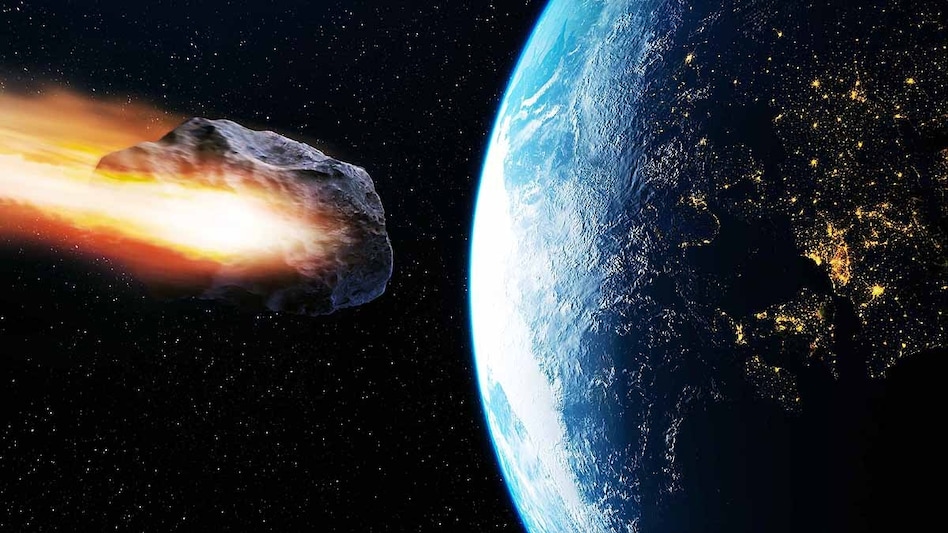
A potential solution to prevent an asteroid-induced apocalypse may have just been discovered.
Spanish scientists have found a method to make it significantly easier to detect space rocks heading on a collision course towards Earth by calculating the gravitational bending of light to precisely locate their position.
This groundbreaking formula, which could potentially avert global disaster, was detailed in a study published in Monthly Notices of the Royal Astronomical Society.
Study author Professor Oscar del Barco Novillo from the University of Murcia in Spain explained that this technique could improve the accuracy of pinpointing distant stars and objects in our solar system, such as asteroids.
The phenomenon of gravitational bending of light (GBL) was first noted by Sir Isaac Newton in the 17th century, and Albert Einstein’s theory of general relativity confirmed it in 1915.
Using this, researchers have developed a method to accurately determine the positions of minor objects in the solar system. This includes objects in the Kuiper Belt — a region beyond Neptune's orbit that contains icy bodies like Pluto and other dwarf planets — as well as the distant, frozen Oort Cloud, which is home to many long-period comets and represents the outermost region of our solar system.
In simple terms, light from most objects travels straight toward our eyes, allowing us to easily spot them. However, this isn't true for faraway objects like asteroids due to a phenomenon called “gravitational lensing.” When light passes through a strong gravitational field, like that of the sun, its path bends, making it more difficult to detect distant objects.
Thankfully, Professor Novillo has developed a formula that calculates this bending of light with greater accuracy, even when both the light source and the observer are at varying distances from the gravitational mass. He calls this the most precise calculation yet for determining the angle of GBL caused by a massive, stationary object.
Using this formula, scientists can more accurately track the orbits of minor solar system objects, including asteroids that may pose a threat to Earth.
This breakthrough is especially timely, as NASA’s Catalina Sky Survey identifies around 2,000 near-Earth asteroids annually. These objects, measuring over 460 feet across and orbiting within 4.6 million miles of Earth’s path around the sun, could potentially be hazardous.
While identifying these space rocks is a major step, eliminating the threat they pose is another challenge. Fortunately, solutions are already being explored. In 2022, NASA’s Double Asteroid Redirection Test (DART) successfully used a satellite to divert the asteroid Dimorphos off its course.
Beyond asteroid detection, the new equation also has applications for mapping distant regions of space. Professor Novillo suggests it could improve the accuracy of locating faraway galaxies distorted by intervening mass, such as galaxy clusters.
The discovery assumes significance as the asteroid Apophis, dubbed the ‘God of Chaos’, will pass close to Earth in five years. Scientists predict that the planet’s gravity could trigger “astroquakes” on the asteroid’s surface and possibly change its surface.
Since Apophis was first discovered in 2004, astronomers have closely monitored its trajectory. Early estimates suggested a 2.7 percent chance of impact in 2029, but recent studies have reduced the risk to nearly zero — about one in two billion.
Apophis, which is scheduled to fly by Earth on April 13, 2029, is a massive ‘city-killer’ roughly the size of the Empire State Building. If it were to collide with Earth, the impact would release the equivalent of dozens or even hundreds of nuclear bombs, devastating a city and its surrounding areas.
While such an impact wouldn’t obliterate the planet, the destruction could extend for hundreds of miles, wiping out everything in its path.
 Inside the India-US interim trade agreement: Reciprocal tariffs on India to come down to 18%, 0% duty on generic pharma
 'Think about it': Deepak Shenoy warns indices mask stress as majority of Nifty 500 stocks lag
 NSE IPO: NSE board approves long-delayed listing plans; IPO to have equity shares of face value Re 1
 IDBI Bank stake sale: Financial bids received; evaluation underway, says FinMin
 Bitcoin avoids $60,000 breakdown, still down over 50% from record high
  RBI Says Trade Deals With EU, US & Others Strengthen India’s External Sector Outlook
 Jeffrey Sachs Praises Modi On India-US Trade Deal: “Trump Blinked, India Must Not Depend On U.S.”
 Agra’s ₹127 Cr Housing Project In Ruins: Flats For Poor Rot Before Occupation
 RBI Credit Policy LIVE Analysis | Aditya Pagaria Explains Rate Pause Impact
 TeamLease Q3 Results: Profit Jumps 47% As Margins Improve Despite Headcount Loss
 'Think about it': Deepak Shenoy warns indices mask stress as majority of Nifty 500 stocks lagBitcoin avoids $60,000 breakdown, still down over 50% from record high NSE IPO: NSE board approves long-delayed listing plans; IPO to have equity shares of face value Re 1
 Max Healthcare discontinues patented cancer drugs, writes to CGHS to review pricing
 NSE Q3 net profit falls to Rs 2,408 crore; PAT up 15%, total income rises 6% QoQ