The survey highlighted that almost 70 per cent of the respondents believe that there will be an improvement in the business outlook. Naturally, with changing sentiments, employee expectations have also gone up manifold. However, organisations are managing these higher expectations carefully and not getting swayed by sentiment alone. Although almost 83 per cent of the respondents have increased the compensation budget, the focus on performance differentiation is far higher, with a larger proportion of budgets being allocated to higher performers. Data this year shows that across the board, top performers are expected to get 1.6 times the salary increase awarded to average performers.
The Sector Story
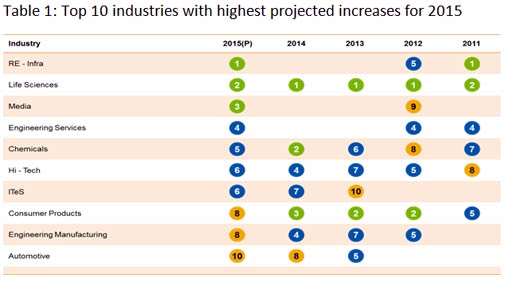
Let's start with the salary increase projections for 2015. There are a few surprises this year. The overall positive sentiment in the economy has impacted the Real Estate & Infrastructure sector significantly. For the first time in four years, they are leading the charts. Other sectors such as Life Sciences, Engineering Services, Chemicals and Media have consistently given higher-than-India average salary increase numbers since 2012 and continue to do so in 2015. The IT and Business Process Management sector has also done well since 2014. On the other hand, services industries like Retail, Financial Institutions, and Hospitality represent the lower end of the salary increase projections.
While Life Sciences has consistently given one of the highest salary increases in the last five years, it is interesting to note that industries like Telecom, Retail and Financial Institutions, which have traditionally given high increases, no longer feature in the top ten. And there are a few reasons which explain that: on the back of buoyant growth and high increases in the past, their fixed pay continues to be higher in relation to the other industries. The business performance continues to be largely difficult on an overall basis and the need to be more judicious in payout continues to be high.
The Match Winners who Matter
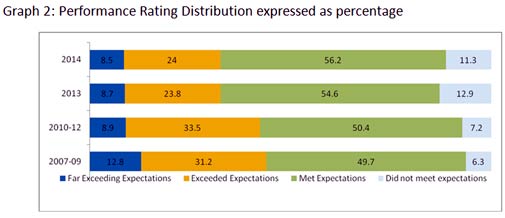
Pay for performance is not a cliched jargon anymore. Over the years, India Inc. has moved from a socialistic view with limited differentiation based on performance to a stage, where organisations have rigorously followed the bell curve principles. India Inc's performance distribution curve today is very different from what it was earlier. Employee distribution has become significantly sharper since 2007. Almost 68 per cent of the population falls under the 'Meets expectation and below' category. This proportion has increased by about 20 per cent since 2012. In the last five years, the percentage of employees with top performance rating has dropped by close to 30 per cent, implying that organisations are not hesitating to differentiate sharply on the basis of performance and are allocating the share of the total increase budget accordingly.
An increasing percentage of employees moving away from the top two ratings shows how firms ensure that they recognise true performance. Even though firms have reported that they have increased their C&B budget, a significant proportion of this increased budget is to reward high performance. A stricter performance curve only assists this process. Since many firms today are able to differentiate higher performance and potential, their ability to drive this pay for performance is sharper. The people who make a difference and are the real match-winners get rewarded commensurately; the rest of the team has to earn their stripes and there are no free loaders anymore.
Is the Divide Increasing?
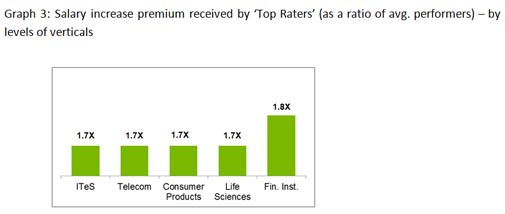
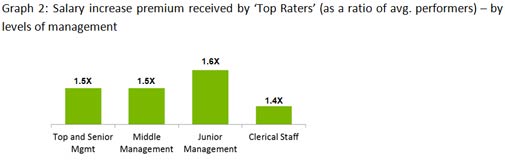
Top performers in India will get almost 1.6 times of what their colleagues will get. Among all industries, Financial Institutions are giving out the highest differentiation at 1.8 times. Life Sciences, Consumer Product, Telecom and ITeS are a close second at 1.7 times. While Financial Institutions have historically led the pack, it is interesting to note that industries like Life Sciences are making the cut as top differentiators. Other industries like Telecom and Consumer products have continued rewarding high performance. Junior management is gaining the most due to this stark differentiation. At this level, the top performers receive almost 1.6 times whereas the top and middle management gets about 1.5 times.
Key Talent Differentiation
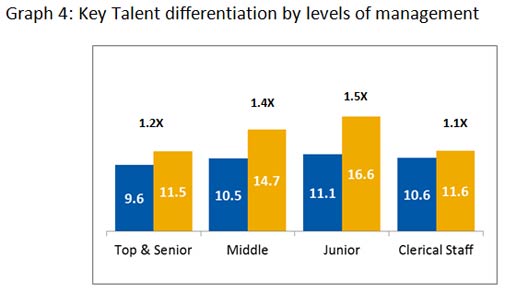
While high performance is gaining more importance with each passing year, so has the concept of critical and key talent. High performers, high potential, key roles, roles difficult to replace-all form a part of the key talent pool. Investment in key talent continues in 2015. Organisations continue to pay above the market as a key strategy for retention of key talent. The gap between salary increases awarded to key talent vs. others is widening year on year. Salary increase differential of key talent is 1.4 times in 2015 versus 1.2 times in 2012
The Pay at RiskWith the growing maturity of an economy, the acceptance of pay at risk increases. India Inc. has at large moved to a 'Pay at Risk' concept. Across industries, organisations are offering variable forms of pay at risk - annual variable pay, sales incentive or long-term incentive. The survey revealed that in 2014, 86 per cent of the organisations reported making a bonus payout. In fact approximately 11 per cent organisations speak of transferring salary increases from fixed pay to variable pay.
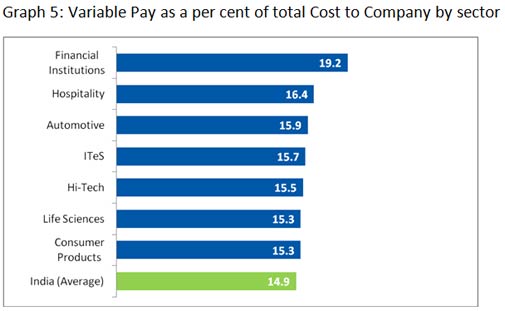
There is a steady trend towards greater performance-based pay and it indicates a shift in overall pay philosophy across Indian companies. Almost 15 per cent of total compensation is formed through pay at risk. At the top and senior management a quarter of the total compensation comes through this. This number is close to 12 per cent at the junior management level.
Long-term incentives (LTI) are increasingly becoming popular. LTI vehicles like ESOPs, which were historically provided only at senior levels, have seen an increased prevalence across all levels of management across industries. Specifically in the technology sector, the rising number of e-commerce firms and startups with niche solutions and technologies are relying on LTI to incentivise, as well as retain, employees and grow with the firm. Financial Institutions, Hi-tech and FMCG firms are the leaders in payouts through long-term incentives.
The Case of Attrition
In spite of market euphoria around business performance and the resultant demand for talent shooting up, attrition is at a controlled 18.1 per cent. In fact this is marginally lower than the 2013 numbers which was 18.5 per cent. External inequity of compensation (57 per cent), limited growth opportunities (55 per cent) and higher education (48 per cent) continue to be the key reasons for voluntary attrition.
It is interesting to note that the key talent attrition has moved up. In 2014, it was at 5.9 per cent vs 4.5 per cent in 2013. While organisations have not jumped at the positive sentiments in the market and have not gone all out on hiring, they have definitely started looking out for better talent available in the market.
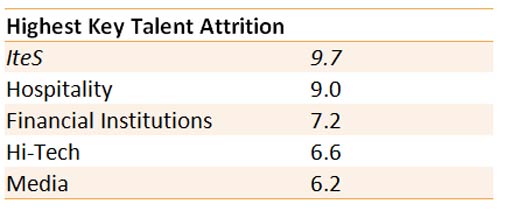
The services industry has been hit hardest by this phenomenon, particularly the ITeS and Hospitality sectors that have key talent attrition in the 9 per cent-plus category, which is a big concern. Manufacturing firms on the contrary continue to keep their key talent attrition at bay.
Time for Total Rewards?
With the increasing pressures on the salary budgets, organisations are now taking a holistic approach to rewards. Firms now focus on other aspects of rewards apart from compensation. They have increasingly started listening to their employees, focusing on engagement scores and employee-preference surveys to understand the pulse of the workforce and provide solutions that help improve the employee's lifestyle, without increasing the compensation budgets.
Of the 500+ organisations that were surveyed, 76 per cent have indicated an increase in their overall benefits budget. The changing demographics, spanning across Gen X, Y and Z have forced organisations to drop the 'one size fits all' approach. Employee preference is now an additional factor considered when designing benefits program for the workforce. Employee wellness and health benefits are gaining significant momentum.
While salary-linked benefits are mandatory, firms are designing bespoke benefits plans to meet the separate needs of Gen X, Y and Z. Therefore, flex-ben has been taken up quite seriously by many firms. The number of people availing these benefits has also seen an increase from the years before. Benefits have been identified as one of the key retention measures apart from compensation.
In spite of the efforts made by organisations to build customised rewards solutions for their employees, the perceived value of the rewards is restricted to compensation. Organisations are now increasingly focusing their efforts to develop an effective communication program to enhance employee appreciation of the total rewards paradigm, rather than the traditional mindset that cash is king.
The match is yet to be won
We believe that industry's response to the economic sentiment and reform-led growth outlook has been sustained, steady and systematic. This augurs well for a country that is increasingly bringing in maturity in its orientation towards rewards, retention and performance differentiation. It also makes sense as some organisations believe that the positive business sentiment and market buoyancy is yet to take shape in the form of a spurt in actual business - most believe this to become a reality in the next six to eight months. And even if the evidence of a strong economic upturn emerges sharp and clear, India Inc. would do well to keep humility and prudence at the forefront of its rewards strategy, and be mindful of the scars that previous extravagances have left. Team India may have bowed out of the World Cup, but India Inc. needs to maintain the focus and the mindset to win the long-term battle of people and profitability as good days start to shine, sooner than later.
Authors
Sagorika Roy is Manager and Roopank Chaudhary is Associate Partner at McLagan, an Aon company.



 Dope test for all pilots annually? Deliberations between DGCA, stakeholders underway
 Apple’s CEO transition begins: iPhone-maker holds farewell for Tim Cook ahead of John Ternus’ takeover
 Sugar prices set to ease? ISMA says panic buying caused spike, no actual shortage in India
 US plans 7.5% ‘overcapacity’ tariff on Chinese goods, to take overall tariffs to about 20%
 Bank unions strike: Around 8 lakh employees to agitate over 5-day working week, PLI scheme, pension issues
 “Frozen Is Not Bad”: Sanjeev Kapoor Busts Myths About Restaurant Food & Food Safety
 Market Masters | Aniruddha Sarkar On Top Sectors, Market Outlook & Where To Invest
 Daily Calls: Ask Your STOCK MARKET TODAY QUERIES | Market Update | Share Market News Today
 All About Debt Funds: Types Of Debt Funds & How To Invest | Mutual Fund Guide | Money Today
 “India Can Attract Global Space Talent Like A Magnet”: PM Modi To Startup CEOs
 BSE, Kalyan Jewellers, Union Bank shares: Expert weighs in
 IDBI Bank shares rise 2% as lender clarifies on surge in trading volumes; details here
 HDFC Bank shares: JM Financial cuts target price to Rs 800, maintains 'ADD'
 Vedanta shares: VRL repays loans, Anil Agarwal firm updates on encumbrance
 HAL, Astra Microwave, Solar Industries shares: Here's Anand Rathi's top defence stock pick
 ChatGPT rolls out AI-generated stickers for WhatsApp, Instagram, Apple Messages
 'In India, entrepreneurs don't have to worry about...': Piyush Goyal refers to Jack Ma's disappearance in pitch to Japanese investors
 I4C warns CFOs, finance teams of WhatsApp ‘Boss Scam’ using fake RBI, MCA files