








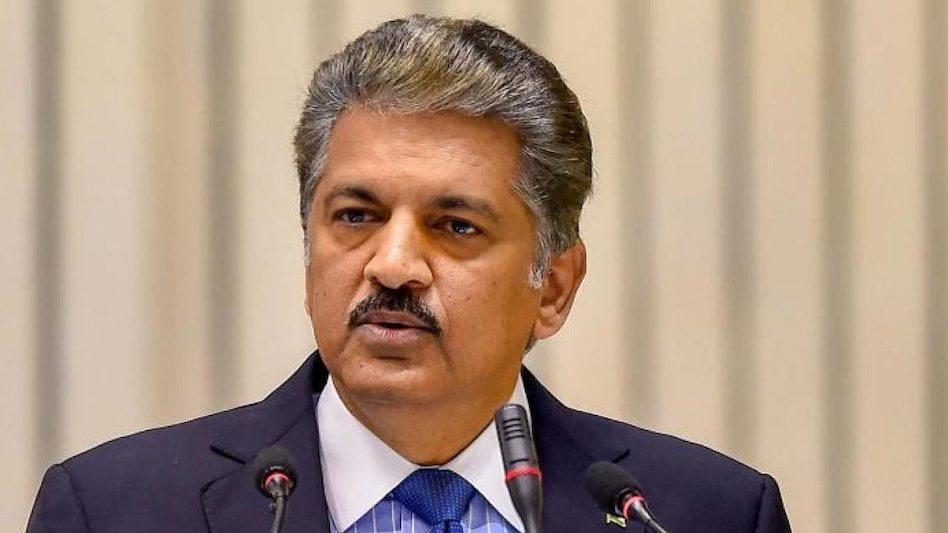
 The video shared by Anand Mahindra has been widely circulated on social media.
 The video shared by Anand Mahindra has been widely circulated on social media.
The rise of deep fakes has been a source of concern for many, as it can be used to spread misinformation and deceit. Industrialist Anand Mahindra recently shared an AI-generated deep fake video on his social media accounts to warn people about the dangers of such content.
The video which now has over 1,30,000 views, shows a deepfake of a man talking about the power of artificial intelligence and how it can be used to manipulate people with the AI morphing the man's face into various people including Virat Kohli, Robert Downey Jr, and Shah Rukh Khan.
The video was shared by Mahindra on his Twitter, with a caption that reads "This clip which has been making the rounds is rightfully raising an alarm. How’re we preparing, as a society, to guard against potentially deceptive content which at best, can be mildly entertaining, but at worst, divide us all? Can there be tech-checks that act as a safeguard?"
The video has since gone viral, with many people sharing their thoughts and opinions on the matter.
The use of AI-generated deep fakes has become increasingly popular in recent years, and it has been used to create false information or to manipulate people. This technology has the potential to be used for malicious purposes, such as spreading false news or creating deep fakes of public figures. It is therefore important for us to be aware of the potential misuse of AI, and to remain vigilant.
The video shared by Anand Mahindra has been widely circulated on social media, and it has helped to spread awareness about the dangers of AI-generated deep fakes. His message is an important one, and it is a reminder that we must be aware of the potential misuse of AI, and remain vigilant. We must also be careful to only share verified information, and be aware of the potential risks of sharing false information or deep fakes.
What’s a deepfake
A deepfake is a type of artificial intelligence-based media in which a person's face or voice is replaced or manipulated to appear as if they are saying or doing something they did not actually say or do. This is typically achieved using a deep learning technique called a generative adversarial network (GAN). Deepfakes are often used to create realistic-looking videos or audio recordings of people that can be used for various purposes, such as entertainment, political propaganda, or misinformation.
Also Read
This social media app for giving compliments is going viral among teens
As Netflix’s Reed Hastings steps down, meet the two new CEOs replacing him
For Unparalleled coverage of India's Businesses and Economy – Subscribe to Business Today Magazine
 Cyber attacks, AI misuse and data privacy rules emerge as top boardroom risks for India Inc
 'India has played it pretty safe, deal is very balanced': Top agri economist on India–US trade agreement
 Shell firms, circular trading: Fake GST invoice frauds continue despite curbs
 'The real sting is the monitoring': Brahma Chellaney flags risk for India in Trump's Russian oil order
 Moltbook hype unravels: Viral posts were human-written, not AI, finds MIT Technology Review
 BT Golf 2025-26 Kochi, Kerala Awards Ceremony Marks A High-Energy, Successful Conclusion
 Golf Is An Addiction. We Eat And Sleep Golf!
 The Fairway Fixes Everything. Mindset, Life, Relationships
 BT Golf LIVE: Join AU Small Finance Bank Presents BT Golf 2025-26 For Its 4th Leg In Kochi, Kerala
 AI Will Change MBAs, Not Leadership: IMD President On India’s Global Education Rise
 RIL, SBI, Kotak Bank, Kalyan, HAL, BEML, BDL among stocks in focus next week; here’s why
 NSE IPO may unlock mega gains for billionaire investors RK Damani, Premji
 SBI Q3 Results: Profit jumps 24% to Rs 21,028 crore; asset quality improves
 IDBI Bank stake sale: Kotak Mahindra Bank says ‘has not submitted a financial bid’
 BDL, Mazagon Dock, MRF, Hindustan Copper, RVNL, others to turn ex-dividend next week