


 Vivo Switch Off Report 2025 (Source: Vivo India)
Indian families are actively seeking to establish boundaries with their smartphones, with dinner time emerging as the most crucial window for daily connection, according to the seventh annual Vivo Switch Off Study, published today.
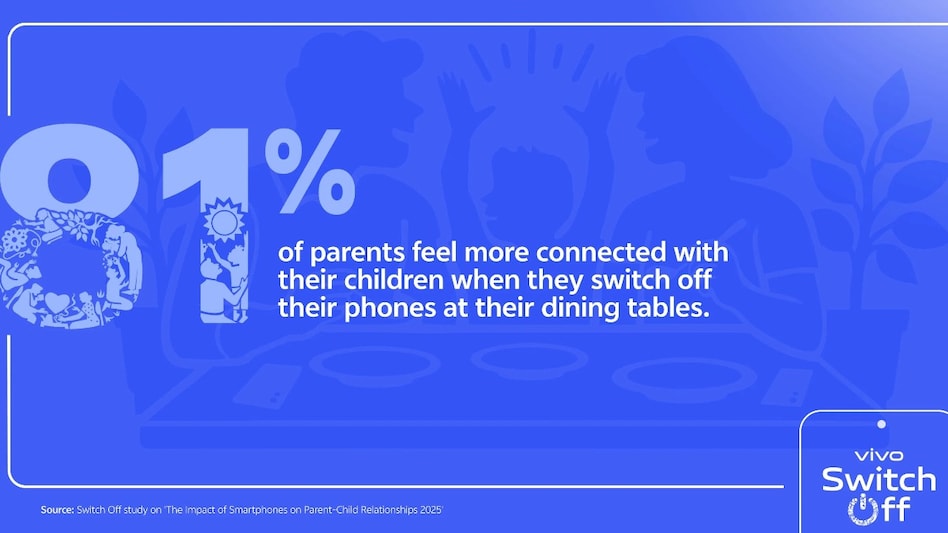
The 'Impact of Excessive Smartphone Usage on Parent-Child Relationships' report found that 72% of children spend the most time with their parents during dinner. Crucially, 91% of children reported that conversations felt easier and more meaningful when smartphones were put away, reinforcing dinner as a natural "attention alignment" moment for families to bond. The data also highlighted that 72% of parents and 30% of children cited parents checking phones at dinner as the top deterrent to conversation.
The Rise of AI Companionship
The study, conducted by CyberMedia Research (CMR) across eight major Indian cities, also revealed a significant trend regarding children’s use of artificial intelligence (AI). A total of 67% of children stated they turn to AI tools because they feel their parents are too busy, which has subsequently led to them speaking less with their parents.
Overall, 54% of children aged 10–16 have adopted AI tools, using them for homework and assignments (61%) and personal growth (63%). Notably, 33% of children even view AI as a companion, occasionally substituting real-life relationships. This is underscored by the fact that one in four children explicitly claimed they speak to their parents less because of AI.
Digital Disturbance and Disconnection
The research shows a clear disparity in daily phone usage: parents spend 4.4 hours daily on their devices, compared to 3.5 hours for children. This usage pattern leads to parents being significantly more active on their phones than children during shared family moments, including movie time (70% vs. 31%) and family celebrations (64% vs. 59%).
Commenting on the findings, Geetaj Channana, Head of Corporate Strategy at Vivo India, stated, "The findings of this year's Switch Off Study remind us that families are actively seeking balance, choosing to disconnect during key moments and rebuild presence in their everyday lives.”
The report concludes that families are finding success through simple behavioural shifts, such as limiting screen time (54% of parents), blocking social media during certain hours (51% of parents), and turning off non-essential notifications (50% of children). These measures lead to a majority of parents (59%) and children (47%) feeling more in control of their digital habits.
For Unparalleled coverage of India's Businesses and Economy – Subscribe to Business Today Magazine

 Exam reforms: Tech titan Nandan Nilekani picked by PM Modi to fix national public examination system
  'Tax officers struggled for own land': Nirmala Sitharaman slams laidback attitude of govt depts
 CBDT issues new crypto reporting guidance: No new tax, but exchanges must track and report all transactions
 Did Cockroach Janta Party's 'Chalo Sansad' 2.0 threat trigger Dharmendra Pradhan's resignation? What we know so far
 'Will discharge my responsibilities with complete humility': Pralhad Joshi after being appointed Education Minister
 AI Data Centers, Aerospace & Gas Turbines: What's Powering Indo-MIM's Future Growth?
 Best Healthcare Stocks: Gaurang Shah's Outlook On Apollo Hospitals, Fortis & The Manipal Health IPO
 Is Indo-MIM's IPO Valuation Justified? Here's Why The Company Sees Strong Growth Ahead
 Treasury Bills Explained: Why T-Bills Are One Of The Safest Short-Term Investment Options
 FDs vs Markets: Where Should You Keep Your Short-Term Money?
 Gland Pharma stock: Price target of Rs 3,250 likely in medium term, says analyst
  Metal recycling stocks to buy: Gravita, Pondy Oxides, Jain Resource among top picks
 TRIL shares: Should you average the falling stock? Here's 'fixed and final' stop loss
 Adani Power: 45 GW target, Rs 2 lakh crore capex plan among conference call highlights
  ITC Hotels, Chalet, Ventive, IHCL, SAMHI: Hotel stocks to buy despite travel disruptions
 SIFs, mutual funds, PMS or AIFs: Which investment route deserves a place in your portfolio?
 Beyond mutual funds: Why analysts see SBI Funds' alternative asset business as a long-term growth engine
 'Ashamed of it...': Manoj Muntashir calls Adipurush his biggest mistake, seeks country's forgiveness Exam reforms: Tech titan Nandan Nilekani picked by PM Modi to fix national public examination system 'Tax officers struggled for own land': Nirmala Sitharaman slams laidback attitude of govt depts









