At a time when semiconductors have become central to economic competitiveness, national security and artificial intelligence, the partnership reflects a growing realisation: building a chip industry is about far more than just setting up expensive fabs.
Germany’s strengths, India’s gaps
The global semiconductor narrative is often dominated by Taiwan, China and the US. Germany, while not a leader in wafer fabrication, plays a critical role in the industry’s less visible but indispensable backbone.
“Germany is not a leader in chip production like Taiwan and Korea, but it is definitely at the centre of those parts of the value chain where India currently lacks,” says Devroop Dhar, co-founder and CEO of Primus Partners, an India-based global management consulting firm. “Germany is a strong location for chip manufacturing equipment, chemical-related sectors and precision engineering that precede manufacturing.”
India, by contrast, is not attempting to leap directly into cutting-edge fabrication. Instead, it is trying to build an ecosystem step by step.
“German knowledge in design, testing and packaging, as well as industrial semiconductors, fits India’s exact requirements at its current stage of development,” Dhar adds.
Not fabs, but fundamentals
Germany is home to Infineon Technologies AG, one of the world’s leading power semiconductor companies. Yet the India–Germany partnership has not, so far, resulted in large funding announcements or fab commitments. Industry experts say that is precisely the point.
“The price for one fab facility may range from $10–20 billion and can take several years to mature,” says Dhar. “But having a fab without knowledge of upstream and downstream processes, design, packaging, testing, equipment and materials, does not create a semiconductor ecosystem.”
The real value of the partnership, experts argue, lies in Germany’s depth in industrial semiconductors, power electronics, automotive chips and precision manufacturing systems.
For India, this could translate into learning how to build stable, high-yield production lines rather than just assembling capacity on paper.
Danish Faruqui, CEO of Fab Economics, a US-based semiconductor fab and OSAT consultancy, says India’s existing chip projects underline the challenge.
“So far, all 10 approved semiconductor projects in India have struggled to find Manufacturing Grade Technology Partnerships (MGTP) and have relied on Asian partners for legacy technologies across fabrication and assembly,” he says. “The India–Germany Semiconductor Alliance could open the door for MGTP enablement from Germany for next-generation logic, memory and display technologies.”
India has also yet to enter semiconductor equipment manufacturing, an area where Germany’s industrial dominance could act as an early catalyst.
Building chips begins with building talent
India’s biggest strength today lies in chip design. Nearly 20% of the global semiconductor design workforce is based in the country. Manufacturing expertise, however, remains a major gap.
Germany’s advantage is its deep pool of trained semiconductor professionals, particularly across hubs such as Dresden. According to Faruqui, Germany has over one lakh trained semiconductor professionals, a talent base that India is only beginning to build.
Early signs of cooperation are already visible. Infineon Technologies has signed an MoU (memorandum of understanding) with the National Institute of Electronics & Information Technology to support semiconductor skilling and workforce development in India. The programme includes curriculum enrichment, expert-led seminars, train-the-trainer initiatives and equipment donations for hands-on training.
Geopolitics is redrawing the chip map
The partnership also reflects how geopolitics is reshaping the semiconductor industry.
The G7 nations, Canada, France, Germany, Italy, Japan, the UK and the US, remain heavily dependent on non-G7 countries for chip fabrication and packaging, with external reliance exceeding 50% of domestic demand in most cases.
The 2020 global chip shortage exposed the vulnerability of this model. It also drove home the reality that semiconductors are now strategic assets.
“This situation worsened for G7 nations during the chip shortage, resulting in nearly $760 billion in annual revenue loss across just three end markets, cumulatively across G7 Nations for each year of chip shortage, ”says Faruqui. “Automotive was the biggest casualty. Yet no single G7 nation, or even all of them together, can realistically replace Taiwan as the world’s primary semiconductor supplier.”
With concerns rising over a potential conflict involving Taiwan, countries are scrambling to diversify supply chains and build alternative production centres.
“This partnership with Germany could potentially position India for its biggest semiconductor opportunity under the G7’s $600-billion Partnership for Global Infrastructure and Investment (PGII) programme,” Faruqui adds.
A long-term ecosystem bet
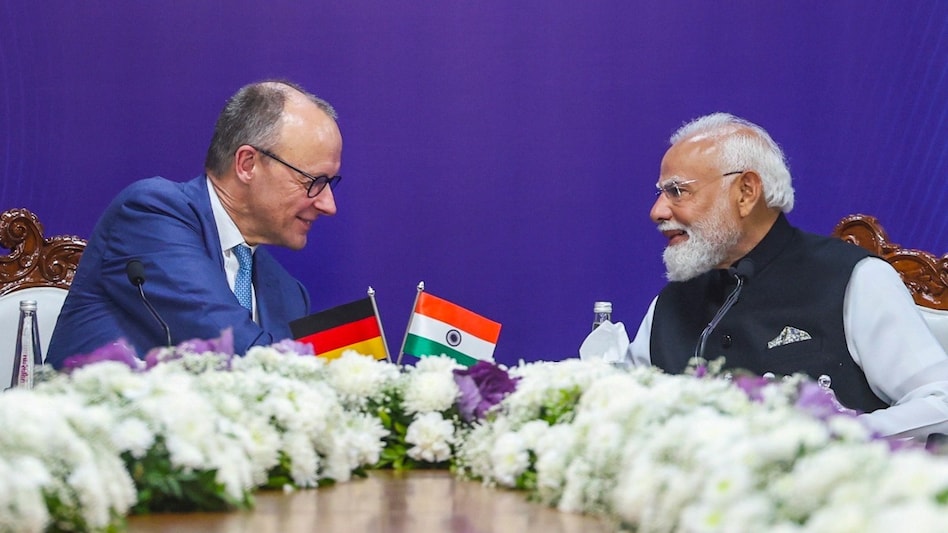
With uncertainties clouding India–US trade ties, India’s engagement with Germany takes on added strategic weight. As New Delhi pushes to become a global semiconductor manufacturing hub, backed by aggressive incentives, political backing and faster execution, deeper cooperation with Europe’s largest economy could evolve into a long-term ecosystem alliance.
The India–Germany Semiconductor Ecosystem Partnership may not deliver a splashy fab announcement in the short term. But by focusing on talent, tools, technology and industrial know-how, it could quietly lay the foundations of a sustainable domestic chip industry.



 Germany announces visa-free airport transit for Indian passport holders after Merz’s India visit
 'Every great airline is built over decades': Tata Sons Chairman says Air India's turnaround is a 5-10 yr mission
  Tata Motors flags ‘severe disruption’ at Sanand plant in Gujarat due to floods
 HDFC Bank penalises top officials, including CEO and CFO, in MSRDC case. Here’s why
 Only 26 of every 100 young Indian graduates have salaried jobs; just 4 enjoy basic employment benefits: Report
 Where are the jobs: Youth unemployment remains high; fewer jobs for those with higher education in India
 DCB Bank Management | Q1 Earnings, Loan Growth, Margins & Asset Quality Explained
 Infosys Fined In France: 70-Hour Work-week Debate Returns After €175,000 Labour Penalty
 I.T. Sector Outlook: Is the Worst Over for Indian I.T. Stocks After Long Underperformance?
 France And Spain Wildfires Threaten Cap Ferret Mansions And Bordeaux Wine Country
 Maruti Suzuki Eyes 25-30% SUV Growth, Says CNG Demand Has Overtaken Diesel
 Tata Power Q1 profit rises 11% to Rs 1,176 crore; revenue up 6%, capex tops Rs 5,300 crore
 HDFC Bank concludes internal review into MSRDC deposit arrangements; CEO, CFO among 3 fined Rs 1 lakh
 How Narayana Murthy's era, Vishal Sikka's stint and Salil Parekh's tenure differed; big task awaits next Infosys CEO
 BEL Q1 results: Net profit rises 9%, revenue at Rs 5,533 crore
  Sensex, Nifty snap five-session losing run; investors add Rs 5.1 lakh crore in wealth
 Grab a ready-to-occupy home in Delhi: DDA rolls out Karmjivi scheme with 25% price cut
 High power bills burning pockets? Claim up to ₹78,000 under PM Surya Ghar scheme
 AU Small Finance Bank hikes FCNR(B), NRE FD rates; here's what NRIs need to know
 India's Vande Bharat sleeper gets a luxury upgrade: First look inside the redesigned first AC coach
 Brazil aced the ethanol journey. Here's why it shows consumer trust matters most










