












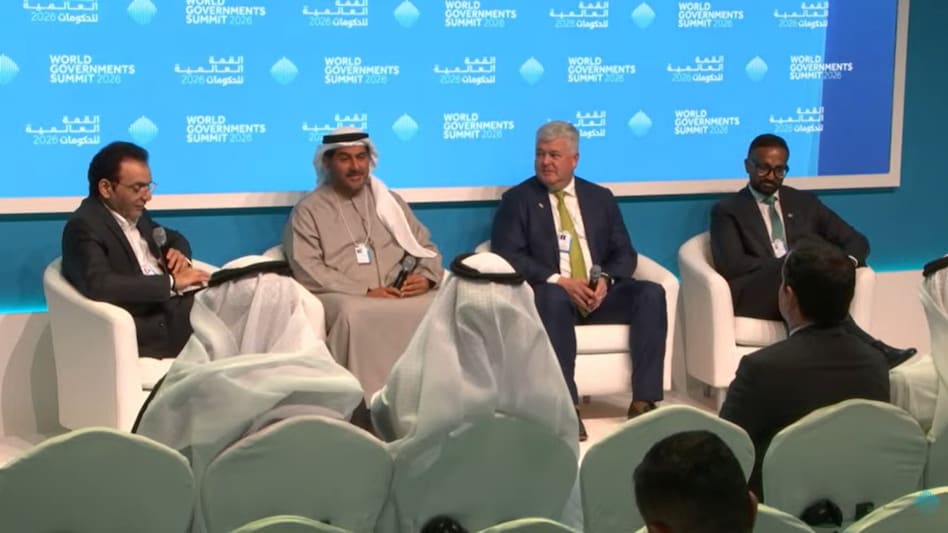
 World Governments Summit 2026 (Siddharth Zarabi, Group Editor of Business Today, Khalifa Alshamsi, CEO of E& International and E& Life, Daniel Gallager of Robinhood and Ashish Koshy of Inception)
 World Governments Summit 2026 (Siddharth Zarabi, Group Editor of Business Today, Khalifa Alshamsi, CEO of E& International and E& Life, Daniel Gallager of Robinhood and Ashish Koshy of Inception)
What once sounded as implausible as landing on Mars has quietly become routine. Digital lifestyles, a term barely imaginable three decades ago, now define how people work, transact, invest, communicate and even think. That shift took centre stage at the World Governments Summit 2026 in Dubai, where policymakers and industry leaders explored how digital life is being redesigned, not just through infrastructure, but through experience.
The session, “Design Digital Lifestyles: From Infrastructure to Experience,” brought together voices from telecom, fintech and artificial intelligence to map how digital living is evolving globally, and what governments must do next.
Telecom is no longer just the pipe
Opening the discussion, Khalifa Alshamsi, CEO of e& International and e& Life, argued that telecom companies have moved far beyond being mere data carriers.
“Three years ago, I would have answered this question very differently,” Alshamsi said, referring to e&’s 2022 transformation from a telecom-centred operator into a global technology company. “We still honour the pipe. We invest in making it faster, bigger, and more resilient so others can enable. But at the same time, we are now investors in technology platforms that power consumer services, enterprise services, and government services.”
He pointed to platforms such as India’s UPI and Brazil’s PIX as global benchmarks for state-enabled digital acceleration. “India’s UPI is a global reference, a country with low banking penetration transforming itself into one of the most digitally connected financial ecosystems, dramatically reducing transaction costs,” he said.
Fintech disruption rarely gets regulatory help
If telecom’s role has expanded, fintech’s journey has often been adversarial. Daniel Gallagher, Chief Legal, Compliance and Corporate Affairs Officer at Robinhood, described how the company’s app-first design rewired investing, often in spite of regulators.
“When our founders started Robinhood in 2013, their idea was simple: build a brokerage firm entirely as an app,” Gallagher said. “Not a physical office translated to mobile, not a website shrunk into an app, but a financial services firm designed natively for mobile.”
From apps to intent: AI reshapes digital experience
While telecom built the foundation and fintech rewired access, AI is now reshaping the interface itself. Ashish Koshy, CEO of Inception, the AI arm of G42, argued that digital lifestyles are moving beyond screens, menus and clicks.
“We’ve moved beyond menus and interfaces. The future is intent,” Koshy said. “People expect to express intent and have AI agents execute it.”
But AI readiness, he cautioned, is not just about user experience. “It’s about sovereignty, compute, agentic infrastructure, and matching private-sector innovation with public-sector intent.”
Emerging markets can leapfrog: if they skip old mistakes
A recurring theme was how emerging economies can avoid the pitfalls faced by developed markets. Alshamsi argued that inclusion must be designed into systems from day one.
“In many developed markets, services focus on select segments, leaving much of the population behind,” he said. Digital identity, eKYC, open finance and data-sharing protocols, he added, are essential to inclusive growth.
“True inclusion means everyone benefits, including blue-collar workers who should be able to invest and build wealth from the economies they help build,” Alshamsi said.
What the digital consumer looks like next
Looking ahead, the panel largely agreed on direction, if not form. Alshamsi predicted rapid adoption driven by simplicity and personalisation. “AI-infused commerce will cut across populations,” he said. “Users won’t need expertise, just intent.”
Gallagher envisioned financial lives consolidated on a single platform. “Everything will be tokenised, 24/7, and AI-assisted,” he said, arguing that AI could close global financial literacy gaps.
Koshy remained firm that the interface of the future is not an app, but an agent. “You tell it what you want. It accesses all services with the right permissions and delivers outcomes,” he said.
For Unparalleled coverage of India's Businesses and Economy – Subscribe to Business Today Magazine
 Cognizant to reduce 15,000 jobs; India to face maximum impact
 AI-driven shares zoom 850% in less than 3 yrs — Multibagger stock to see more gains ahead?
 Vedanta is set for the next phase of growth and value creation: Anil Agarwal
 Coforge shares on a roll post Q4 earnings as MOFSL sees 54% upside; Cigniti surges 12%
 'Operation Epic Fury is over': US declares Iran bombing campaign over after 66 days of attack
 Mutual Fund Strategy: Why You Shouldn’t Exit Underperforming Funds Too Soon
 "Badla Nahi, Badlav!": PM Modi Hails Violence-Free Election As Bengal Enters A New Era Of Peace
 India Vs Global Markets: Why Experts Still Prefer Domestic Mutual Funds
 Tehran Crisis: India Today Reports From Damaged Golestan Palace Amid Protests
 Stalin Defeated! The Unbelievable Rise Of Vijay That Has Shaken Indian Politics | TVK
 Bajaj Auto Share Buyback: What history suggests; past two repurchase prices & amountAI-driven shares zoom 850% in less than 3 yrs — Multibagger stock to see more gains ahead?Coforge shares on a roll post Q4 earnings as MOFSL sees 54% upside; Cigniti surges 12%
 Embassy Developments shares rallied 20% today; here's why
 BT Opening Bell | Sensex rises over 450 pts, Nifty above 24,150; M&M, IndiGo, Bajaj twins lead gains