









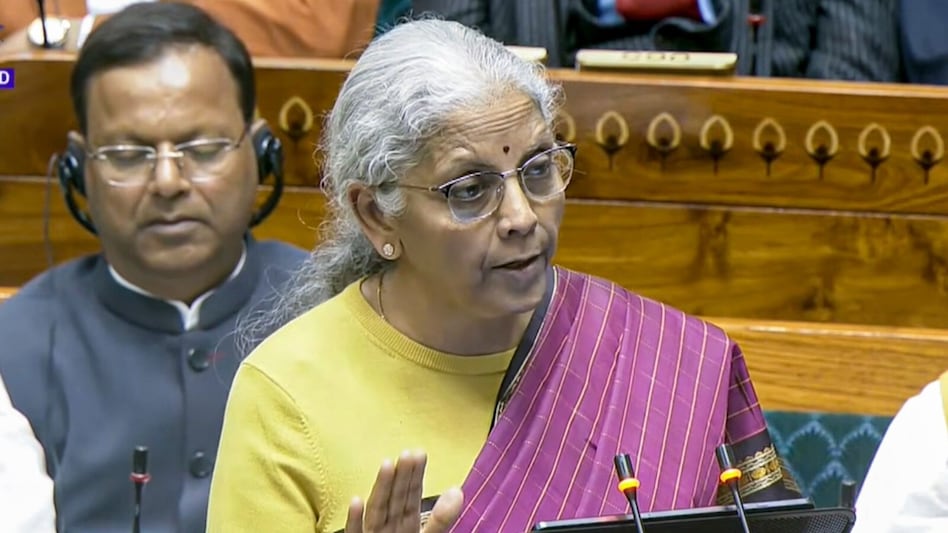
 The Centre has also pegged its capital expenditure at Rs 12.2 lakh crore in FY27.

 The Centre has also pegged its capital expenditure at Rs 12.2 lakh crore in FY27.
 With a nominal GDP growth of 10%, the Centre has budgeted for just a 7.1% increase in its net tax revenue in FY27 and is likely to depend more on non-tax receipts, including those from disinvestment and dividend to fund its spending.
As per the Union Budget 2026-27, the Centre’s net tax revenue is estimated at Rs 28.66 lakh crore in FY27 as against Rs 26.74 lakh crore in the Revised Estimates for FY26. Significantly, the Centre’s net tax revenue for this fiscal is seen to be lower than the Budget Estimate of Rs 28.37 lakh crore.
Dividends and profits are expected to bring in Rs 3.91 lakh crore in FY27 as against Rs 3.75 lakh crore in the RE this fiscal. Meanwhile, miscellaneous capital receipts, which is the umbrella term for disinvestment proceeds, are budgeted at Rs 80,000 crore in FY27, which reflects the inclusion of potential proceeds from the proposed stake sale in IDBI Bank.
The Centre has also pegged its capital expenditure at Rs 12.2 lakh crore in FY27. The capex for FY26 has been lowered to Rs 10.97 lakh crore from the Budget Estimate of Rs 11.21 lakh crore.
With a new fiscal road map, the Budget has proposed that the central government’s debt-to-GDP ratio will be lowered to 55.6% of GDP in BE 2026-27 with a Fiscal Deficit target of 4.3% of GDP. In FY26, the fiscal deficit is seen to be maintained at 4.4% of the GDP while the revenue deficit is pegged at 1.5%.
As per the Budget documents, the Centre’s fiscal strategy rests on the principle of continuing on the path of gradual fiscal consolidation while retaining operational flexibility.
“The strategic priorities for the FY27 are augmentation of resources through continuation of policy reforms introduced in tax domain in conjunction with reasonable rationalisation of expenditure, prioritisation of expenditure towards the key developmental sectors, enhancing the social and physical infrastructure of the country in an inclusive manner by supporting and strengthening the capital spending of States, improving public expenditure quality and management by leveraging technology and an active debt management strategy,” said the Statements of Fiscal Policy as required under the Fiscal Responsibility and Budget Management Act, 2003.
D.K. Srivastava, Chief Policy Advisor, EY India, noted that the pace of fiscal consolidation has moderated in the FY27 Budget, which is primarily due to a fall in the government’s tax revenue. After achieving a reduction of 40 basis points from 4.8% of GDP in FY25 to 4.4% in FY26 (RE), the reduction in FY27 (BE) is only 10 basis points, taking the FY27 fiscal deficit to 4.3% of GDP, he said.
In the medium term, covering years from FY28 to FY31, the stated target is to reduce the debt-GDP ratio from the estimated level of 55.6% in FY27 (BE) to 50%+/- 1% in FY31.
“This moderation is due to a fall in the GoI’s gross tax revenues to GDP ratio, which has progressively gone down from 11.5% in FY25 to 11.4% in FY26 (RE) and further to 11.2% in FY27 (BE), which translates into a fall in GoI’s non-debt receipts relative to GDP,” he noted.
Madan Sabnavis, Chief Economist, Bank of Baroda, on the Union Budget, noted that the Union Budget has delivered good fiscal numbers while providing targeted incentives in critical areas. “There has been steadfastness shown in terms of lowering the debt to GDP ratio, and the fiscal deficit ratio will be marginally lower than last year at 4.3%," he said.
More importantly, the gross and net borrowing programmes have been maintained almost at last year’s level, which should assuage bond markets as bond yields should remain stable, he further said, adding that this will also throw open the window tothe RBI to take a call on repo rate without having to worry about the borrowing programmes.
The Centre’s net borrowing in FY27 is pegged at Rs 11.73 lakh crore and gross at Rs 17.2 lakh crore.
 Major relief! Price of 19 kg LPG cylinder cut by ₹183.50; check new rates
 Fixed deposits remain a safe bet in July 2026: Where can investors earn highest interest?
 July 1 rulebook is here: 6 money changes that will affect your ITR, passport, Aadhaar and credit cards
 NCC shares in focus on Rs 535-crore order win, more details
  Gold, silver prices today (July 1): Yellow metal stays below ₹1.5 lakh, silver remains stable; check latest rates here
 IBM’s Quantum Bet On India: CEO Arvind Krishna Announces New Research Centers & Talent Hubs
 Rajnath Singh’s Big Vision: Why Gujarat Is Set To Become India’s Next Defence Manufacturing Hub!
 WhatsApp's Biggest Transformation Begins! No Phone Number, Ads & Premium Plans
 PM Modi Meets Top Secretaries | Watch To Know The Full Agenda
 100% Road Tax Waiver For Clean Vehicles! Centre's Big Push For EVs & Green Transport
 BT Opening Bell | Sensex, Nifty open in green; M&M, Titan, Eternal, Infosys top gainers
 KPIT Technologies warns of a weak Q1; JPMorgan downgrades stock, cuts price target
  Shriram Finance, Glenmark, PCBL Chem: Top stocks to buy — Target prices, stop loss & moreNCC shares in focus on Rs 535-crore order win, more details
  Nifty, Sensex, Nifty Bank outlook for today: GIFT Nifty down 7 points; key levels to watch