


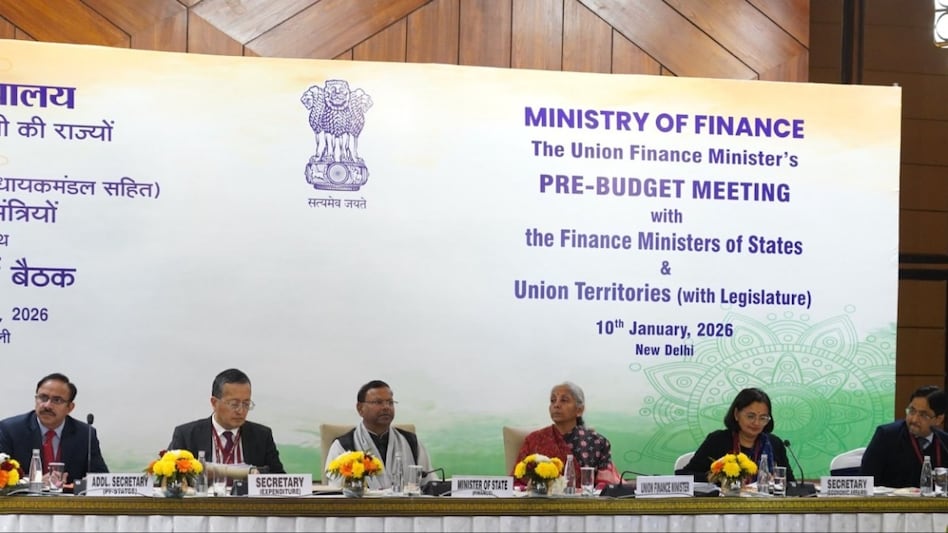
 Union Budget 2026: Pre-budget meeting: States seek revenue share, flag post-GST fiscal strain
Union Finance Minister Nirmala Sitharaman on Saturday chaired a pre-Budget meeting with states and Union Territories (UTs), where participants raised concerns over revenue losses after GST rationalisation, borrowing constraints, and Centre–state funding patterns. The GST cuts were introduced last September.
The meeting was attended by the Governor of Manipur; Chief Ministers of Delhi, Goa, Haryana, Jammu and Kashmir, Meghalaya and Sikkim; Deputy Chief Ministers of Arunachal Pradesh, Madhya Pradesh, Odisha, Rajasthan and Telangana; Finance Ministers of 17 states and Union territories; and representatives of two states. Officials from the finance ministry's Departments of Economic Affairs, Expenditure and Revenue were also present.
 Multibagger ESDS Software shares zoom 201% from IPO price; check target price
 5 bank stocks to buy, target prices | FCNR(B) windfall, unevenly shared
  ‘Must stay the course during turbulence’: Singapore defends investment in Air India
 GST Council may take stock of one-year rate rationalisation; broad-based cuts unlikely in October meeting
 'Clear winners are NRIs and FPIs': ISB professor flags risks from RBI's $136 billion dollar strategy
 “Files Used To Get Stuck”: PM Modi Takes Dig At Delays, Hails 2,800 Km Freight Corridor
 Indegene’s Growth Story: Global Expansion, AI & The Future Of Healthcare Tech
 Ambareesh Baliga Turns Bullish On Specialty Chemicals, Bets On Archean Chemicals & Vinati Organics
 Gold Loan Rise Faces Risk? Ambareesh Baliga Flags Correction Threat For NBFCs
 Hindustan Copper Set To Rise 10-12% From Current Market Price
 Why Titan Company stock is top jewellery pick ahead of festive season
  Archean Chemical, Vinati Organics: Specialty chemical stocks to buy during correction
 Sensex slumps 555 points; Nifty briefly slips below 23,400 amid CAS volatility
 Polycab India: Recent underperformance offers buying opportunity?
 Force Motors, Century Plyboards, Prince Pipes, JMB Auto, GNFC among 20 stocks turning ex-dividend on September 9“Files Used To Get Stuck”: PM Modi Takes Dig At Delays, Hails 2,800 Km Freight CorridorIndegene’s Growth Story: Global Expansion, AI & The Future Of Healthcare TechAmbareesh Baliga Turns Bullish On Specialty Chemicals, Bets On Archean Chemicals & Vinati OrganicsGold Loan Rise Faces Risk? Ambareesh Baliga Flags Correction Threat For NBFCs
 Chandigarh suspends Uber, Rapido licences for 6 months for failing to comply with rules












