Now Iran, too, has spent decades pursuing nuclear capabilities. Israel has vowed not to let Tehran succeed.
In June 2025, Israel struck several Iranian nuclear sites. The United States joined the war and dropped bunker-buster bombs on the heavily fortified facility at Fordow, along with targets at Natanz and Isfahan.
This February, the US and Israel again carried out joint operations after accusing Iran of restarting work on parts of its nuclear infrastructure. When Donald Trump announced the US strikes, he said Iran had tried to rebuild its nuclear programme while continuing to develop long-range missiles.
"It has always been the policy of the United States, in particular my administration, that this terrorist regime can never have a nuclear weapon," Trump said. "I'll say it again, they can never have a nuclear weapon."
But years before these strikes, Israel's spy agency, Mossad, carried out one of the boldest intelligence operations in modern espionage: the theft of Iran's nuclear archive in 2018.
A new book, Target Tehran, describes, in detail, how the operation unfolded. Written by Yonah Jeremy Bob and Ilan Evyatar, the book traces how successive Israeli governments and Mossad chiefs made stopping Iran's nuclear programme a strategic priority.
According to the authors, the campaign included sabotage operations, assassinations of Iranian nuclear scientists, diplomatic outreach to Gulf states, and eventually the theft of Iran's nuclear archive.
The authors write that not only Israel but several Gulf countries are also "scared" about the prospect of a nuclear-armed Iran, "and wanted someone else to do the job. And Israel was ready to do the job."
The Decision to Steal Iran's Nuclear Archive
The Mossad operation came three years after Iran signed the Joint Comprehensive Plan of Action with the US, and five other countries. Israeli Prime Minister Benjamin Netanyahu fiercely opposed the deal. He even called it a "disaster".
In 2016, he appointed Yossi Cohen as head of Mossad and gave him a clear instruction. "We need not only to convince the world that Iran lied about its nuclear weapons programme," Netanyahu told him, according to the book. "We need to show the world."
Cohen began planning an operation to steal Iran's nuclear archive. After a series of meetings with intelligence officials, he presented a plan to Netanyahu to send a Mossad team into Iran and extract the documents.
"Do they have a copy?" Netanyahu asked. "I don't know," Cohen replied. "But they are so sure that nobody knows about this archive that they may not have made a copy."
"You think they didn't put all this information on computerised files?" Netanyahu asked.
"Not if they believed we could get at such computer files," Cohen said. "Maybe they thought hiding only the original paper files was the best defence."
Netanyahu approved the mission.
Mohsen Fakhrizadeh and the Hidden Archive
Mohsen Fakhrizadeh, a close adviser to Iran's supreme leader Ali Khamenei, was widely seen by Western intelligence agencies as the architect of Iran's military nuclear programme. He had led the AMAD Project, Iran's first organised attempt to develop nuclear weapons. The programme was believed to have been suspended in 2003 after the US invaded Iraq. Tehran feared it could be the next target.
According to the book, Fakhrizadeh scaled down the programme but preserved its assets and documents. Those materials later became known as Iran's nuclear archive.
When Trump was elected US president in 2016, Khamenei ordered Iran's nuclear programme to move even further underground. Fakhrizadeh reorganised the archive, separating publicly disclosed material from documents that remained secret. He eventually moved the files to a warehouse in the quiet Tehran neighbourhood of Shirobad.
The 2015 nuclear deal required Iran to give the International Atomic Energy Agency access to records of its past nuclear activities. But, according to the book, Iran managed to conceal large parts of the archive.
"They were deeply worried that these documents, which told the entire history of Iran’s nuclear programme, were too exposed in their existing location," the authors write.
How Mossad Infiltrated Iran
Before launching the operation, Mossad needed precise intelligence. Cohen sent a female agent into Iran. She spoke fluent Farsi and had an engineering background. She spent several days scouting the area around the warehouse. To avoid drawing attention, she was accompanied by a man. The information she gathered allowed Mossad to plan the rest of the operation.
The Night of the Tehran Heist
The operation took place on Jan 31, 2018. That night, Iran experienced the longest total lunar eclipse of the century, leaving the sky unusually dark. A fog had rolled in to Tehran, providing an additional shield for the operation, the book says. The fog was at its thickest at precisely the times the team moved in and then in the early hours of the morning when they were to make their escape.
The archive was stored in two shipping containers mounted on flat-bed trailers inside a warehouse. Inside were two rows of steel vaults containing the files.
According to the book, Mossad agents rehearsed the operation repeatedly using a full-scale model of the warehouse built in another country. The agency even acquired identical Iranian-made safes and practised cutting them open. The agents knew the location of alarms and security cameras and how to disable them.
Cohen later described the operation as similar to the Hollywood film Ocean's Eleven, in which a group of thieves steal millions of dollars from a Las Vegas casino vault.
The Shirobad warehouse was lightly guarded. Two security guards left around 10 pm and returned at 7 am. That gave the Mossad team precisely six hours and twenty-nine minutes to complete the mission.
At 10:31 pm, the electronics team disabled the alarm system. The break-in team forced open the heavy iron doors and entered the warehouse. Using blowtorches heated to about 3,600 degrees Fahrenheit, the team cut open six of the 32 vaults.
Their main target was a set of black binders that, according to the book, contained designs for a nuclear weapon Iran hoped to build.
But the agents found much more.
As they went through the vaults, the Mossad agents found over 100 CDs containing roughly 55,000 files and videos documenting the nuclear program, along with photographs of secret experiments.
All of this was loaded onto two trucks that left the scene.
The Manhunt and the Escape to Azerbaijan
By the time Iranian authorities discovered the break-in at 7 am and launched a nationwide manhunt, the Mossad team had already left the warehouse. The trucks carrying the archive headed toward different points along Iran's border with Azerbaijan.
According to the book, by the time Iranian security forces realised what had happened, the agents - along with tens of thousands of nuclear files - had already slipped out of the country across the Azerbaijan border.



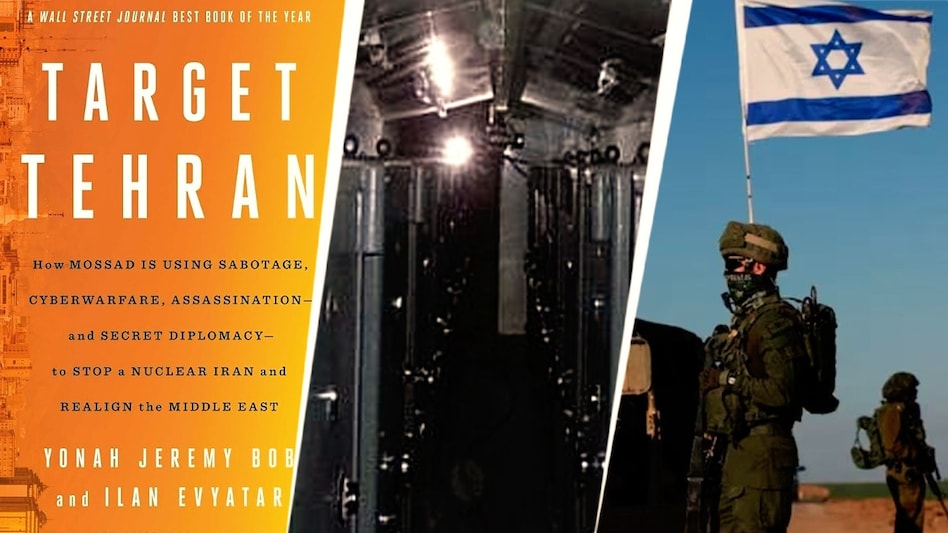 Target Tehran details how Mossad stole Iran's nuclear archive in 2018
 Missed your minimum balance? Banks pocketed ₹26,100 cr in penalties in just 4 years
 Why Tata Sons got ₹28,291 cr from TCS in FY26, down from ₹32,184 cr in FY25
 What a new report says about India's digital banking frauds
 ‘Extremely disturbing occurrence ’: MeitY reacts to removal of PM Modi video, seeks explanation from Meta
 HUL to further raise prices. Here’s how much
 7.1 Quake Shakes Southern Japan: Roads Split, Buildings Burn, Hundreds Of Thousands Evacuated
 How Mohammad Irfan Went From Street Hawker To India's Most Viral Protest Voice
 Congress Vs BJP Clash In Lok Sabha Over Anti-Paper Leak Bill 2026 As Opposition Questions Police
 "Justice Delayed Is Justice Denied": Bansuri Swaraj Hails Anti-Paper Leak Bill Strict Penalties
 CM Rekha Gupta Approves ‘Delhi Lakshmi Yojana’; Women To Get ₹2,500 Monthly Financial Assistance
 Moschip Technologies, Tamilnad Mercantile Bank shares: Here's what charts indicate
 Sensex, Nifty end lower as FMCG, energy weigh; IT stocks outperform
 L&T Q1 results: PAT rises 14% to Rs 4,123 crore; revenue up 7%
 Tata Capital Q1 results: PAT jumps 56% YoY to Rs 1,547 crore; AUM rises 22%
 KPIT Tech, Firstsource: What to do with these two battered IT stocks?
 8.5% FD vs 7% FD: How much extra can senior citizens earn on ₹10 lakh, ₹25 lakh, ₹1 crore?
 CJP warns of fresh nationwide protests if Centre fails to honour July 25 assurances
 Toyota Hilux facelift launched in India at Rs 31.99 lakh










