


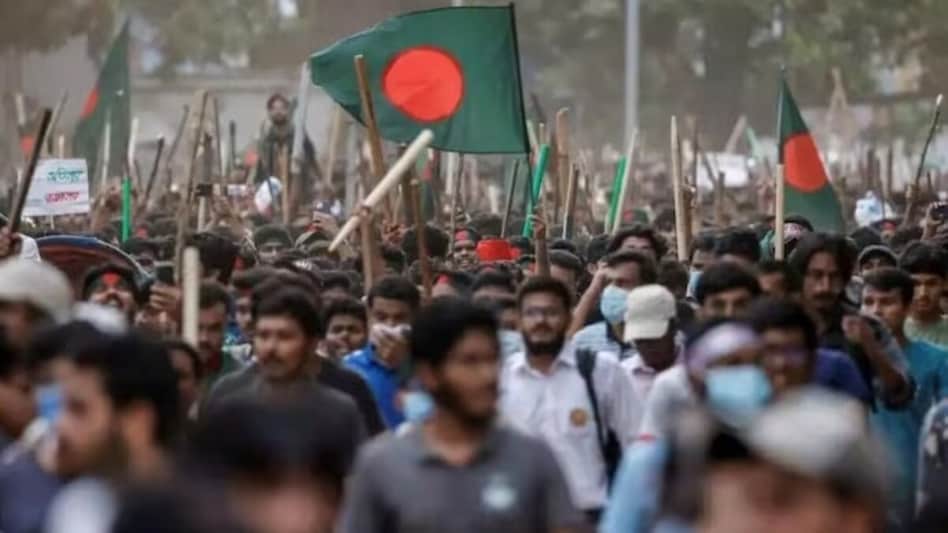
 Former prime minister Khaleda Zia’s Bangladesh Nationalist Party (BNP), which has emerged as a frontrunner in the post-Awami League political landscape, called for a national awakening against mob violence.
Amid rising domestic unrest and strained regional optics, Russia on December 22 called on Bangladesh and India to lower tensions, even as Dhaka grapples with mob violence, minority protests and political uncertainty ahead of the February 12 national elections.
Speaking at a press briefing at the Russian Embassy in Dhaka, Ambassador Alexander Grigoryevich Khozin underscored the need for de-escalation between the two neighbours “the sooner the better”, while stressing that Moscow does not interfere in bilateral relations. He said relations between neighbouring countries should be guided by mutual trust and confidence and cautioned against any escalation beyond the current level.
The remarks come at a crucial moment for Bangladesh, where a series of violent incidents have triggered concerns at home and abroad, including in India. Khozin welcomed the election schedule announced by the Election Commission and said Russia expects the polls to be held on time on February 12. He expressed hope for a conducive environment ahead of the vote and said Russia remains in contact with the Election Commission, awaiting official invitations to send Russian election observers.
Minority protests and lynching spark outrage
On December 22, minority groups in Bangladesh staged protests in the capital, accusing the interim government of failing to protect minority communities. Leaders of Hindu and other minority organisations formed a human chain in front of the Jatiya Press Club, condemning the lynching of Dipu Chandra Das, a Hindu garment factory worker in Mymensingh.
Das was dragged out of a factory by a mob on December 18, lynched to death and his body set on fire — an incident that sparked widespread protests by factory workers, students and rights groups, and drew expressions of concern from India.
“He (Muhammad Yunus) claims he will build a humane Bangladesh, but in reality, he is an inhumane chief adviser,” said Manindra Kumar Nath, joint coordinator of the Minority Unity Front, addressing protesters.
Authorities said investigations are ongoing. The Rapid Action Battalion arrested 10 suspects over the lynching, while police later detained two more. A police headquarters spokesman said 12 people were now in jail or custody in connection with the killing.
Attacks on media, diplomatic missions
The interim government also confirmed multiple arrests over attacks on media houses and cultural institutions. The chief adviser’s office said nine people were arrested over violent attacks on the mass-circulation newspapers Prothom Alo and The Daily Star, as well as cultural groups Chhayanat and Udichi Shilpi Goshthi in Dhaka.
Law enforcement agencies identified 31 suspected perpetrators after analysing video footage. The same analysis detected three individuals who attempted to create “rowdiness” in front of the residence of India’s assistant high commissioner in the port city of Chattogram.
The government has urged restraint, responsibility and unity, warning that no one involved in hate-driven violence, arson or destruction would be spared.
The violence follows the death of Sharif Osman Hadi, leader of the radical right-wing cultural group Inqilab Mancha, who died last week in Singapore after being shot in Dhaka on December 12. Hadi was known for rhetoric against deposed prime minister Sheikh Hasina, the now-disbanded Awami League and neighbouring India, and had played a prominent role in last year’s violent “July Uprising” that toppled Hasina’s government.
Tensions escalated further today when unidentified gunmen shot Motaleb Shikder, a leader of the 2024 student-led uprising and a senior figure in the National Citizen Party (NCP), in the southwestern city of Khulna. Shikder remains in critical condition.
BNP calls for resistance to mobs
Former prime minister Khaleda Zia’s Bangladesh Nationalist Party (BNP), which has emerged as a frontrunner in the post-Awami League political landscape, called for a national awakening against mob violence.
“Those of us who truly want to see Bangladesh as a genuinely independent, sovereign and democratic country cannot remain merely aware any longer; we must stand up,” BNP secretary general Mirza Fakhrul Islam Alamgir said at a joint press conference with the Editors’ Council and the Newspaper Owners’ Association of Bangladesh. “It is time to put up resistance against mobs.”
Alamgir, 78, said the current situation was far removed from the Bangladesh he had once envisioned.

 Exam reforms: Tech titan Nandan Nilekani picked by PM Modi to fix national public examination system
  'Tax officers struggled for own land': Nirmala Sitharaman slams laidback attitude of govt depts
 CBDT issues new crypto reporting guidance: No new tax, but exchanges must track and report all transactions
 Did Cockroach Janta Party's 'Chalo Sansad' 2.0 threat trigger Dharmendra Pradhan's resignation? What we know so far
 'Will discharge my responsibilities with complete humility': Pralhad Joshi after being appointed Education Minister
 AI Data Centers, Aerospace & Gas Turbines: What's Powering Indo-MIM's Future Growth?
 Best Healthcare Stocks: Gaurang Shah's Outlook On Apollo Hospitals, Fortis & The Manipal Health IPO
 Is Indo-MIM's IPO Valuation Justified? Here's Why The Company Sees Strong Growth Ahead
 Treasury Bills Explained: Why T-Bills Are One Of The Safest Short-Term Investment Options
 FDs vs Markets: Where Should You Keep Your Short-Term Money?
 Gland Pharma stock: Price target of Rs 3,250 likely in medium term, says analyst
  Metal recycling stocks to buy: Gravita, Pondy Oxides, Jain Resource among top picks
 TRIL shares: Should you average the falling stock? Here's 'fixed and final' stop loss
 Adani Power: 45 GW target, Rs 2 lakh crore capex plan among conference call highlights
  ITC Hotels, Chalet, Ventive, IHCL, SAMHI: Hotel stocks to buy despite travel disruptions
 Beyond mutual funds: Why analysts see SBI Funds' alternative asset business as a long-term growth engine
 'Ashamed of it...': Manoj Muntashir calls Adipurush his biggest mistake, seeks country's forgiveness Exam reforms: Tech titan Nandan Nilekani picked by PM Modi to fix national public examination system 'Tax officers struggled for own land': Nirmala Sitharaman slams laidback attitude of govt depts
 Delhi targets traffic bottlenecks on Aruna Asaf Ali Marg with ₹1.97 crore elevated road study









