












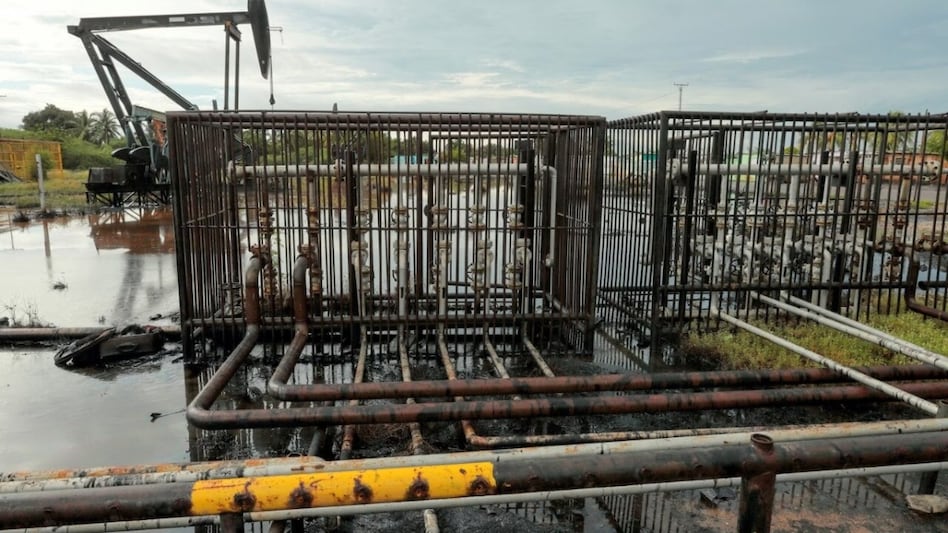
 The surge marks a significant re-entry of Venezuelan crude into the global market after a period of constrained exports.
 The surge marks a significant re-entry of Venezuelan crude into the global market after a period of constrained exports.
Oil sales under the US-Venezuela agreement are set to reach $2 billion by the end of February, driven by the marketing and export of millions of barrels currently held in floating storage within Venezuelan waters. Trading houses Vitol and Trafigura are playing a central role in the distribution, while international partners such as Chevron have increased production and shipments, news agency Reuters reported.
This surge marks a significant re-entry of Venezuelan crude into the global market after a period of constrained exports. The US took control of Venezuela's oil exports shortly after the capture of President Nicolas Maduro in early January, with proceeds directed to a US-supervised fund in Qatar. The arrangement has provided a more structured and transparent framework for managing Venezuela's oil revenues, aiming to stabilize the country's energy sector and ensure accountability.
The renewed export flows have resulted in Venezuelan oil returning to regions including Asia, Europe, and the US Gulf Coast. Most of the crude is destined for these major refining centres, with additional shipments being negotiated for delivery in the coming months. The volume of barrels expected to be sold by the end of February aligns closely with the pact's initial sales targets, signalling strong demand and efficient execution by involved parties. After months or even years of limited activity, these renewed flows are being closely watched by the industry, as they represent a shift in global supply dynamics and offer new opportunities for buyers and sellers.
"Most of that oil will go here to the U.S. Gulf Coast, but it'll go to India, it'll go to Asia, it's going to Europe," U.S. Secretary of Energy Chris Wright said. "Every barrel you produce will be sold, so the question is just where." This reflects the broad international appetite for Venezuelan crude under the revised trade framework, with customers reengaging after previous limitations. The diversity of destinations underscores the flexibility and reach of Venezuela's oil exports, as refiners across continents seek to secure supplies amid shifting market conditions.
According to Wright, "More customers in Asia and Europe are negotiating deals to import soon, with 40 million barrels expected to have been sold by the end of February at about $50 per barrel, Wright said." This price point and sales volume are in line with the agreement's goal, supporting Venezuela's effort to maximise returns from its oil sector. The competitive pricing has made Venezuelan crude an attractive option for buyers looking to diversify their sources, especially as global demand for energy remains robust.
US President Donald Trump confirmed the agreement's targets, stating, "The pact's initial sales target was between 30 million and 50 million barrels, U.S. President Donald Trump had said." This benchmark has shaped trading activity and guided expectations for all participants involved in the Venezuelan oil export programme. The clarity provided by these targets has helped establish predictability for sellers and buyers, fostering confidence in the deal's ongoing implementation.
The trading arrangement also benefits buyers previously restricted by sanctions. As Wright explained, "Chinese independent refineries that were previously importing sanctioned oil can now buy Venezuelan crude on the open market, Wright said." This has widened access and encouraged competitive purchasing among international buyers. The lifting of restrictions has increased the number of potential customers and contributed to greater liquidity and transparency in the market for Venezuelan oil.
Venezuelan oil to India
Venezuela is sharply increasing crude shipments to India, deploying Very Large Crude Carriers (VLCCs) capable of transporting up to 2 million barrels per voyage. The move follows a renewed Caracas–Washington supply arrangement that has eased US sanctions under a revised licensing framework.
Reuters reported that trading houses have booked the first VLCCs to lift Venezuelan oil since restrictions were relaxed, signalling a revival in exports. VLCCs carry roughly twice the volume of Suezmax tankers and nearly four times that of Aframaxes, reducing per-barrel freight costs and improving delivery efficiency.
At least three VLCCs — Nissos Kea, Nissos Kythnos and Arzanah — chartered by Vitol and Trafigura, have secured March loading slots at PDVSA’s Jose terminal, with India as the destination. Another supertanker, Olympic Lion, is also heading toward Venezuela.
Indian refiners are re-engaging with Venezuelan crude at a strategic time. Chevron recently sold its first Venezuelan cargo to Reliance Industries in nearly six years. State-run refiners including IOC, BPCL and HPCL Mittal have also sourced heavy crude cargoes.
While discounted Merey crude remains attractive, tighter global market dynamics have narrowed margins. Still, larger shipments via VLCCs could improve overall economics and mark a logistical upgrade in Venezuela–India oil trade.
 RBI MPC 2026: Repo rate unchanged at 5.25%, maintains neutral stance
 US-Iran news impact? IndiGo, BPCL, HPCL, IOC, Asian Paints, Ceat, JK Tyre rally up to 11%; here’s why
 Sensex, Nifty: 7 reasons why stock market rallied today; US-Iran ceasefire, oil prices & more
 RBI MPC April policy: Hold, cut or hike? 7 key signals to watch today
 Stock market, US-Iran ceasefire: Sensex zooms 2,775 pts, Nifty above 23,900; IndiGo shares up 10%
 Aludecor – Powering India’s Modern Facades
 "Pakistan Ke Kitne Tukde Honge": Rajnath Singh’s Big Warning Amid Bengal Political Battle | Exclusive
 "Pakistan Ke Kitne Tukde Honge": Rajnath Singh’s Big Warning Amid Bengal Political Battle | Exclusive
 Tata Trusts Row Deepens After Venu Srinivasan Exit, Legal Battle Intensifies
 Fresh Row At Tata Trusts Over Non-Parsi Trustees | Matter Headed For Courts?
 IndiGo, GMR Airports, SpiceJet, Dreamfolks Services, other aviation stocks jump up to 11%; here's whyUS-Iran news impact? IndiGo, BPCL, HPCL, IOC, Asian Paints, Ceat, JK Tyre rally up to 11%; here’s why
 Sensex, Nifty rally 4%: Rs 14.20 lakh cr added in investors wealth; top market gainers
 EMS stocks to 'Buy': Up to 40% upside | Kaynes Tech, Syrma SGS, Amber - Price targets, Q4 previews
 Up to 43% upside, outperform rating: Why Macquarie is bullish on the Adani Green Energy stock