












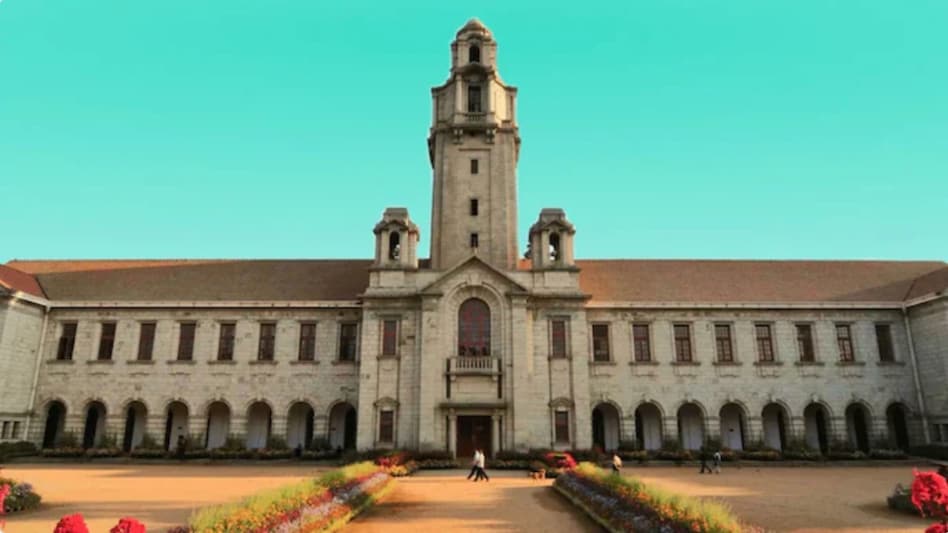
 New IISc attendance rule sparks unrest; faculty, students question research culture shift
 New IISc attendance rule sparks unrest; faculty, students question research culture shift
The Indian Institute of Science (IISc) is facing growing unrest after its Department of Electronic Systems Engineering (ESE) introduced a new attendance and parking policy this month, mandating fixed on-campus hours for faculty, staff, and students. The policy, which the institute says is aimed at improving “discipline and accountability,” has instead drawn sharp criticism from the academic community for its perceived rigidity.
Under the new rules, faculty and staff are required to log 40 working hours per week. For MTech and first-year PhD students, the requirement is even higher, at least 50 hours on campus each week. Senior PhD scholars are expected to accommodate their supervisors’ schedules, often extending to 70 or 80 hours per week.
The policy also links access to key facilities, such as the National Nanofabrication Centre (NNFC) and the Microscopy Facility, to separate time logs. Requests for remote work now require written approval.
Many students see the policy as a step towards surveillance rather than scientific productivity. “It feels like a surveillance system,” said one research scholar. Another added, “When every hour must be accounted for, rest becomes guilt.”
Faculty members defending the move say it is intended to bring transparency and consistency across the department. Administrators argue that the policy standardises work habits and ensures optimal use of research infrastructure.
However, critics warn that such corporate-style frameworks risk equating innovation with attendance rather than output. “Research thrives when the mind is free, not when the clock is ticking,” said a senior professor who requested anonymity.
Campus counsellors have reported signs of burnout among younger researchers, who fear their performance is now measured in logged hours rather than intellectual contribution. For a community that has long prized academic independence, many say the new rule represents a cultural shift—one that prioritises presence over purpose.
A review of the policy’s impact is scheduled at the end of the semester, but for many students, the unease is already palpable. As one observer put it, IISc now faces a defining question: will India’s top research institution measure excellence by hours—or by ideas?
 Will the hike in customs duty on gold, silver reduce India’s import bill?
  Bharti Airtel Q4 earnings: Net profit slips 26%, board declares Rs 24 dividend
  Record jet fuel prices bite: Air India suspends Chicago, Shanghai flights; reduces overseas frequencies till August
 Mirae Asset Platinum Hybrid Long-Short Fund: Can SIFs beat traditional hybrid funds?
 'Best investors can...' - Robert Kiyosaki has a Rich Dad lesson, and crash warning!
 Modi Cabinet Announces Big MSP Hike For Farmers | ₹2.6 Lakh Crore Boost
 Cabinet Clears Mega Coal Gasification Plan | Jobs, Power & Fertilizer Boost
 Vaibhav Shah Decodes SIFs, Hedging Strategies & Wealth Creation Amid Volatility | Mirae Asset
 Cabinet Approves ₹20,667 Crore Ahmedabad-Dholera Rail Project | Ashwini Vaishnaw
 Buy The Dip Or Stay Cautious? Daljeet Kohli Decodes Market Recovery & Strategy
 Sensex, Nifty outlook for tomorrow: What lies ahead for the stock market?
 Expert strategy: Analyst's views on TCS, Wipro, E2E Networks | Daily Calls on BTTV
 Paras Defence Q4 profit jumps 74%; stock extends decline, still up 13% in a month: Target prices, outlook
 Tata Power, Adani Power shares: Buy now or wait? | Daily Calls on BTTV
 Sun Pharma, Biocon, others: Expert shares view on pharma pack | Daily Calls on BTTV