








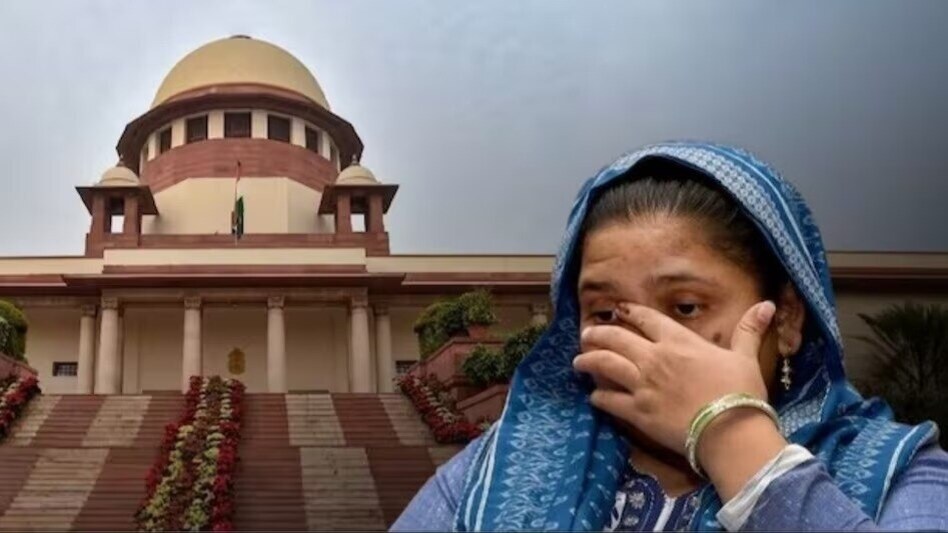

In a significant update in the Bilkis Bano case, the Supreme Court has dismissed a plea of two convicts out of the 11. Their plea had challenged SC's January verdict on cancelling their remission.
A two-judge bench comprising of Justices Sanjiv Khanna and Sanjay Kumar disbanded the petition calling it "absolutely misconceived." It also said that the court cannot sit in a petition over which the apex court had already passed an order.
"What is this plea? How is this plea maintainable? This is absolutely misconceived. How can an Article 32 petition be filed? We can’t sit in appeal over an order passed by another bench," the bench said.
Appearing on behalf of Radheyshaym Bhagwandas Shah and Rajubhai Babulal Soni, the convicted individuals, attorney Rishi Malhotra requested permission to withdraw their plea.
The bench permitted the attorney to rescind the plea. Meanwhile, Shah has also requested provisional bail.
In March, both convicts appealed to the top court, arguing that its January 8 decision to cancel their sentence remission went against a 2002 constitution bench ruling, and requested the matter to be referred to a larger bench for a final decision.
Shah and Soni, currently held in Godhra sub-jail following the top court's ruling, highlighted a contradiction where two coordinate benches had conflicting opinions on the premature release issue and which state government's policy should apply to their remission petitions.
The plea, submitted through Malhotra, pointed out that one bench on May 13, 2022, directed the Gujarat government to review Shah's request for early release based on the state's remission policy dated July 9, 1992. However, the bench that delivered the verdict on January 8, 2024, concluded that only the Maharashtra government had the authority to grant remission, not Gujarat.
They argued that the January 8, 2024, judgment directly contradicted the 2002 constitution bench decision in Rupa Ashok Hurra's case and should be overturned to avoid legal inconsistencies and confusion in future cases.
The plea also raised a fundamental question about whether a later coordinate bench can nullify its earlier judgment and issue conflicting rulings, or if it should refer the matter to a larger bench if it believes the previous decision was based on incorrect legal interpretation or facts.
The plea sought a directive for the government to review the convicts' cases for early release and clarify which of the conflicting judgments from the coordinate benches should be applied to them.
Given the conflicting orders from two coordinate benches of the apex court, the plea requested the matter to be referred to a larger bench for a final decision.
On January 8, the top court invalidated the remission granted to 11 convicts in the high-profile Bilkis Bano gang-rape case and the killings of her seven family members, criticizing the Gujarat government for colluding with the accused and misusing its authority.
The court ordered all prematurely released convicts to return to jail within two weeks, emphasizing that the Gujarat government overstepped by deciding on remission that fell under Maharashtra's jurisdiction.
It declared the May 13, 2022, judgment by another apex court bench as void, accusing it of deceiving the court to obtain favorable rulings.
Bilkis Bano was 21 and pregnant when she was raped during the 2002 riots following the Godhra train burning incident; her young daughter was among the deceased family members.
 Blackstone’s 9.99% stake acquisition in Federal Bank deal gets RBI green light: Report
 SEBI ends expiry day margin benefit for single stock derivatives to curb risk
 Crypto slump deepens: Bitcoin breaks below $70,000 as ‘digital gold’ claim faces fresh test
 'Deeptech does take a J curve': Lightspeed’s Hemant Mohapatra on the strategy behind deeptech funding
  Sarvam AI unveils 'Sarvam Vision', a multilingual document intelligence model
  Metropolis Q3FY26 Growth Led By Specialty, Wellness Diagnostics
 Piyush Goyal Explains Roadmap Of India–U.S. Trade Deal | What Happens Next?
 #Promo | World Governments Summit 2026 Dubai: India Today Exclusive Coverage
 AI Hype Vs Reality: Ex-French Minister & VC Fleur Pellerin On What Comes Next
 Rahul Gandhi Vs Ravneet Bittu: “Traitor” Remark Sparks Sikh Row Outside Parliament
 SEBI ends expiry day margin benefit for single stock derivatives to curb riskBlackstone’s 9.99% stake acquisition in Federal Bank deal gets RBI green light: ReportCrypto slump deepens: Bitcoin breaks below $70,000 as ‘digital gold’ claim faces fresh test
 Tata Motors PV reports net loss of Rs 3,486 crore in Q3 as JLR cyber hit weighs
  IndiGo shares fall on CCI probe trigger; here's what analysts advise