











 The Indian crude basket has surged dramatically
On Friday morning, global markets found some relief as benchmark Brent crude eased to around $105 per barrel after briefly threatening to touch $120.
But for India, that relief is irrelevant.
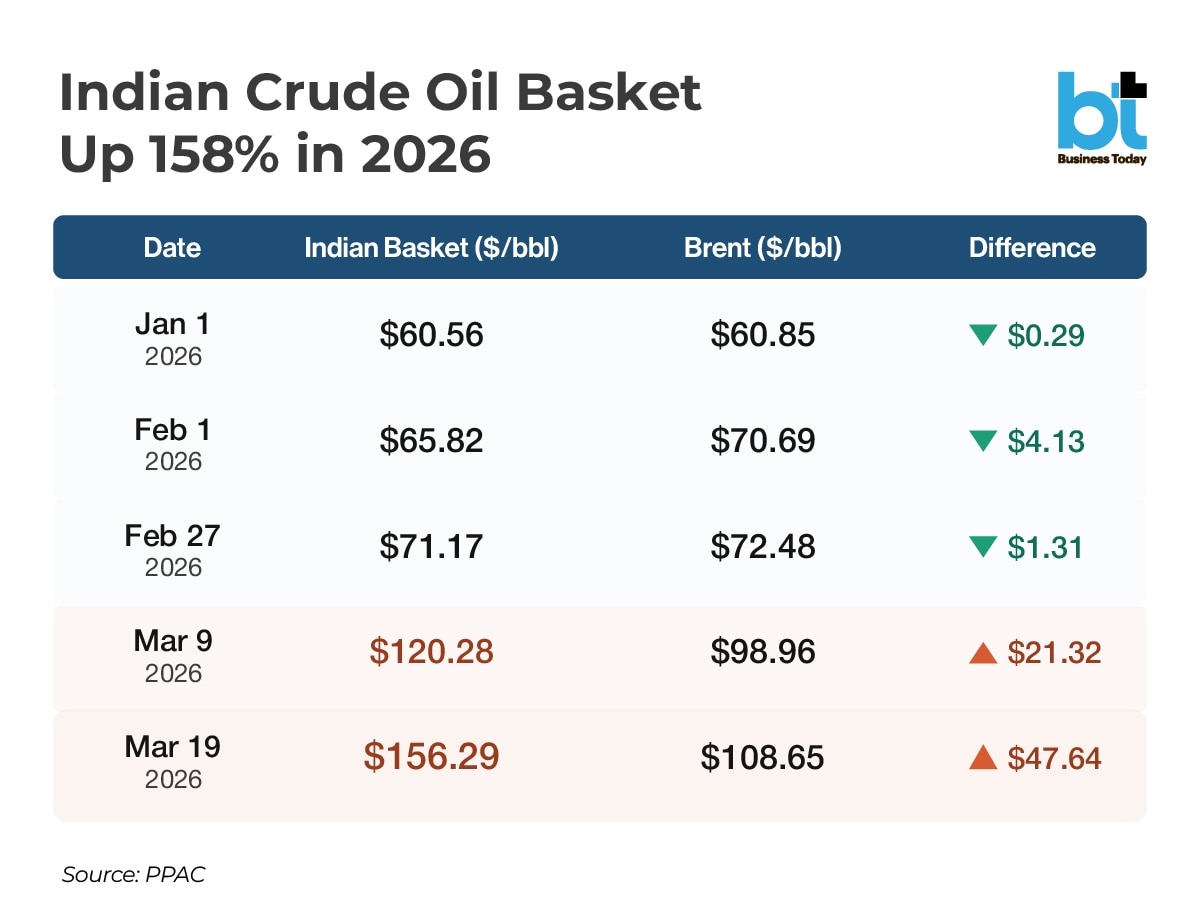
The price India actually pays for crude – the Indian crude basket – has surged dramatically over the past three weeks, hitting an all-time high of $156.29 per barrel on Thursday, March 19.
This widening gap highlights a critical reality – the Brent is no longer an indicator of India’s oil costs.
The Crude Price Divergence
This year until late February, the Indian crude mix was actually cheaper than Brent.
That changed dramatically after the first wave of missile strikes in West Asia on February 28. Since then, the Indian basket has more than doubled, and is now nearly $50 per barrel costlier than Brent.
Indian basket up 158% in 2026
Why Not Brent…
Brent crude is widely used as a global benchmark, but it does not reflect the actual sourcing realities of India’s oil imports.
India imports nearly 89% of its crude oil needs, and most of it comes not from Brent-linked markets, but from West Asia.
What Is The Indian Crude Basket?
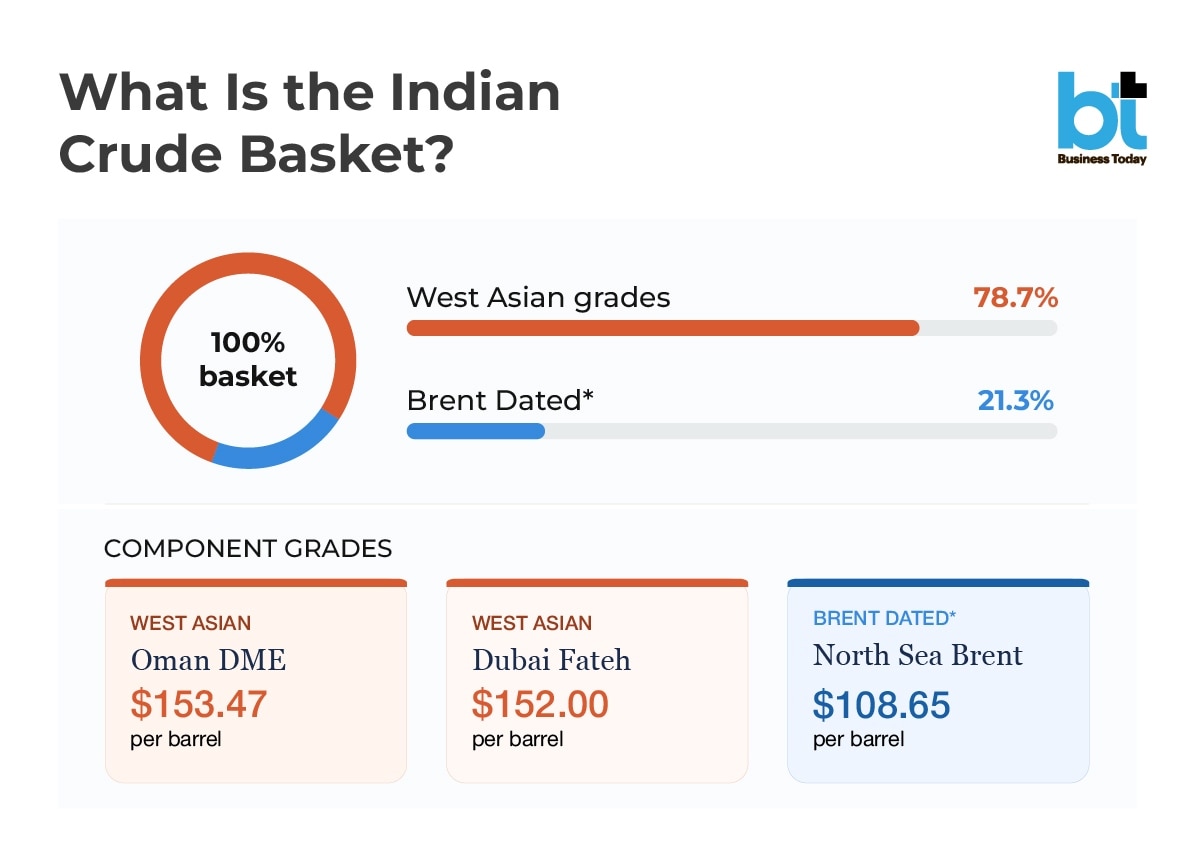
This makes India far more vulnerable to regional disruptions – especially in times of conflict.
The bulk of India’s crude comes from Oman and Dubai benchmarks – both of which have surged sharply due to the ongoing Gulf tensions.
Meanwhile, Brent-linked crude forms a much smaller portion and is often priced on pre-agreed contracts, not real-time market spikes.
A Crisis Driven By Geography And Conflict
The current oil shock is unlike previous cycles.
Earlier disruptions were typically driven by either supply cuts or demand surges. This time, it is a double blow – severe logistical disruptions, especially around the Strait of Hormuz and direct damage to production and storage infrastructure.
The Gulf conflict has choked key supply routes, reduced tanker movement, and pushed up regional crude benchmarks far beyond global averages.
The hidden costs Brent doesn’t show
The divergence goes beyond just crude prices.
India’s import bill is also being hit by:
+ skyrocketing freight and insurance costs, which are not included in the Indian basket price
+ limited availability of tankers and cargo shipments
+ currency pressure from a weakening rupee
In some cases, freight rates have surged up to 3.5 times normal levels, further inflating the effective cost of oil imports.
A Massive Economic Burden Builds Up
The implications for India’s economy are severe.
Estimates suggest that every $10 rise in crude prices increases India’s oil import bill by $14-16 billion annually.
With prices already up by nearly $80 from the standard $70 calculations, the additional burden could reach a staggering $120 billion.
The Bottom Line
While global headlines track Brent crude as the key oil indicator, India’s reality tells a very different story.
For a country heavily dependent on West Asian oil, regional conflict, logistics disruptions, and supply shocks matter far more than global benchmarks.
And right now, that divergence is turning into a full-blown economic challenge.
 Did Cockroach Janta Party's 'Chalo Sansad' 2.0 threat trigger Dharmendra Pradhan's resignation? What we know so far
 'Will discharge my responsibilities with complete humility': Pralhad Joshi after being appointed Education Minister
 From NEET protests to politics? What CJP's Saurav Das and Ashutosh Ranka have now revealed
 From a BA graduate to a five-time MP and Cabinet veteran: What did new Education Minister Pralhad Joshi study?
 Large office spaces remain in demand as India's leasing touches 48 million sq ft in H1 2026, says report
 FDs vs Markets: Where Should You Keep Your Short-Term Money?
 Why Term Insurance Is Essential for Every Earning Member | Sum Assured & Coverage Explained
 Pakistan's Alleged Terror-Politics Nexus: Lashkar Links Spark Questions Over Fazlur Rehman
 Think Life Insurance Is Optional? Here's Why Every Indian Family Needs It Today
 FD Vs Arbitrage Fund: Which Is Better For High Taxpayers?
 TRIL shares: Should you average the falling stock? Here's 'fixed and final' stop loss
 Adani Power: 45 GW target, Rs 2 lakh crore capex plan among conference call highlights
  ITC Hotels, Chalet, Ventive, IHCL, SAMHI: Hotel stocks to buy despite travel disruptions
 ITC shares: Rs 307 a key short-term level to watch; here's target price
 Mphasis shares: FY27 guidance maintained; brokerages keep 'Buy' after Q1; check target price
 Top 5 smartphones with AI camera features: iPhone 17 Pro Max, Samsung Galaxy S26 Ultra, moreDid Cockroach Janta Party's 'Chalo Sansad' 2.0 threat trigger Dharmendra Pradhan's resignation? What we know so far
 'The Odyssey' box office collection day 9: Christopher Nolan's film sees massive boost on Saturday, will it near 'Doctor Strange in the Multiverse of Madness'?
 'You don't perform, you don't exist': TV Mohandas Pai recalls working under Narayana Murthy, calls him the best boss he ever hadTRIL shares: Should you average the falling stock? Here's 'fixed and final' stop loss