The transition is about more than retirement. It is a chance to reassess where their expertise can make a difference and how they define success beyond a corporate title.
Roopa Kudva, former MD and CEO of CRISIL, moved into impact investing before making more room for writing and other interests. Aruna Jayanthi, former Capgemini executive and a member of the supervisory board of Michelin Group, combines board responsibilities with advising start-ups and a social enterprise. Former State Bank of India chairperson Arundhati Bhattacharya took on a new leadership role at Salesforce during the Covid-19 lockdown. Ritu Anand, former Chief Leadership & Diversity Officer and Senior Vice President HR at TCS, is exploring opportunities across industries, while Raju Mistry, former global CHRO at Grasim, Jubilant and Cipla, has become an entrepreneur.
For these leaders, the transition has meant rethinking not just what they do next, but what they want from work and life.
‘You Do Not Have to Keep Extending the Same Version of Yourself’
Kudva’s biggest career reinvention began when she left the corner office at CRISIL for an open office at Omidyar Network India. After eight years as MD and CEO of CRISIL, she moved into impact investing, evaluating young ventures, and working with entrepreneurs, many in their 20s.
“I went from a corner office with a team of five dedicated staff to sitting in an open office with no cabin and a shared assistant,” she says. The shift required a different approach to assessing businesses.
“I had to move from thinking primarily about risks to thinking more about possibilities while evaluating organisations,” she says.
Over the following decade, Kudva deepened her experience in impact investing and served on boards including Infosys, Nestlé India, Tata AIA Life Insurance, and IIM Ahmedabad. Her work at Omidyar focused on India’s “Next Half Billion”—lower-income and lower-middle-income populations.
Now in her 60s, she has stepped back from professional commitments to make room for writing, reading, travel, exercise, family and friends, while continuing to speak on business and technology, and pursue philanthropy.
“When you’re running an organisation, somebody else owns your diary. Now, you know, it’s a much more conscious decision that I make. Does this deserve my time?” she says.
Kudva identifies four aspects that professionals typically deal as they transition to a new chapter of their professional journey: identity, daily routine, intellectual stimulation, and purpose. She also cautions against treating a board position, investment role or mentoring assignment as a scaled-down version of an executive job.
“A board position is not a smaller CEO job. Investing is not operating.”
“There is actually a double disadvantage which older women face. An experienced man leaving a senior executive role is often seen as someone whose decades of experience can be used, can be put to use as a board member, as an advisor or mentor. I’m not sure that women are always viewed through quite the same lens,” she says. Kudva links the disadvantage older women face to the pipeline into senior leadership. Fewer than 5% of NIFTY 500 companies are led by women, she points out.
“You do not have to keep extending the same version of yourself.” She believes that at different stages of life, one can really choose to begin again.
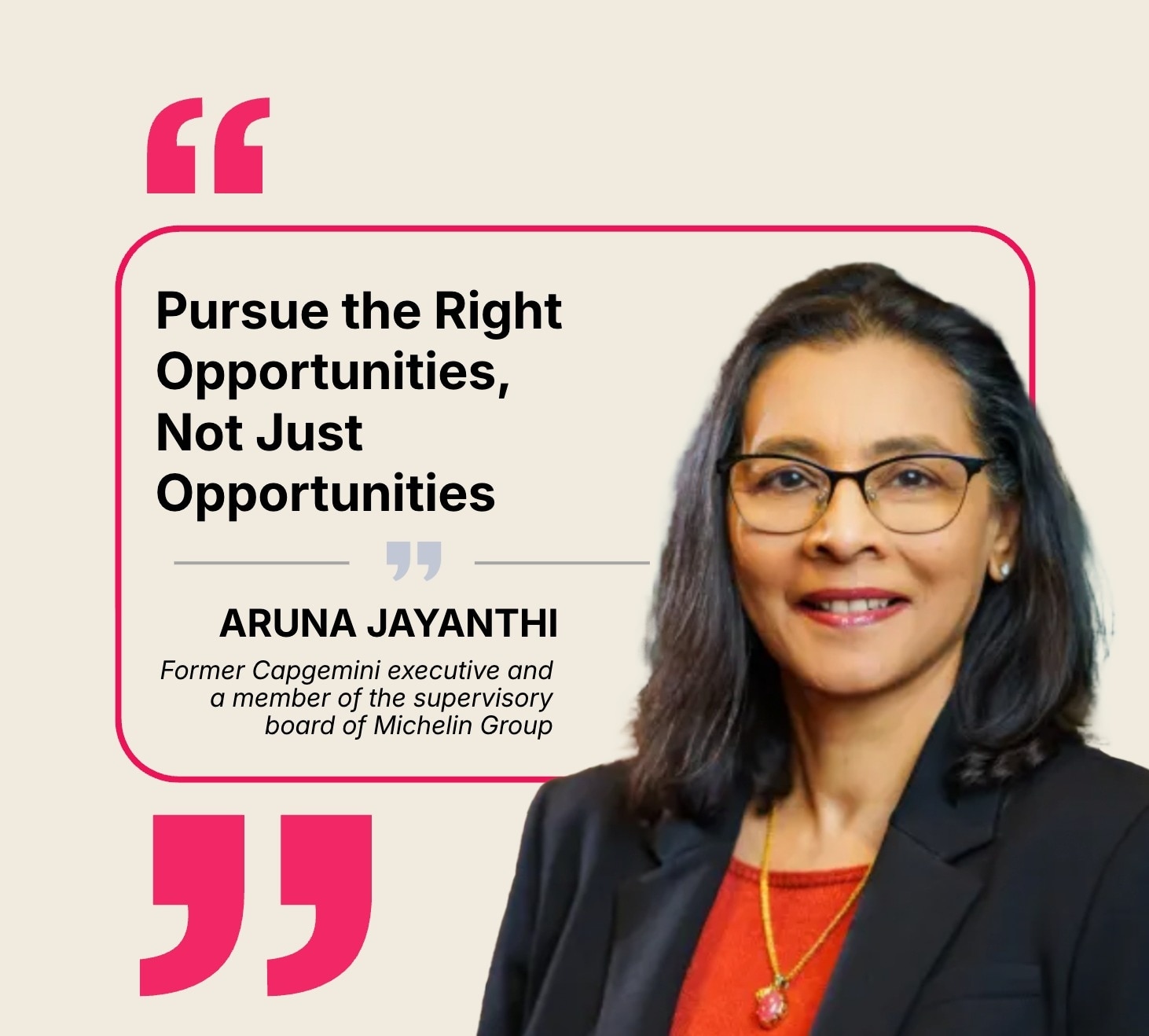
‘Pursue the Right Opportunities, Not Just Opportunities’
After more than 26 years at Capgemini, Jayanthi stepped away from a full-time executive role in March 2026. She led the company's business in Canada and Latin America, served as CEO of Capgemini India and CEO of Business Services, and headed its Asia-Pacific and Latin America operations. She was also a member of the Group Executive Committee and part of the core team that established Capgemini's offshore capabilities.
Her career has not ended with her executive role. She is now a member of the supervisory board of Michelin Group and a board member of Barry Callebaut. Her governance experience also includes chairing the Board of Governors of the National Institute of Technology Calicut, serving as an independent director at SBI Capital Markets and being part of Nasscom’s Executive Council.
Yet planning for life after a full-time leadership role did not receive enough attention while she was still in one.
“I suppose the assumption is that C-suite executives are experienced enough to know what they want to do next and will plan for it! But often, one is so caught up in the full-time demands of the job, that planning for the next chapter doesn’t get enough attention and for sure, I didn’t do enough of it,” she says.
Jayanthi is focusing on three areas: continuing her corporate board work, helping startups and entrepreneurs scale, and advising a social enterprise developing women-led initiatives in rural India.
However, she cautions against succumbing to social pressure and the inevitable questions about what comes next. The first challenge, she says, is often a lack of clarity.
Jayanthi believes organisations must also rethink how they engage senior talent. Most were designed around full-time employees working together in the same physical location. Remote work has loosened that model, but employment structures have not changed enough to accommodate people who want to contribute without returning to conventional full-time roles.
She now has more time to learn, speak to people in different fields and understand developments in management, technology, community development and innovation.
“The big difference now is that I have more time to learn,” she says. Her definition of success remains unchanged.
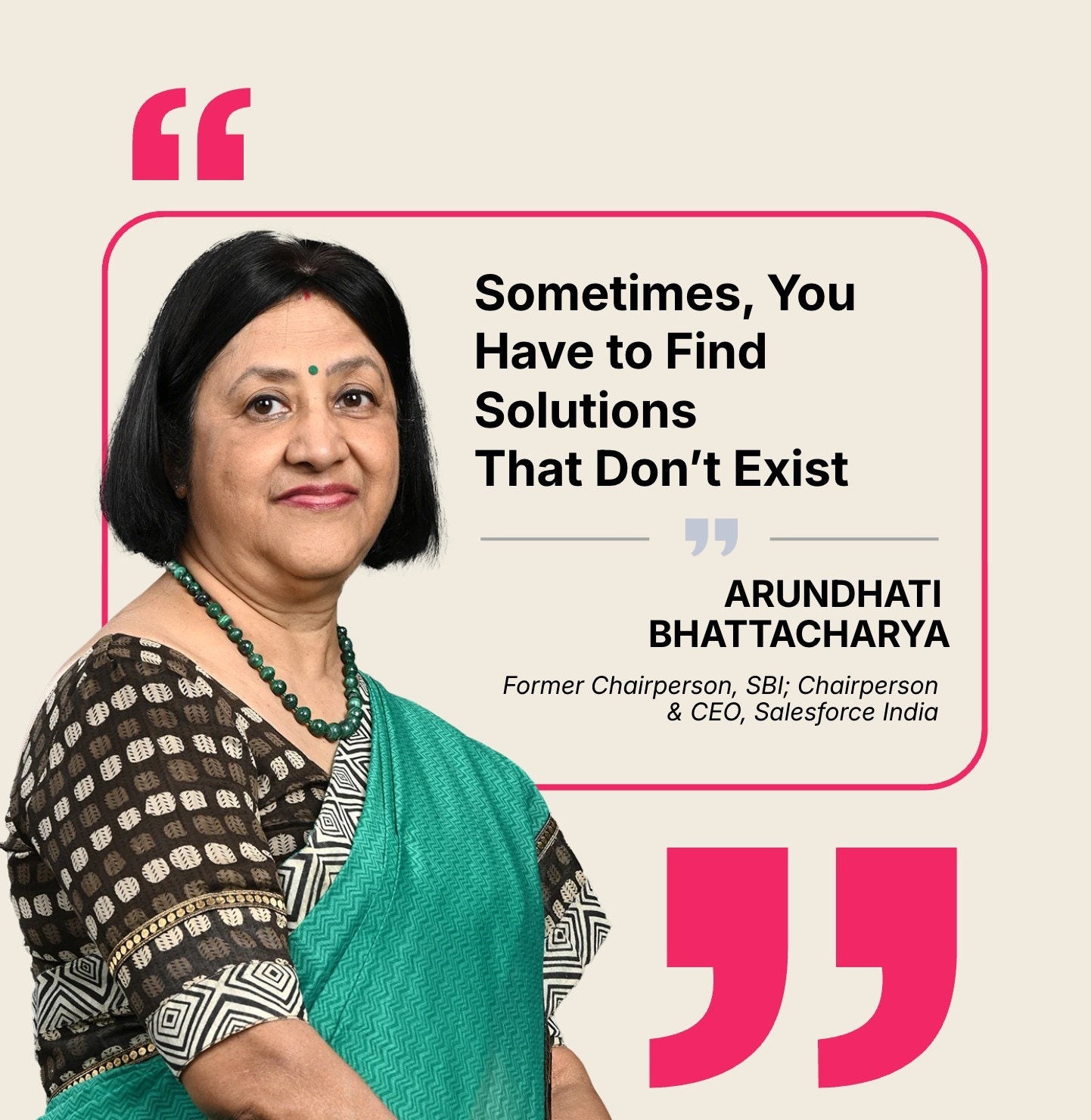
‘Sometimes, You Have to Find Solutions That Don’t Exist’
Bhattacharya joined Salesforce as Chairperson and CEO of Salesforce India in April 2020, a week after India’s Covid-19 lockdown began. She had expected the disruption to last a month or two. Instead, remote work became the norm, and she had to navigate a new organisation and a different way of working after four decades in corporate life—from the corner of her bedroom!
“Forty years of corporate life had not prepared me for doing my job from a corner of my bedroom,” she says.
At SBI, Bhattacharya saw this in Girls Forever, a group of serving and retired women employees who have pursued interests ranging from painting and poetry to publishing and board positions. One member became the second runner-up at Mrs India after retirement.
“When we were in our earlier jobs, we focused on mentoring. In this role, I have experienced reverse mentoring on a scale I would never have imagined,” she says. “I now firmly believe that reverse mentoring is necessary.”
Earlier in her career, security had been her primary objective. Today, she sees it more broadly, encompassing society, the environment and the planet.
Her views on career transitions are shaped by the difficult choices she faced as a working mother. When her aunt, who was helping care for her daughter, had to return to India from New York because of visa issues, Bhattacharya had to find an alternative care arrangement. Later, a posting to Lucknow raised another dilemma: how to manage her daughter’s schooling without separating the family.
Bhattacharya is equally clear that staying in a career is not the only valid choice. Women may decide to retire, pursue a passion or move on to something else. What matters is that the decision is genuinely theirs.
Today, she has more control over her mornings, time for exercise, leisurely lunches, and reading. Through difficult transitions, she has held on to one simple belief: “Humour is the lubricant of life.”
‘Not Less Ambition. More Choice’
For Ritu Anand, former Chief Leadership & Diversity Officer and Senior Vice President HR at TCS, stepping away from a full-time corporate career after more than three decades was both liberating and unsettling.
“The biggest adjustment was not having to be somewhere or be responsible for something every day. I actually had to learn to live without the pressure of being needed,” she says.
What surprised her was that she did not miss the title. Anand does not see leaving a full-time job as the end of professional contribution. “I discovered that experience doesn’t retire when a job does. I still have curiosity, opinions, energy and a desire to contribute. What has changed is that I am much more selective about where I put them.”
Retirement, for Anand, has therefore not meant stepping away from work. It has meant stepping away from having to work. And that is a very different thing. She now engages with different industries and contributes to people development in varied ways.
Anand believes India Inc. loses more than individual talent when experienced professionals leave full-time roles. “Someone who has spent several years working in business brings something very different into a classroom,” she says.
Women should prepare for the next phase before leaving their current roles is her belief.
“Do your current job better than you did yesterday. Create a unique space for yourself within the organisation. Make yourself visible. Build relationships outside your immediate workplace,” she says.
Her definition of success has evolved. Earlier, it was closely linked to achievement, responsibility and the scale of the role. Today, impact still matters, but so does agency: the freedom to decide where her energy goes and contribute without needing a designation to confer authority.
For Anand, a good day might mean solving a complex problem, meeting someone she has not seen in a while or making a new friend.
“Not less ambition. More choice.”
‘First real step in second chapter is unlearning’
Even after leaving a demanding corporate career, Raju Mistry found that she had not quite left its routines behind.
“The 9-to-9 rhythm is so deeply embedded that it took me a couple of months to realize I could begin and end my workday whenever I chose,” says Mistry, former President and Global Chief Human Resources Officer at Grasim, Jubilant and Cipla, who founded Aarunyam Behavioural Specialists LLP.
“Unlearning that was the first real step in my second chapter.”
A corporate career, she says, can become all-consuming, with power equations and egos diverting creative energy and taking a toll on health.
“Entrepreneurship offers the opposite: freedom, autonomy, and the chance to build something that is truly yours. Starting from the ground up demands patience, courage, and conviction, but that is exactly the thrill of it,” she says.
Aarunyam, a dream she had nurtured, became a reality at the beginning of this year. The venture has given her a new professional purpose, while the change in routine has created room for interests that were harder to accommodate during her corporate career.
Mistry’s reflections on reinvention extend to lessons she learnt while building her career. Early on, she resisted generalist roles because she believed she lacked the experience to move beyond her specialist background. Mentors and bosses encouraged her to broaden her exposure, eventually opening the way to senior HR leadership positions.
“Today we’d call that imposter syndrome,” she says.
Mistry believes the conversation around women’s access to board positions needs to move beyond comparisons between men and women. Expectations around gender, she says, begin in childhood and are reinforced through socialisation, shaping the choices and experiences people carry into their careers.
She also sees a shift in how women approach board opportunities. Rather than waiting to be considered, many are now in a position to choose the organisations they want to serve.
“What I find most striking is that women today have the luxury of choice. They are deciding which companies they want to serve, rather than waiting to be chosen,” she says. Digital communication platforms have further widened access to professional networks.
For Mistry, reinvention is about building a more fulfilling way of working and living.















 For many, this phase also offers the freedom to rediscover personal interests, spend more time with family and friends, and choose how they want to work and live.

 NSE MD Ashishkumar Chauhan is hopeful on the new Samvat, but has a word of caution for investors
 Too many mutual funds? Why three well-chosen schemes may work better than 10, explains expert
 How much can you withdraw from your retirement corpus every month without running out of money?
 Your air purifier's running cost could be ₹2,810 to ₹10,210 a year
 Cashback, reward points and gift cards: How to cut your gifting budget without compromising on value
 Gold Vs Silver In 2026 | Ajay Kedia Recommends 60:40 Allocation To Silver & Gold
 Silver May Rebound Faster Than Gold, Ajay Kedia Sees ₹3 Lakh By Next Diwali
 Large-Cap Stocks: Nilesh Shah Sees Attractive Valuations In These Two Bellwether Stocks
 Equity, Gold or Fixed Deposits: How Should Investors Allocate Money Now?
 Are SIP Investors Bailing Out FIIs? Nilesh Shah Explains India's Financialisation Trend

 Muhurat Trading 2026: Sensex, Nifty edge lower; key sectors to watch
 Muhurat Trading 2026: Sensex, Nifty open higher in special session; Tata Steel, Sun Pharma shares among top gainers
 Diwali picks BSE, Adani Power, MCX, TechM, HFCL among top stocks for Samvat 2083 for upto 110% rally
 Tata Steel, Hindalco, Power Grid shares upgraded to 'Buy'; brokerage raises target prices
 Visa-free for Indians does not mean stay as long as you like: Limits by country
 Scientists couldn’t solve these problems for years. Now an IIT Madras startup is offering $1 million to anyone who can