


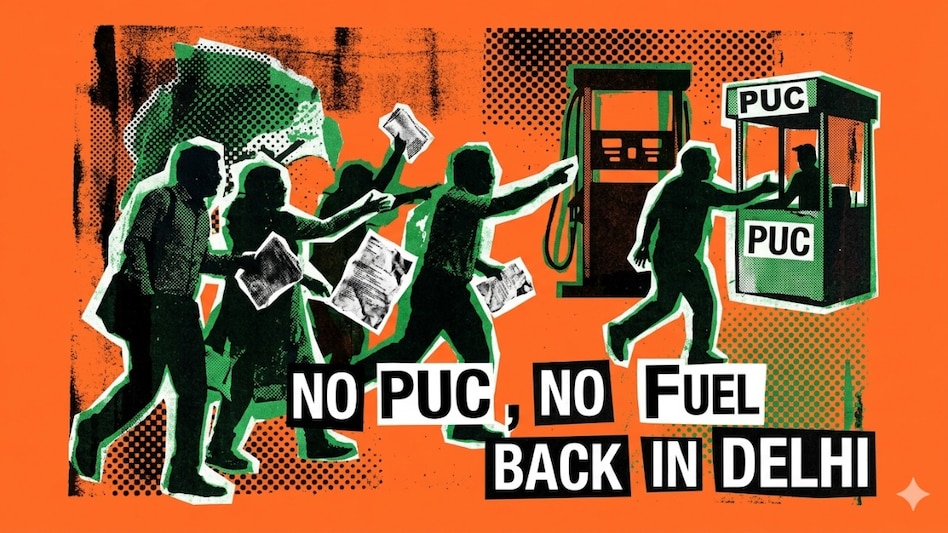
 The 'No PUC, No Fuel' rule makes a comeback in Delhi, what you need to know
If your vehicle does not have a valid Pollution Under Control (PUC) certificate, you can no longer fill up your car tank in Delhi. The 'No PUC, No Fuel' rule is back in the national capital, and petrol pumps across the city have been strictly directed to supply fuel only to vehicles with a valid PUC certificate.
Caught without a valid PUC certificate? You're staring at a penalty of up to ₹10,000 and even seizure of the vehicle. Due to this, several Delhi vehicle owners are scrambling to check whether their PUC is current.
Enforcement of the rule has been ramped up across the city, and officials are not in the mood to give warnings. This story simplifies what the rule means, who it applies to and how to avoid getting caught on the wrong side of it.
So before you head to your nearest petrol pump, here's exactly what you need to know.
Don't Miss | Petrol, diesel prices may rise Rs 25–28 per litre; here’s why
What does this mean?
Vehicles without a valid Pollution Under Control (PUC) certificate will not receive fuel (petrol, diesel, CNG, or LPG) at fuel stations across the national capital. The Delhi government has said that accountability has been clearly fixed across all concerned agencies to ensure zero tolerance.
Check out the latest diesel prices
Why has this rule been announced?
The Delhi government, led by Rekha Gupta, has taken this decision to control vehicular pollution in the national capital effectively. Gupta said that tackling air pollution requires firm and effective interventions, and this decision is a significant step in that direction.
She further said that although the initiative was launched last December, vehicles without a valid PUC certificate continue to ply on Delhi roads.
Check out the latest petrol prices
What kind of vehicles are likely to be impacted?
The order will likely impact end-of-life vehicles, as PUC certificates can't be issued to petrol vehicles older than 15 years and diesel vehicles older than 10 years in Delhi.
As per Rule 115 (sub-rule 7) of the Central Motor Rules, 1989, it is mandatory for vehicles to carry a valid PUC certificate after one year of registration and produce it when asked by authorities.
DON'T MISS | BT Explainer: Why Centre wants auto industry to introduce flex fuel vehicles that use E85
What are the consequences for driving without a valid PUC?
The framework also provides for stringent action against violators, including seizure and the imposition of maximum penalties.
According to Section 190(2) of the Motor Vehicles (Amendment) Act, 2019, a fine of ₹10,000 will be imposed for the first offence and up to six months in jail, or both fine and imprisonment.
In case of repeat violations, your driving licence will be suspended for 3 months.
Who has been tasked with the implementation of this rule?
The food and supplies department, transport department, Municipal Corporation of Delhi, and Delhi Traffic Police have been tasked with enforcing the rule.
"Authorities have been warned that any lapse or negligence will invite strict action. Accountability has been clearly fixed across all concerned agencies to ensure zero tolerance in implementation," the chief minister added.
When was the rule first rolled out?
The 'no fuel without PUC' rule was first implemented on October 25, 2025. The enforcement, however, was limited to select areas due to logistical hurdles such as the absence of seamless verification mechanisms at petrol pumps and the risk of congestion.

 Crude oil, electronics and gems and jewellery top three imports adding to trade deficit
 What's driving the rapid growth and interest in India's gold loan market
 How REITs are becoming a rewarding investment proposition
 Banks set for Q1 credit boost, but margin pressure may spoil the party
 BrahMos turns 25: The secret story behind India's most powerful cruise missile
 Indian I.T. Stocks Face AI Disruption: Why Growth, Margins And PE Multiples May Fall
 The AI Cost Illusion Explained | Instagram New Updates & GoPro Mission 1 Pro First Look | Tech Today
 IT Stocks Rally After TCS Q1 Results: Nifty IT Surges, ICICI Direct Shares Outlook
 India’s Astra Mk2 Missile Production May Open To Private Firms | Defence Policy Shift Explained
 AI Sector Boom: Pankaj Pandey Reveals The Best Sectors To Invest In India's Data Centre Growth
 HCLTech Q1 FY27: Profit rises 20% YoY to Rs 4,624 crore; announces Rs 12/share interim dividend
 Vedanta, demerged stocks: What should investors do? Centrum's Nilesh Jain shares his view
 Reliance Power, BLS International, Bajaj Healthcare: Analyst decodes trading strategy
  Sensex, Nifty end marginally higher after volatile session; what should investors watch now?
 Rs 1,616 to Rs 18,141 in five years: Now, this defence stock set to nearly halve, says Kotak









