












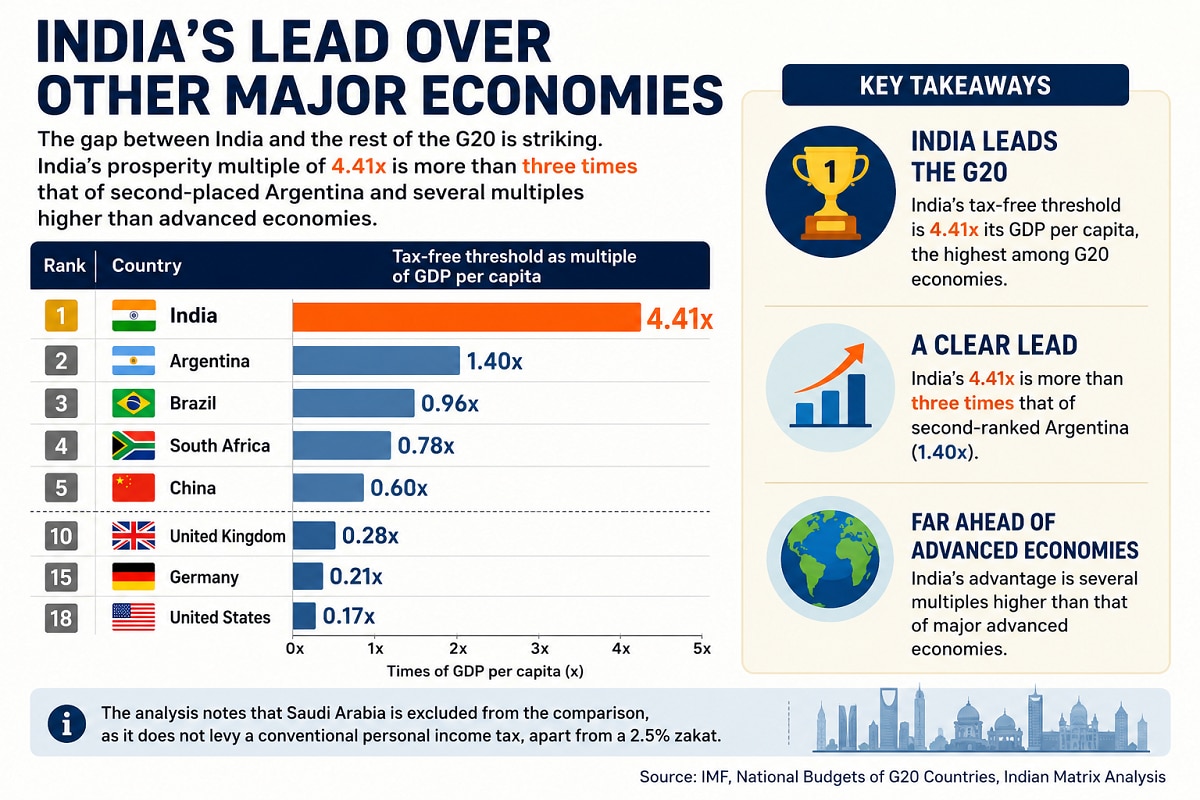



 India's revamped personal income tax structure is creating a larger financial cushion for first-time earners. The tax-free income threshold is equivalent to 4.41 times the country's GDP per capita
For young Indians entering the workforce, the country's income tax regime is offering an advantage unmatched by any other G20 economy. According to an analysis based on IMF data and the national budgets of G20 countries, India now has the world's highest tax-free income threshold relative to its average income, giving Gen Z more room to earn before paying income tax.
The numbers highlight how India's revamped personal income tax structure is creating a larger financial cushion for first-time earners. The tax-free income threshold is equivalent to 4.41 times the country's GDP per capita, far ahead of every other G20 nation.

 Jio IPO: Meta, Google, ADIA, 7 others eye Rs 3.2 lakh crore stake value, gains on investment
 SIR row: Supreme Court issues notice to EC; seeks response from Gyanesh Kumar, 2 other ECs
 BT Explainer: What is BS-VII, what changes does the draft propose, and how could it impact vehicle manufacturers and buyers?
 'Trump likely to take decision in 10 days or so': Sergio Gor on 100% tariff against India for Russian oil purchases
 A 100-bps rate rise could weigh on global growth: What does it mean for Indian exports? Here's what Goldman Sachs says
 Cockroach Janta Party Leaders Sent to Tihar Jail Over Jantar Mantar Protest
 India-US Trade Deal Almost Done? Sergio Gor Says Big Issues Settled, Talks Near Finish
 JNU Sexual Harassment Row: Bimol Akoijam Denies Charges, BJP Steps Up Pressure
 Punjab Drug Menace: Anti-Drug Activist Parvinder Singh Jhota Murdered, Accused Arrested
 Akash Ambani Reveals Jio's 5 Big Growth Plans | 5G By 2030, AI For All & Global Expansion
 Nifty’s festive comeback: Can the bulls keep the party going?
 Tata Communications shares jump after Q2 earnings; key things to know
 ICICI Lombard shares: Outperform rating maintained after Q2 results; check stock reaction
 YES Bank shares plunge 9%; mcap slips to Rs 60k crore; here's why
  Polycab India Q2 earnings: Net profit rises 43%, EBITDA at Rs 1,422 crore Nifty’s festive comeback: Can the bulls keep the party going?Cockroach Janta Party Leaders Sent to Tihar Jail Over Jantar Mantar ProtestTata Communications shares jump after Q2 earnings; key things to knowIndia-US Trade Deal Almost Done? Sergio Gor Says Big Issues Settled, Talks Near FinishICICI Lombard shares: Outperform rating maintained after Q2 results; check stock reaction


