












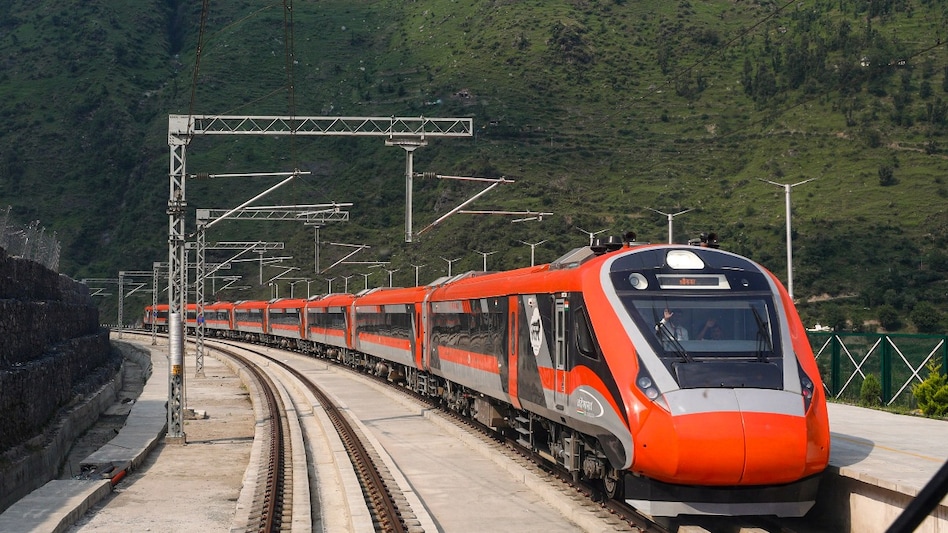
 Cabinet approves first semi high-speed double-line project in Gujarat
 Cabinet approves first semi high-speed double-line project in Gujarat
The Cabinet Committee on Economic Affairs, chaired by Prime Minister Narendra Modi, on Wednesday approved a Rs 20,667 crore semi-high-speed double-line railway project connecting Ahmedabad and Dholera in Gujarat.
The Ahmedabad (Sarkhej)-Dholera project will become Indian Railways' first semi-high-speed rail corridor developed with indigenous technology, according to the Cabinet statement.
Semi-high-speed rail for Ahmedabad-Dholera
The railway line will connect Ahmedabad, the Dholera Special Investment Region (SIR), the upcoming Dholera airport and the Lothal National Maritime Heritage Complex.
The Centre said the project would significantly reduce travel time between Ahmedabad and Dholera, enabling daily commuting and same-day return travel.
"This semi-high-speed railway would not only bring two cities closer but also bring the people living hundreds of kilometers away, closer to each other," the government said.
The project is being positioned as a model for future semi-high-speed rail expansion across India.
"As India's first semi high-speed rail project, the project will serve as a pioneer project acting as a reference model for the phased expansion of semi high-speed rail across the country," the Cabinet said.
'Will improve connectivity for 284 villages'
The proposed railway line will span around 134 km and increase the existing Indian Railways network in Gujarat. The project will improve connectivity for around 284 villages with a combined population of nearly five lakh people.
The government said the corridor was planned under the PM Gati Shakti National Master Plan with a focus on multimodal connectivity and logistics efficiency. The Centre also linked the project to Modi's "New India" vision and said it would create employment and self-employment opportunities in the region.
The rail corridor is expected to improve mobility, service reliability and direct connectivity while supporting lower logistics costs.
The government added that the project would help reduce oil imports by an estimated 0.48 crore litres and cut carbon emissions by around 2 crore kilograms, which it said was equivalent to planting 10 lakh trees.
Last month, the Railway Board approved the manufacturing of two new trainsets with a design speed of 220 kmph, marking a major step in India's semi-high-speed rail push.
 Bharti Airtel Q4 earnings: Net profit slips 26%, board declares final dividend
  Record jet fuel prices bite: Air India suspends Chicago, Shanghai flights; reduces overseas frequencies till August
 'Best investors can...' - Robert Kiyosaki has a Rich Dad lesson, and crash warning!
 Bombay HC allows withdrawal of plea challenging Sir Ratan Tata Trust structure
 Why Maruti Suzuki is suddenly sending more cars on trains than ever before
 Daily Calls LIVE: Ask Your STOCK MARKET TODAY QUERIES | Market Update LIVE | Share Market News Today
 Dr Reddy’s Turns To Obesity Drugs, Biosimilars And Consumer Health For Next Phase Of Growth
 West Asia Crisis A ‘Live Stress Test’ For India’s Balance Of Payments: CEA V Anantha Nageswaran
 Sagility CFO Srinivas Mattapalli On 41% Profit Jump & AI-Led Growth Story
 Syrma SGS Technology Q4 Results | Profit jumps 55%, Dividend declared | Management On Q4 Performance
 Tata Power, Adani Power shares: Buy now or wait? | Daily Calls on BTTV
 Sun Pharma, Biocon, others: Expert shares view on pharma pack | Daily Calls on BTTVBharti Airtel Q4 earnings: Net profit slips 26%, board declares final dividend
  Gold, silver ETFs: What should you do after Wednesday's rise? | Daily Calls on BTTV'Best investors can...' - Robert Kiyosaki has a Rich Dad lesson, and crash warning!