












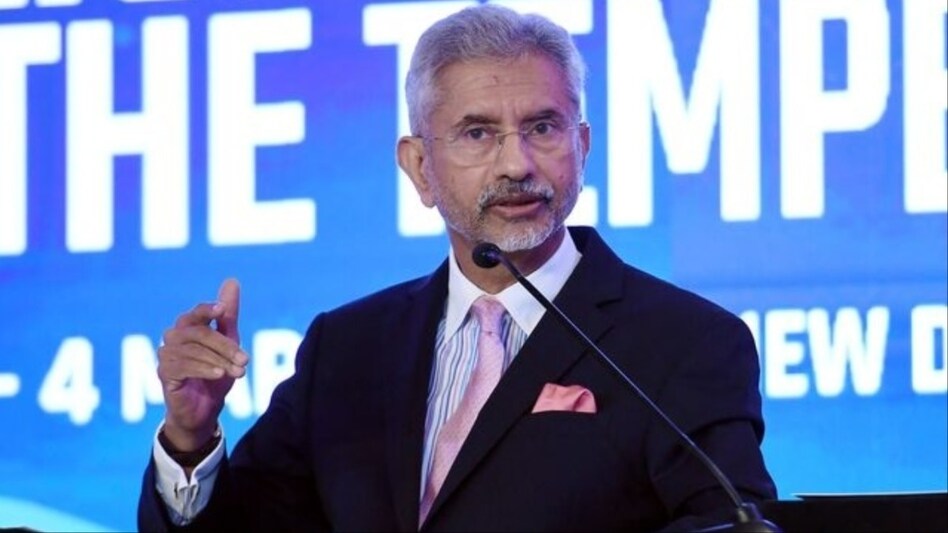
 Jaishankar is unlikely to spend more than 24 hours in Pakistan before flying back to India.
 Jaishankar is unlikely to spend more than 24 hours in Pakistan before flying back to India.
External Affairs Minister S Jaishankar is expected to land in Pakistan on Tuesday evening for the upcoming Shanghai Cooperation Organisation (SCO) meet from October 15-16. He along with Chinese Premier Li Qiang and Russian Prime Minister Mikhail Mishustin are likely to be among those joining the welcome dinner hosted by Pakistan Prime Minister Shehbaz Sharif, The Times of India reported.
Jaishankar is unlikely to spend more than 24 hours in Pakistan before flying back to India. Ahead of Jaishankar's visit, the Punjab government in Pakistan has imposed Section 144 across Rawalpindi till October 17 to ensure law and order during the SCO summit, Geo TV reported.
Other security measures have also been put in place including tightening of security in the Adiala Jail, where former Pakistan PM Imran Khan has been locked up. His supporters, family members or lawyers aren't allowed to meet him.
Shehbaz Sharif's government has also deployed troops from the Pakistan Army in Islamabad from October 15-17 to maintain law and order during the SCO summit. All marriage halls, restaurants and cafes will remain closed in Rawalpindi and Islamabad for 5 days, Geo TV further said.
Police has also issued notices to traders and hotel owners, warning that violations of these restrictions would result in penalties. A day after Jaishankar's visit to Pakistan was confirmed, the fiery minister said that he was not going to discuss India's ties with Pakistan but to be a "good member" of the SCO.
"I am scheduled to go to Pakistan in the middle of this month, and that is for a meeting of the SCO Heads of Government... I'm not going there to discuss India-Pakistan relations. I'm going there to be a good member of the SCO but you know, since I'm a courteous and civil person, I will behave myself," the Minister said.
The Shanghai Cooperation Organization (SCO), founded in 2001, focuses on fostering political, economic, and security collaboration across the region.
Apart from India, its member states include Pakistan, China, Russia, Iran, Kazakhstan, Kyrgyzstan, Tajikistan, Uzbekistan, and Belarus, along with 16 other nations associated as observers or dialogue partners.
 West Bengal Election Results 2026: How BJP, TMC, Congress performed in the last election
 RR sold for ₹15,660 crore: After $18 billion valuation, IPL continues to mint money
 Rajasthan Royals sold: Lakshmi Mittal family teams up with Adar Poonawalla to buy RR in ₹15,660 crore deal
 Who is Vinod Kannan, a frontrunner in the race for Air India CEO position?
 What is Polymarket, and why is it trending more than Phalodi Satta Bazaar ahead of Assembly election results?
 Think Electrolyte Drinks Are Healthy? Watch This Before Your Next Sip
 Upgrade To Downgrade: Why World Bank Sees India At 6.6% | Aurélien Kruse Explains
 Hormuz Crisis Explained | Oil Hits $126, UAE OPEC Tensions Rise, Global Economy On Edge
 Inflation Outlook: Why India Starts Strong Despite Oil Shock | World Bank
 Stalin Vs Vijay: Today’s Chanakya Gives Edge To DMK But Axis My India Predicts TVK Revolution
 Mazagon Dock shares up 32% in April; should you buy?
 Sector rotation in May 2026: Banking vs IT vs Energy; what may work now?
  Suzlon, GRSE, Ola, BHEL among 20 stocks with 40-70% rally in April; do you own?
 Multifold jump in Q4 profit: How 10 stocks fared - Should you buy?
 Nuvama keeps 'Buy' on this chemical stock; company announces Rs 30 dividend — Check record date