








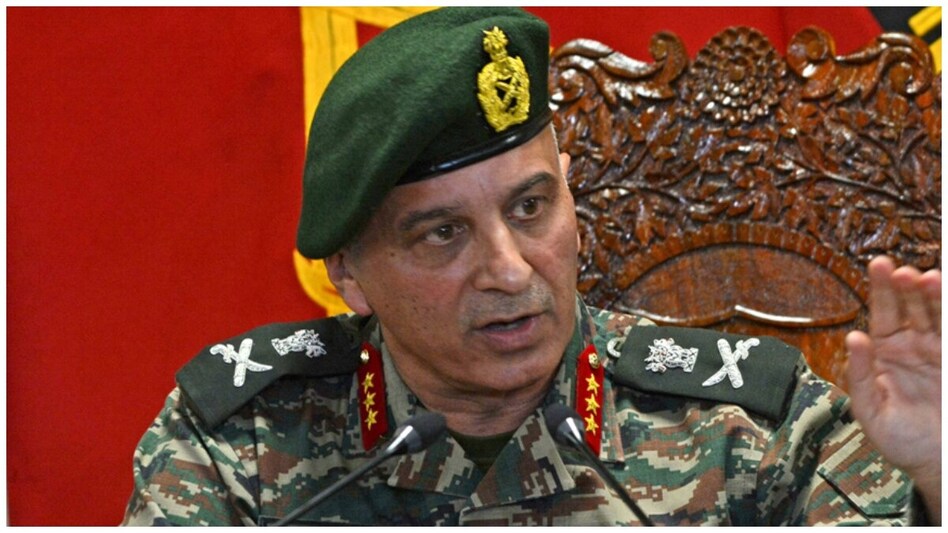
 Director General of Military Operations Lt Gen Rajiv Ghai
 Director General of Military Operations Lt Gen Rajiv Ghai
Director General of Military Operations (DGMO) Lt Gen Rajiv Ghai on Tuesday said that the Indian Army had fully anticipated Pakistan's response during Operation Sindoor, and the strikes were planned several steps ahead to neutralise any retaliatory attempt. He rejected suggestions that India was unprepared for escalation.
"Often I've seen some people suggest that we were after terror targets and therefore we were not prepared for the eventualities that would follow. I think that's very naive, and it's almost churlish to suggest that a professional army such as the Indian army would go into this kind of action not preparing for the contingencies. We had war-gamed four to five steps ahead, and we knew that the Pakistanis were going to do this," he said during a briefing on Operation Sindoor.
He said that once Indian forces anticipated Pakistan's next move, the Army launched precision attacks deeper along the Line of Control (LoC). "So we went and hit them on the second layer, which is not something that they expected on the line of control, and that's why they had the number of casualties that they did," he added.
Ghai detailed that a range of Pakistani drone attacks had been attempted to cause casualties and damage to Indian assets, but all failed. "A variety and class of drones was utilized (by Pakistan) in an attempt to cause casualties and damage to men and material but everything was a dismal failure," he said.
Following these failed attempts, the senior military officer said the Indian Air Force was brought into action for targeted strikes on May 9 and 10. "This then led us to swing the Indian Air Force into action and in precision strikes that they carried out on the night of the 9th and 10th of May."
"We hit 11 of their air bases. Eight air bases, three hangars and four radars were damaged. Pakistani air assets were destroyed on the ground. We know for sure that one C130 class of aircraft and one AEW, four to five fighter jets, and there were assets that were also destroyed in the air," he said.
The DGMO credited the Indian Navy’s readiness during the conflict, noting that it had already moved into the Arabian Sea and was positioned for further escalation if needed. "The Indian Navy was also very much in action. And this is possibly a fact that is not so well known, but the navy had sailed into the Arabian Sea. And when the DGMO spoke they were very well poised. Had the enemy decided to take it any further, it could have been catastrophic for them, not only from the sea but from other dimensions as well," he said.
Ghai said that more than 100 terrorists were neutralised in the opening phase of Operation Sindoor on May 7. "In the strikes that we carried out in the early hours of 7th of May, more than 100 terrorists were neutralisd," he said. "The Pakistanis possibly unwittingly let out their awards list on the 14th of August and the number of posthumous awards that they awarded suggests to us now that their casualties on the line of control were also in excess of 100."
He added that the operation's intent was not to escalate the conflict but to respond decisively to terrorism. "We went after terrorists and once that had been achieved, it wasn't our intention to escalate it unless compelled to do so," Ghai noted.
Operation Sindoor, launched on May 7, targeted Pakistan-based terror infrastructure in response to the Pahalgam terror attack. India reached a ceasefire agreement on May 10.
 'Iran hasn't received anything in return': Jaishankar as two Indian-flagged gas carriers cross Hormuz, calls it a result of diplomatic dialogue
 Nomura, Citi trim Dec 2026 Nifty targets; when should you buy?
 Indians in Musk’s AI orbit: Aman Gottumukkala joins xAI as Elon Musk taps more Indian-origin talent
 Withdraw FDTL relaxations given to Air India due to Iran war: Pilots’ body to DGCA
 US Israel Iran war: Dubai int'l airport gradually resumes flight ops, Emirates likely to resume limited flights
 Market Correction Strategy: How To Build A Buy List During A Market Fall | Arun Kejriwal
 Laura Loomer Apologises For Anti-India Posts, Says ‘I Don’t Hate India Or Hindus’
 PM Modi’s Bengal Push Turns Political As Kolkata Clashes Erupt Ahead Of Brigade Rally
 West Asia War Spills Wider: Fujairah Port Hit As Iran Warning Pushes Gulf Tensions Higher
 Kharg Island Hit: U.S. Strikes Iran’s Oil Lifeline As Hormuz Tensions Push West Asia To Brink
 Nomura, Citi trim Dec 2026 Nifty targets; when should you buy?
 Bandhan Bank shares tumble over 12% today; here's why
 Infosys shares: JM Financial maintains 'buy' as IT major maintains healthy demand outlook
 MRPL, Chennai Petroleum shares jump up to 12%; here is why
 Tejas Networks shares gain up to 8% today; here's why