


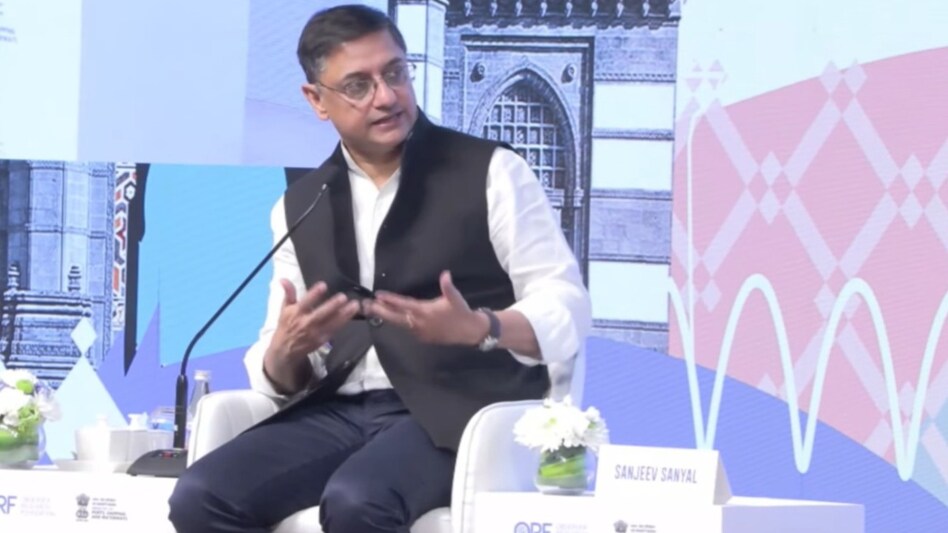
 Sanjeev Sanyal, economist and member of the Prime Minister's Economic Advisory Council
Sanjeev Sanyal, economist and member of the Prime Minister's Economic Advisory Council, has raised concerns over India's insufficient investment in research and development (R&D), especially within the private sector.
In a conversation with Samir Saran of ORF, he highlighted that India is at a crucial demographic peak, a phase that will only last for 25 to 30 more years. "We have just about entered our demographic peak period. However, be very, very clear that this is not going to last forever," the economist said, stressing the urgency of capitalising on this window to accelerate India's growth.

 'Every great airline is built over decades': Tata Sons Chairman says Air India's turnaround is a 5-10 yr mission
  Tata Motors flags ‘severe disruption’ at Sanand plant in Gujarat due to floods
 HDFC Bank penalises top officials, including CEO and CFO, in MSRDC case. Here’s why
 Only 26 of every 100 young Indian graduates have salaried jobs; just 4 enjoy basic employment benefits: Report
 Where are the jobs: Youth unemployment remains high; fewer jobs for those with higher education in India
 DCB Bank Management | Q1 Earnings, Loan Growth, Margins & Asset Quality Explained
 Infosys Fined In France: 70-Hour Work-week Debate Returns After €175,000 Labour Penalty
 I.T. Sector Outlook: Is the Worst Over for Indian I.T. Stocks After Long Underperformance?
 France And Spain Wildfires Threaten Cap Ferret Mansions And Bordeaux Wine Country
 Maruti Suzuki Eyes 25-30% SUV Growth, Says CNG Demand Has Overtaken Diesel
 Tata Power Q1 profit rises 11% to Rs 1,176 crore; revenue up 6%, capex tops Rs 5,300 crore
 HDFC Bank concludes internal review into MSRDC deposit arrangements; CEO, CFO among 3 fined Rs 1 lakh
 How Narayana Murthy's era, Vishal Sikka's stint and Salil Parekh's tenure differed; big task awaits next Infosys CEO
 BEL Q1 results: Net profit rises 9%, revenue at Rs 5,533 crore
  Sensex, Nifty snap five-session losing run; investors add Rs 5.1 lakh crore in wealth
 From Aadhaar to UPI: Why Nandan Nilekani remains India's go-to architect for nation-scale reforms
 How 'Thekua' turned a former Bihar teacher into the founder of a ₹ 15 crore brand
 'Create jobs, do not replace them': Satya Nadella calls for community-first AI growth
 Top 10 highest-earning film directors and the movies that made them billion-dollar legends, Check full list here
  Grab a ready-to-occupy home in Delhi: DDA rolls out Karmjivi scheme with 25% price cut










