















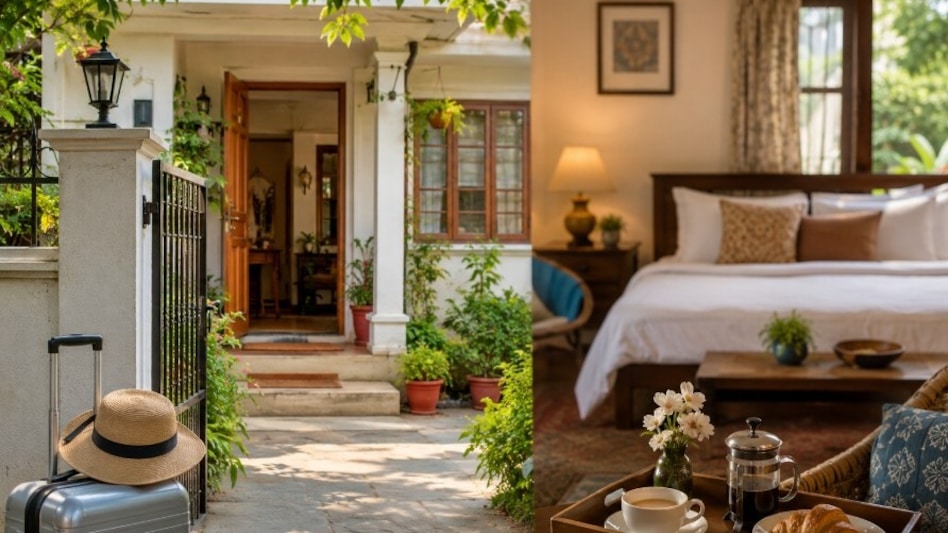
 According to the draft policy, encouraging B&B establishments can promote inclusive tourism, support local communities, and create additional household income streams.
The Delhi government has unveiled the draft Bed and Breakfast (B&B) Policy 2026, a move that could allow homeowners to legally earn income by hosting tourists in their homes. The proposed framework aims to create a regulated homestay ecosystem while expanding affordable accommodation options for visitors and generating additional income opportunities for residents.
The Department of Tourism has placed the draft policy in the public domain and invited comments and suggestions for 30 days before finalising the framework. If implemented, the policy could revive Delhi's homestay sector and provide homeowners with a new avenue for monetising spare rooms.
FAQs
What is Delhi's draft Bed and Breakfast Policy 2026?
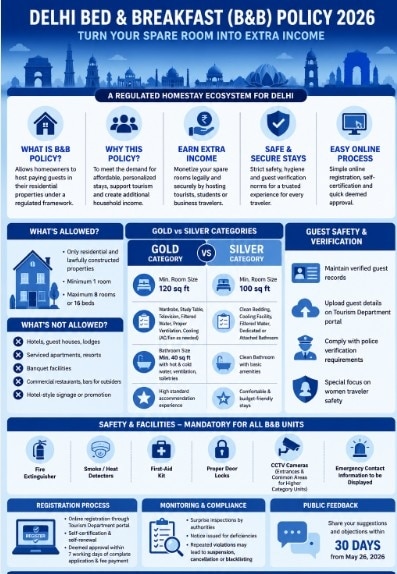
Delhi's draft Bed and Breakfast Policy 2026 is a proposed framework that will allow homeowners to legally register residential properties as B&B units and host paying guests. It aims to create a regulated homestay ecosystem, expand affordable stay options, and help residents earn extra income.
How can homeowners earn money under the new Delhi B&B policy?
Homeowners can register eligible residential properties and rent out spare rooms to tourists, business travellers, students, and other visitors. The policy allows at least one guest room and up to eight rooms with a maximum of 16 beds, which can create a steady additional income stream.
Which properties are eligible and which are not allowed under the policy?
Only lawfully constructed residential properties can be registered as B&B units. Hotels, guest houses, lodges, serviced apartments, resorts, banquet facilities, and other commercial hospitality establishments are not eligible under the proposed policy.
What are the Gold and Silver categories in Delhi's B&B Policy 2026?
The policy proposes Gold and Silver classifications based on room size and amenities. Gold category units must meet higher standards such as bigger rooms, wardrobes, study tables, televisions, filtered drinking water, and better-equipped bathrooms, while Silver category units require slightly smaller rooms with basic clean and comfortable facilities.
What safety and registration rules will Delhi B&B operators have to follow?
Operators will need to maintain guest records, verify identity documents, upload guest details on the tourism portal, and follow police verification norms. Safety measures like fire extinguishers, smoke or heat detectors, first-aid kits, emergency contact details, and proper door locks will be mandatory, while registration is expected to happen online through a self-certification process.

 90% EVs exported out of India are from Maruti Suzuki: MD & CEO Hisashi Takeuchi
 India's $30 trillion goal needs 8-10% growth, $400 billion more annual investment: Jayant Sinha
 1.1 billion barrels gone: IMF warns that global oil market is running out of safety cushions
 From Devbhoomi to industrial destination: Uttarakhand’s manufacturing moment
 India’s deep-tech startups face a new test: Crossing the valley of death
 #IndiaAt100 : Adipen Bose Nandhiji On Conscious Capitalism- Can Profit & Purpose Coexist?
 #IndiaAt100 : Hisashi Takeuchi On Driving India’s Manufacturing Revolution
 #IndiaAt100 : Manufacturing For Viksit Bharat | Can Industry Power India’s $30-Trillion Dream?
 #IndiaAt100 : Tarun Garg On Hyundai & India’s Manufacturing Powerhouse Ambition
 #IndiaAt100 : CM Pushkar Singh Dhami On Uttarakhand’s Industrial Growth & India’s Next Leap
 Cupid, NTPC Green, NTPC, Raymond Realty, HAL shares: Key technical levels to watch
 Defence stock with Rs 2,654-crore order book hits record high; here's why
  GACM Technologies: FII holding jumps to 29%; penny stock in focus
 Puravankara shares rise 5% on fresh order win
  20 high-conviction ideas for up to 95% upside | stocks to buy
  NHAI’s ₹350 monthly toll pass now available: who can apply? Check eligibility and benefits
 90 million litres of glacier water every day: How Ladakh is reviving 1,000 acres of farmland#IndiaAt100 : Adipen Bose Nandhiji On Conscious Capitalism- Can Profit & Purpose Coexist?#IndiaAt100 : Hisashi Takeuchi On Driving India’s Manufacturing Revolution#IndiaAt100 : Manufacturing For Viksit Bharat | Can Industry Power India’s $30-Trillion Dream?


