


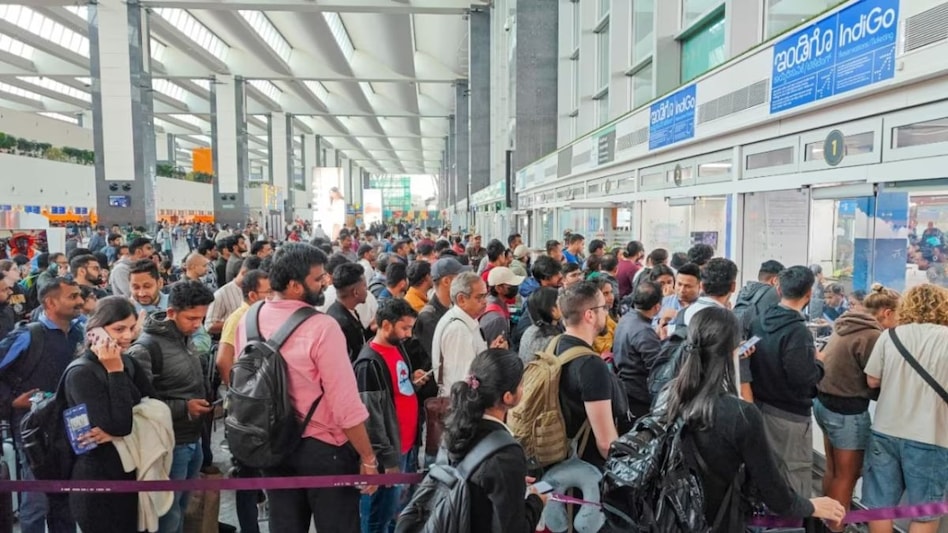
 IndiGo’s days-long flight cancellations caused major disruption across key airports, but CEO Peter Elbers said yesterday the airline is “back on its feet” with operations now stabilised.
IndiGo has suffered a sharp operational setback that is expected to weigh heavily on its financial performance for the current fiscal, credit rating agency ICRA said in a note on Wednesday. The carrier has recorded more than 11,000 cancellations in recent days, with an acute peak on December 5 when roughly 1,600 flights, about 70% of the day’s schedule, were cancelled during a network reboot prompted by revised Flight Duty Time Limitation (FDTL) norms.
ICRA’s outlook highlights two immediate effects: a material hit to near‑term profitability and pressure on earnings for the current financial year. The agency cautioned that lost revenue from cancellations, costs of passenger compensation and re‑accommodation, higher operational expenses to stabilise schedules, and potential regulatory penalties will constrain margins in the months ahead. “IndiGo’s near‑term financial performance expected to be significantly impacted,” the note states, underlining the severity of the disruption.

 'AI ending humanity is nonsense': Ex-Infosys CEO Vishal Sikka rejects growing doom warnings
 'Majority among two is two': Tata Trusts says Chandrasekaran reappointment failed AoA condition, has no legal effect
 ICAI plans further reforms to scale up homegrown accounting firms
 'Modi admin has done a phenomenal job': Blackstone's Jon Gray on what changed in India
 'SC/ST Act is being weaponised': Tech CEO backs IIT Bombay Professor, calls for case withdrawal
 Gold Price Target 2026: Expert Sees MCX Gold At ₹1.8 Lakh By Year-End Amid Strong Demand
 Health Insurance: Why Pre-Existing Diseases And Waiting Periods Matter For Buyers
 Crude Oil Above $100: How High Energy Prices And Rupee Weakness Impact Gold Prices In India
 CEA On India’s Manufacturing Rise, Atmanirbhar Bharat And Modi’s Economic Policy
 Health Insurance Buying Guide: 7 Things First-Time Buyers Must Check Before Choosing A Policy
 SpaceX weight in Nasdaq 100 to jump to 2.82% following quarterly index rebalance: Report
 Tata Motors or Ashok Leyland? Analyst reveals his preferred auto stock for near-term gains
 Maharashtra Scooters, Dixon Tech, Bharat Dynamics, Jai Corp among stocks to turn ex-dividend on Monday
 Jindal Supreme, SS Retail, Hero Motors IPOs subscribed up to 181 times on final day; details here
 Sensex, Nifty post sixth weekly loss; TCS, Titan among top laggards, slip up to 4%
 From terrace Wi-Fi to IIT Delhi: How this Mumbai student secured AIR 2,456 in JEE Advanced
 Hormuz crisis exposed the world's energy weak spots: Why the next shock could hurt more
 ‘Just have to know what floats your boat': Former Uber CMO on quitting Rs 1 crore job for farm life
 Could AI really kill us all? Here’s what MIT researchers fear and what they don’t
 Major milestone: Rajasthan's 700 MWe nuclear reactor begins initial fuel loading, enters key commissioning stage












