









By Abhishek Gupta (Economist)
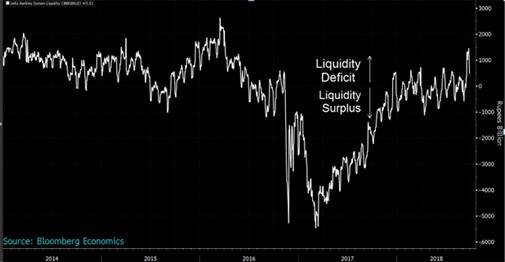
The Reserve Bank of India has signaled it's unlikely to give much clarity on bond purchases that could replace a short-term liquidity deficit with durable liquidity. The deficit is one reason why there's so much upward pressure on bond yields. In our view, the RBI's refusal to acknowledge the durable liquidity shortfall in the economy, along with another measure aimed at reducing banks' regulatory demand for government bonds, is likely to push sovereign bond yields higher.
The RBI said in a statement on Thursday that banking system liquidity is in ample surplus. What the central bank is calling an ample surplus is, in fact, a temporary infusion of liquidity -- which itself is a measure of the liquidity deficit in the banking system.
Bloomberg Economics' daily index of banking system liquidity shows a deficit of 734 billion rupees. This reflects the banking system's net borrowing from the RBI, with a short- term maturity of less than a month.
India's Banking System Liquidity in Durable Deficit
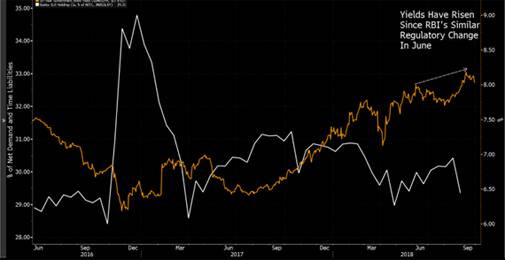
In another measure to address the liquidity shortage announced on Thursday, the RBI lowered its regulatory requirement for banks' holdings of sovereign bonds by roughly 2% of aggregate deposits, or 2.4 trillion rupees. To understand this regulatory change, we need to go through the technical details of the regulatory landscape of banks' demand for government bonds. Indian banks demand government bonds to meet two kinds of regulatory requirements:
The RBI undertook a similar relaxation from 11% to 13% in June, which as we had argued has pushed bond yields higher. In theory, this liquidity requirement relaxation should be seen as a positive for banks as it will help certain banks meet their liquidity coverage ratio, while others can sell excess government bonds in exchange for much-needed rupee liquidity. In practice though, this is unlikely to be the case. The reason:
There is a simple solution that can ease the strain in the government bond market and at the same time meet the durable liquidity needs of the economy. The central bank could announce a calendar of open market purchases of government bonds. This would give certainty to market participants on an infusion of durable liquidity going ahead. It would also likely ignite positive sentiment in the bond market as over time, it would ease banks' excess holding of government bonds. But the central bank's refusal to even accept liquidity deficit conditions makes this a tall order.
Abhishek Gupta covers India for Bloomberg Economics in Mumbai. He previously worked as an economist at DSP Merrill Lynch and as a research analyst at the National Institute of Public Finance and Policy, India's premier macro/finance think tank.
 US-Israel-Iran war LIVE Updates: US issues 30-day sanctions waiver on Russian oil, PM Modi assures Indians on LPG supply
 Iran won’t close Strait of Hormuz but ships must coordinate with the navy to pass
 US issues 30-day license for nations to buy Russian oil, easing global supply concerns; Oil prices dip
 Stock market: Sensex plunges 698 pts, Nifty cracks below 23,450; L&T, IndiGo lead losers
 Iran war: Helium prices rise sharply due to disruptions from Qatar; why it matters to India
 Rahul Gandhi Vs Hardeep Puri In Lok Sabha Over India’s Oil Security
 Induction Cooktop Sales Jump 300% In Delhi-NCR Amid LPG Supply Concerns
 Market Fall Deepens | Oil Hovers Near $100, Nifty Slips - Sanjay Sinha Explains What Next
 Market Crash Amid Oil Surge? Devang Shah Decodes | Live Market Commentary
 #Podcast | #Episode09 | From Bollywood Icon To Entrepreneur: Malaika Arora On Food, Fashion & Fitness
 IFCI shares jump nearly 11% in early trade; here is why
 Ola Electric, Ather Energy, TVS Motor: What Antique says on FY26 retail trend
 NTPC Green, KPI Green Energy shares extend gains; check target prices & key support levelsStock market: Sensex plunges 698 pts, Nifty cracks below 23,450; L&T, IndiGo lead losers
 Kavach 4.0 trials: Quadrant Future shares in focus today; here's why