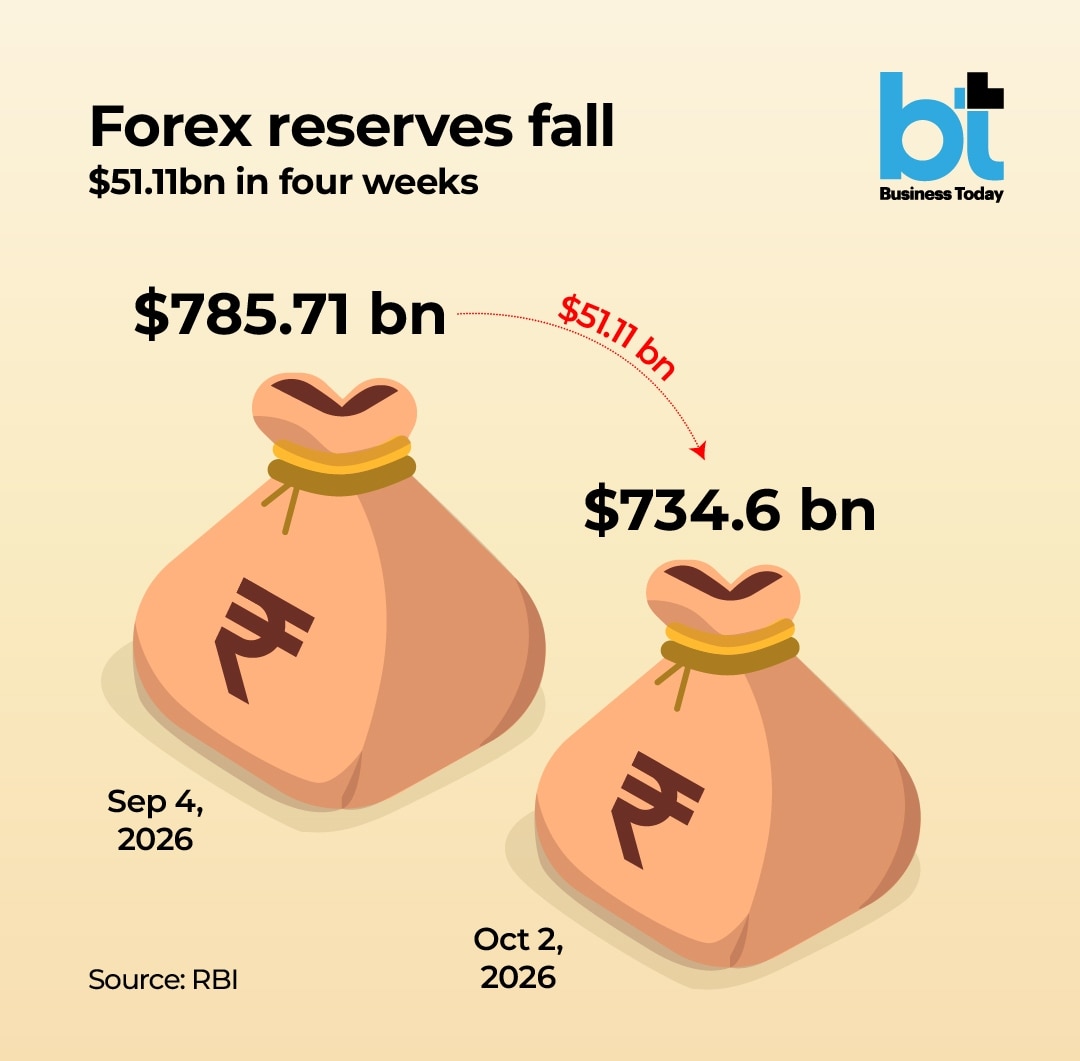
The sharp fall suggests continued intervention by the RBI in the foreign exchange market. The fall in reserves comes even after an unprecedented inflow through Foreign Currency Non-Resident (Bank), or FCNR(B), deposits, which was expected to provide additional dollar liquidity and support the domestic currency.
The rupee has remained under pressure against the US dollar this year, weighed down by geopolitical tensions and the war in West Asia. The resulting rise in crude oil prices has increased India’s import bill and, consequently, the demand for dollars. At the same time, sustained selling by foreign institutional investors in Indian equities has added to the pressure on the rupee.
The FCNR(B) plan
In a bid to counter dollar outflows and bolster foreign currency liquidity, the RBI announced a special concessional swap window in June, allowing banks to raise FCNR(B) deposits and swap the foreign currency with the central bank for rupees.
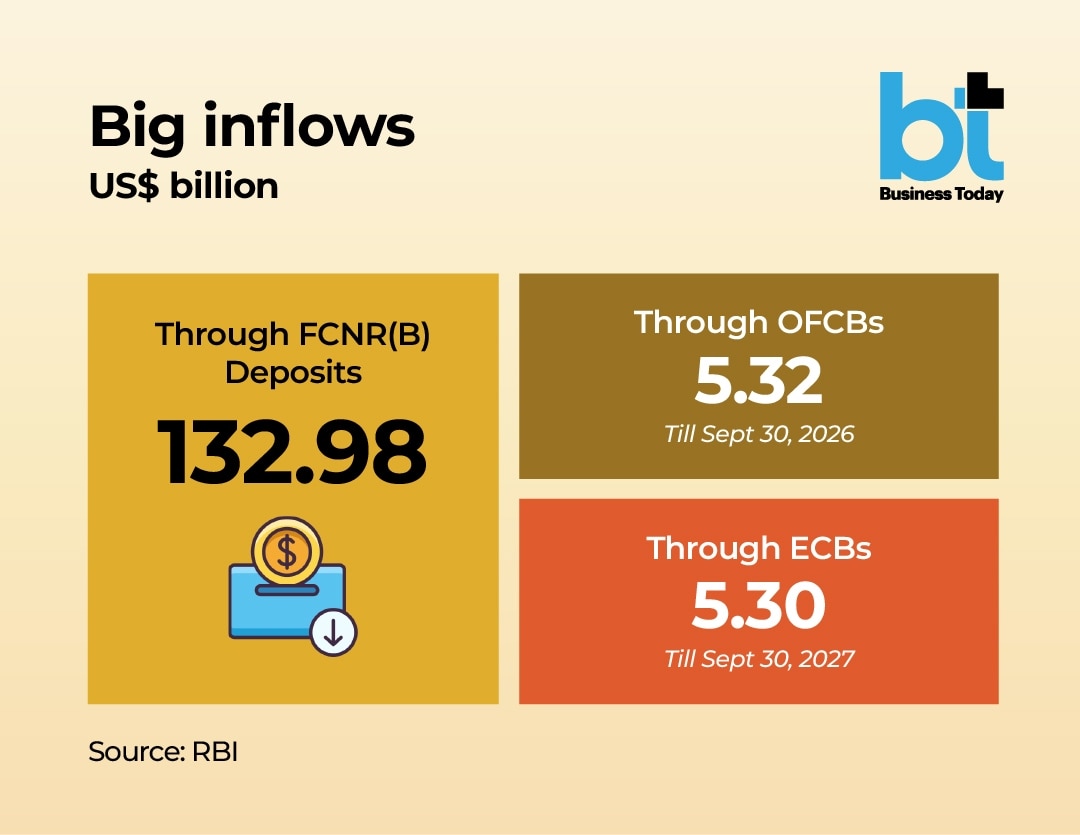
The response was far stronger than expected. Banks raised a record $132.98 billion through FCNR(B) deposits. The flow was so huge that RBI closed the window for FCNR (B) a month early, even as the special window for External Commercial
Borrowings (ECBs) and Overseas Foreign Currency Borrowings (OFCBs) remains open till December 31. As of September 30, $5.32 billion had been raised through OFCBs, while another $5.3 billion had been mobilised through ECBs.
The massive FCNR(B) mobilisation was expected to provide a significant boost to the rupee, which had hit a record low of 96.96 against the US dollar on May 20. But the impact on the currency has so far been limited.
The weakening rupee
The contrast is particularly striking when compared with the level of the rupee when the special swap window was announced in early June. The currency was trading at around 95.74 to the dollar at the time.
Since then, instead of appreciating, the rupee has weakened further. On Wednesday, October 7, the day, the Reserve Bank’s monetary policy committee announced a 25-basis-point hike in its benchmark repo rate, the rupee once again touched 96.84 against the greenback, before closing around 96.77. It recovered marginally on Thursday morning, trading at around 96.65.
The numbers suggest that the record foreign currency mobilisation through FCNR(B) deposits has not, by itself, been enough to reverse the broader forces weighing on the rupee. Strong dollar demand from importers, elevated crude prices, foreign portfolio outflows and geopolitical uncertainty continue to offset the additional foreign currency liquidity.
The RBI view
RBI Governor Sanjay Malhotra, however, sought to put the rupee’s recent weakness in perspective, saying that financial markets can behave irrationally over the short term and may take longer to reflect underlying fundamentals.
“By a number of estimates, including the REER (real effective exchange rate), the rupee is not overvalued. It may be undervalued,” Malhotra said on Wednesday.
His comments indicate that the RBI does not necessarily view the rupee’s current level as a reflection of its fundamental value. Instead, the central bank appears focused on ensuring that the currency’s adjustment remains orderly while using its reserves to manage excessive volatility.
MUST READ: FCNR-B deposits are boosting bank growth — but could squeeze margins, says report
The more than $50-billion decline in forex reserves over the past month therefore reflects not just weaker external conditions, but also the RBI’s efforts to absorb some of the pressure on the rupee. The record FCNR(B) inflows have added to the country’s foreign currency resources, but persistent dollar demand has meant that the additional liquidity has yet to translate into a sustained recovery in the domestic currency.
Malhotra also said the central bank would continue to ensure that the rupee moves in an orderly manner. But there are limits to what the RBI can control. However, two key factors remain largely outside the central bank’s control: oil prices and foreign investor flows.
With a lasting peace in West Asia still elusive, crude oil prices have risen again in recent weeks, putting renewed pressure on India’s import bill and external finances. Higher oil prices typically translate into greater demand for dollars, making it harder for the rupee to recover. More importantly, the FIIs continue to sell. In September, foreign portfolio investors offloaded Rs 35,861 crore in India’s equity market and have sold another Rs 25,126 crore worth equity this month till October 7. In total, FPIs have sold a massive Rs 2.85 lakh crore in Indian equity so far in 2026.
As long as these outflows continue, the rupee is likely to remain under pressure, even as the RBI steps in periodically to smooth volatility and prevent disorderly movements in the currency.
Economists at HDFC Bank, Sakshi Gupta and Deepthi Mathew, said the recent weakness in the rupee was being driven by broader global and domestic factors, rather than simply the interest-rate differential.
“We continue to believe that interest rate hikes offer a weak defence in the short term for the currency and the currency weakness is being driven by broader factors, including oil prices, equity valuations and FII outflows, AI trade and US dollar strength,” they said.
ALSO READ: FCNR(B) scheme closes after strong NRI demand: Why digital onboarding now matters
Compared to their expectation that the rupee would trade in the 95-96.50 range, they now expect the rupee to move in the 96-98 range against the dollar over the second half of the current financial year ending March 2027 and depreciate a further 2-3% in financial year 2028.
Professor Prasanna Tantri, associate-professor, finance, Indian School of Business (ISB), in a recent conversation with Business Today, questioned why the RBI had used the forex swap window, which is an emergency measure generally used during crisis times, this time around.
“There was no forex issue this time. Even if you were to take out the forward short positions of RBI, your forex reserves would still be around $500-600 billion (in June when the window was opened).
Other than the rupee probably touching 100 to the US dollar, I don’t see any calamity that could have happened. So, there was absolutely no reason for such an emergency measure this time around,” Tantri had stressed.
Globally, major central banks such as the Bank of Japan and the US Federal Reserve are now raising interest rates. Bond yields have surged. The US 30-year Treasury yields hit 5.70% on Wednesday. In such a high-yield scenario, foreign investors may not want to take too many risks, parking money abroad.
At the same time, higher global yields are keeping FII flows cautious, adding pressure on the currency, says Jateen Trivedi, VP research analyst - commodity and currency, LKP Securities.
DO READ: ₹5 lakh crore profit, not loss? SBI Research’s case for FCNR(B) scheme explained
"With central banks now moving towards a tighter policy stance, the rupee could see a modest pullback if crude prices remain contained," according to Trivedi, who sees the rupee range between 96.45 and 97.00 against the US dollar in the near term.
The RBI is now expected to raise its repo rate by at least another 25 basis points in December, with some economists projecting an additional 50-75 bps increase in rates over the next few MPC meetings.
But unless geopolitical tensions ease, crude oil prices fall, and bond yields decline, the rupee may remain under pressure, FPI flows may not meaningfully reverse, say analysts, and that would keep the rupee under pressure.
















 The rupee has remained under pressure against the US dollar this year, weighed down by geopolitical tensions and the war in West Asia.
 Setback for IT giants: US suspends Microsoft, Infosys, TCS, Wipro, HCL from green card programme
 NPCI likely to defer UPI MDR rollout, announcement expected on Friday: Report
 Trump says US will not attack Iran before November 3 midterm elections, blockade to continue
 No UPI MDR discussion at GST Council meet; rates unchanged, ITC protection among key takeaways
 Trump to honour Elon Musk, Nvidia's Jensen Huang with US' top science and technology medals
 Trump Under Pressure To Crack Down On Russia’s Oil ‘Shadow Fleet’ Before Octtober 18
 RBI Forex Reserves Crash $50 Billion In A Month! Why Is The Rupee Still Under Pressure?
 Why E-Commerce And Internet Could Be India’s Next Big Consumption Growth Story
 Stock Market | D Street Under Pressure | Where Do Markets Go From Here?
 What Are REITs? Is This The Best Way To Invest In Real Estate? Investment Guide | Money Today
 Market extends fall as Nifty hits 52-week low; investors lose nearly Rs 13 lakh crore in two days
 TCS adds 4,258 employees in Q2, marks third quarter of headcount addition
  Exit Ola Electric stock, switch to ICICI Lombard: Analyst
 Recovery in Max Healthcare stock depends on easing of regulation fears: Analyst
 Rs 4,341 cr dividend payout bonanza! TCS declares Q2 dividend; check record date & payment date
 For 21 years, he collected rubbish for a living. At 71, he discovered ₹61 lakh waiting for him
 NPS is no longer just about pension: Healthcare and emergency liquidity enter the retirement equation
 GST eases ITC rules: Insurance, telecom towers, free samples and more get relief
 From a solo trip at 13 to 186 countries: Meet the 20-year-old just 9 countries away from becoming the youngest to visit every country
 Financial Horoscope Today, October 9, 2026: Pisces Will Gain Financially, Know the Status of Other Signs