


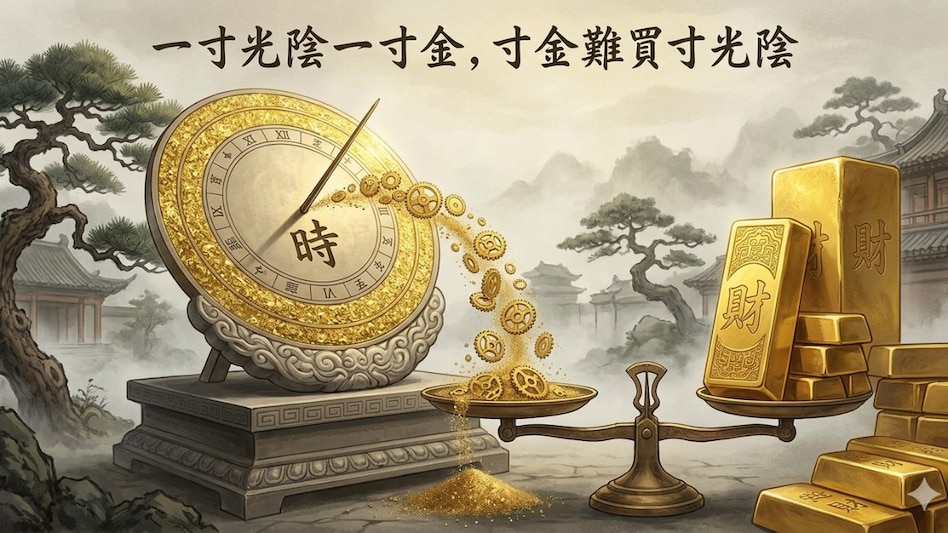
 The proverb acts as a constant forcing function, nudging us away from mindless "busy-ness" and toward intentional living.
 "An inch of time is an inch of gold, but an inch of gold cannot buy an inch of time." — a classic Chinese proverb (a great reminder that instead of wondering where your hours go, evaluate whether your daily activities align with your core goals and values.).
It is one of the most elegant ways to describe the absolute scarcity of time. Unlike money, energy, or resources, time is the one asset that cannot be mined, manufactured, or recycled.

 'When India grows 7.8%, world sees fresh hope': PM Modi's big message amid global uncertainty
 NTPC and Adani apply under Rs 37,500 crore coal gasification scheme
 'India's fintech story has been amazing... A big champion of this is UPI': PM Modi
 Why Titan Company stock is top jewellery pick ahead of festive season
  Chandigarh suspends Uber, Rapido licences for 6 months for failing to comply with rules
 “Files Used To Get Stuck”: PM Modi Takes Dig At Delays, Hails 2,800 Km Freight Corridor
 Indegene’s Growth Story: Global Expansion, AI & The Future Of Healthcare Tech
 Ambareesh Baliga Turns Bullish On Specialty Chemicals, Bets On Archean Chemicals & Vinati Organics
 Gold Loan Rise Faces Risk? Ambareesh Baliga Flags Correction Threat For NBFCs
 Hindustan Copper Set To Rise 10-12% From Current Market Price
 Nifty 50 returns have been flat for 2 years. What should investors expect over the next 12 months? DSP mutual fund’s Sahil Kapoor explains
 Hindustan Copper shares jump nearly 5%; what's next on tech charts?Why Titan Company stock is top jewellery pick ahead of festive season
  Archean Chemical, Vinati Organics: Specialty chemical stocks to buy during correction
 Sensex slumps 555 points; Nifty briefly slips below 23,400 amid CAS volatility
 Bank strike on September 11: Unions refuse to withdraw call as talks with govt remain inconclusive
 'Please don't try this at home': Anand Mahindra reacts to Scorpio parked on two-storey rooftop
 'Look what Delhi has done to him': Dreams of education turn into nightmare for student’s family
 FDA suspends licence of IRCTC supplier, 3 ISKCON food establishments in Mumbai
 ChatGPT's cricket play gets bigger: AI giant joins Campa, SBI Life as BCCI sponsors












