















 Jefferies said Indian financials have also borne rub-off effect of global dislocations. They are better placed with higher share of retail deposit, limited ALM gap & MTM, limited dependence on AT-1 bonds, it said.
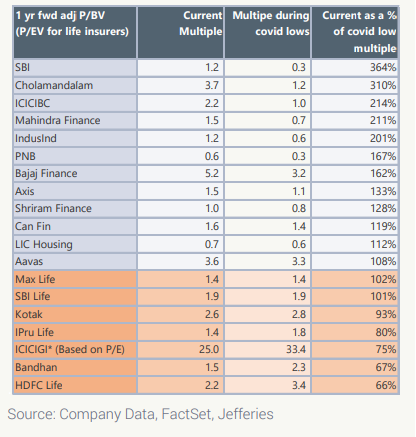
Foreign brokerage Jefferies said India had its Credit Suisse like AT-1 bond issue around Covid when YES Bank wrote-down AT-1 bonds, but local bond market investors today are not really seeing risks for Indian stocks. Indian banks, it said, has higher share of retail deposits and lower asset and liability management (ALM) gaps. There is lower risk from mark-to-market (MTM) losses and asset quality, adding that valuations in some banking stocks are below Covid lows.
IndusInd Bank, ICICI Bank and SBI are Jefferies' top stock buys, with price targets that suggest up to 55 per cent potential upsides. Overall, it has price targets that suggest up to 69 per cent potential upside for banks under its coverage.

 Aadhaar authentication mandatory for subsidised LPG refills from October 1: Check rules
 Japan’s semiconductor push in India: Why Japanese companies are betting on materials, equipment and technology
  Tata Steel seeks fresh UK government funding as Port Talbot project faces delays
 How big is Apple Pay? US payment giant to enter India as UPI dominates digital payments
 Delhi airport gets its third runway operational; optimise aircraft movement
 CEA On India’s 7.8% Growth, Rural Incomes And Government’s Job Creation Push
  Gold Price Outlook: Why Dollar Weakness Could Keep Gold And Silver Prices Attractive Ahead
 Gold vs Silver Investment Strategy: Is This The Right Time To Buy For Long-Term Returns?
 Corporate Vs Personal Health Insurance: Which Is Better On A Budget?
 Gold Price Outlook: Why Gold Could Rise Despite Global Interest Rate Hikes | Silver Market Update
 Jindal Supreme, SS Retail, Hero Motors IPOs subscribed up to 181 times on final day; details here
 Sensex, Nifty post sixth weekly loss; TCS, Titan among top laggards, slip up to 4%
 How AI collapse could benefit Indian equity market; Jefferies' Christopher Wood explains
  Banks are no more secular growth story, prefer NBFCs: Chris Wood
 Jefferies' Christopher Wood sees gold at $10,000 'sooner or later'; likes India's small, midcaps
 Who is Nila Vikhe Patil? Maharashtra educationist’s daughter elected to Swedish Parliament
 AI biotech without humans? Stanford deploys 37,000 agents to hunt new therapies
 From 18% to 100%: How the new US law changes the tariff risk for India
 AI agents are coming for every day tasks: What Goldman Sachs sees for the next AI growth wave
 Chandigarh’s 'iPhone langar' plan stopped amid stampede concerns and legal restrictions


