










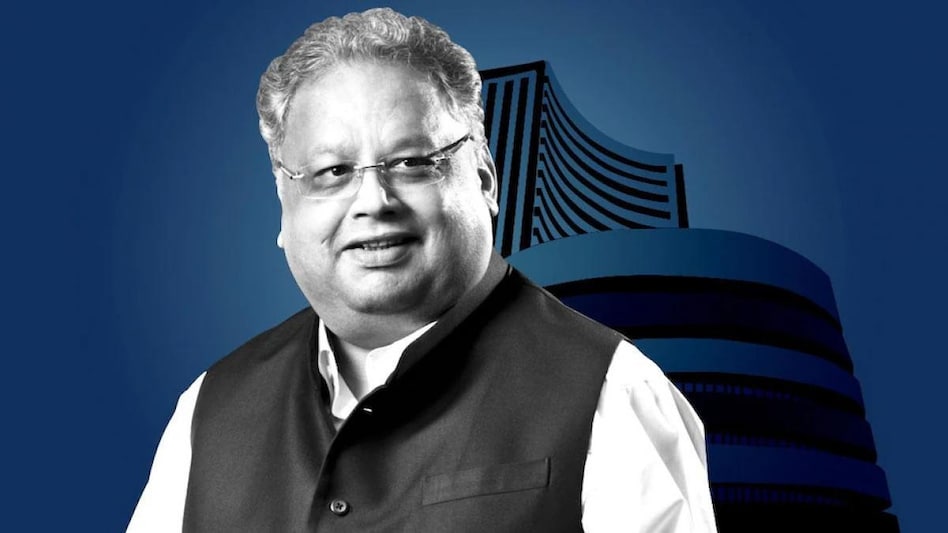
 'Stock market investment cannot be taught. It has to be learnt': Behind Rakesh Jhunjhunwala's mantra to pick stocks
 'Stock market investment cannot be taught. It has to be learnt': Behind Rakesh Jhunjhunwala's mantra to pick stocks
Rakesh Jhunjhunwala, India's iconic stock market investor, often used to say, "Respect the market. Have an open mind. Know what to stake. Know when to take a loss. Be responsible." He died at the age of 62 on August 14 last year. There will be a party in heaven today as Mr. Rakesh Jhunjhunwala celebrates his birthday. He would have been so happy seeing the markets breaking all levels to hit record highs.
I recently got my hands on this book, ‘The Big Bull of Dalal Street: How Rakesh Jhunjhunwala Made His Fortune’, by Neil Borate, Aprajita Sharma, and Aditya Kondawar. This book looks at the life of India's big bull, as Rakesh was famously known, both as a person and as a professional. Providing a fascinating account of his journey, it analyses the records of Jhunjhunwala's investments and interviews he has given over the years. More than just a biography, a large section of the book is devoted to understanding the stocks that made him rich and the mistakes he made.
Every Jhunjhunwala follower wants to learn how he picked his stock bets. He used to say that stock market investment cannot be taught. It has to be learnt. The book has a very significant chapter on his stock picking mantra. There are six aspects which, according to Jhunjhunwala, should be followed to pick multi-bagger stocks. Today, on his birth anniversary, let's take a look at Big Bull's mantra. Here's an excerpt from the book
1) Keep an open mind
Be receptive to what the world is showing you. By “keep an open mind’, for Jhunjhunwala it meant that one has to observe their surroundings. Some of the great stock ideas come when you least expect it. Your observation about how everyone is using a certain technology, product or service and which listed player is behind it can help you land great stock opportunities.
2) Opportunity
Second, one needs to assess the market opportunity as to how big an opportunity the company is looking at as its market size grows. The opportunity and market size should move in tandem. This is what provides a long runway for growth. There has to be a big change or a turnaround happening. The greatest wealth is earned when change happens, Rakesh would say. The business model should have entry barriers.
3) Corporate governance
Corporate governance is about the management and how someone runs their company – their behaviour with their staff, vendors, distributors and others and their behaviour with money. Are they running their business with frugality? One needs to look into this stuff. A hard-working and honest management is important. Rakesh excelled at studying people and betting on them. Why he loved Tata Group stocks was only because of the sheer integrity of the management.
4) Competitive ability
The company must have something superior in terms of competition against its peers, be it the brand, technology or capital. It should be a market leader.
5) Valuations
Finally, there is the price at which you are buying it. Even a great company bought at the wrong price (high valuations) will hurt your returns. So, price is important. Learn to value a company. Read valuations.
6) Constant monitoring
Even though a long-term investor, he would keep monitoring how his portfolio companies were performing. He would often turn up in investor calls to quiz the management about the business prospects or other actions. If he felt the initial thesis was failing or the business model hadn’t turned out the way he anticipated, he would prefer to sell his stakes.
When exactly should one sell an investment? Let’s hear from the late Jhunjhunwala himself: “As far as selling goes, I sell if a better opportunity comes along that will give me more value for money from what I am getting now. I will sell when I feel the stock has peaked or the business opportunity has peaked out. Selling should be an independent decision. It shouldn’t be linked to how the stock market is doing. Don’t flower your weeds and cut your roses. Maine kasam khayi ki nuksaan mein nahi bechunga ki is bullshit (I have sworn that I won’t take a loss and sell – this is bullshit)."
Jhunjhunwala wasn't scared of death. He lived his life to the fullest, at his best. This book eloquently explains why Rakesh Jhunjhunwala was such a success at doing what he did, in the time that he spent in this world. Wealth creation, from Rs 5000 that he started with in the late 1980s to Rs 35,000 crore at the time his death, stands at the heart of his success story. But there was a lot more to his life than just money-making. May his wisdom and learnings live on.
Also read: Hot stocks on June 5, 2023: HPL Electric, Suzlon Energy, Brightcom Group, MRPL and more
Also read: Suzlon Energy shares tank 5% amid huge turnover; stock snaps 7-day winning run on fundraising plan
 'Will continue to evaluate...': What Mukesh Ambani said about Reliance Jio IPO
  LIC shares: Why this stock might be showing upto 55% fall in your portfolio today?
 Rs 150/share dividend: Auto stock to trade ex-dividend amid highest Q4 profit
 60-day ceasefire extension, Hormuz to reopen: US-Iran truce deal taking shape but Trump yet to sign off
 Wipro shares: IT stock rises 5% in early deals; here's why
  UAE-India Trade Hits Record High: Dr Thani On CEPA, Africa & Future Growth
 Will RBI Start Raising Rates From June? Devang Shah Weigh In
 Why Is India Sending AI Data Centres To Space?
 U.S. & Japan 30-Year Bond Yields Cross 5% - What It Means For India
 If India Is Growing So Fast, Why Are Investors Pulling Back?
 Delta Corp shares dive 16% in early trade; here is why
 JSW Energy, Sona Comstar, Tube Investment: Stocks to buy — Check targets, stop loss & moreLIC shares: Why this stock might be showing upto 55% fall in your portfolio today?Wipro shares: IT stock rises 5% in early deals; here's why
  BT Opening Bell | Sensex jumps 352 pts, Nifty tops 24,000; IT stocks shine