










 Retail investors have a 15 per cent allocation in the buyback, which means that 1.5 crore shares worth Rs 2,700 crore shall be bought back from their quota.
Infosys announced its biggest ever share buyback of Rs 18,000 crore on Thursday, September 11, 2025. The IT solutions major said that it will be buying back 10 crore equity shares, representing 2.41 per cent of the total equity shares outstanding. The price of buyback has been fixed at Rs 1,800 per share, suggesting a 18 per cent premium at its price at Rs 1,525 as of September 12.
All equity shareholders of the company as on the record date (which is yet to be announced) shall be considered eligible to participate in the buy back. Retail investors have a 15 per cent allocation in the buyback, which means that 1.5 crore shares worth Rs 2,700 crore shall be bought back from their quota.
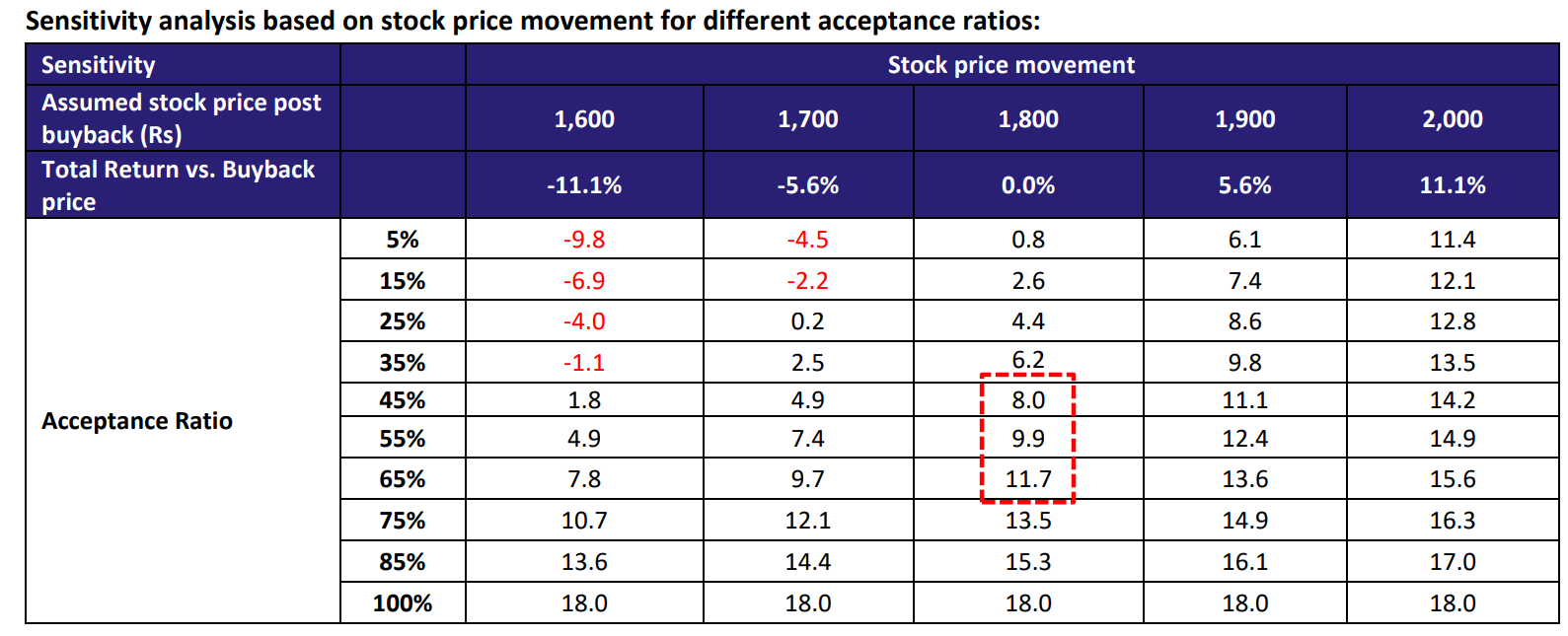
Sunny Agrawal, Head of Fundamental Equity Research at SBI Securities has penciled various pay-off scenarios based on the tentative acceptance ratio and calculated pre-tax return on investment (RoI) based on that calculation. The broking firm has assumed 100 per cent participation from the retail segment and an investor can buy a maximum of 111 equity shares (Rs 2,00,000) at Rs 1,800 apiece to be eligible in this category.
The acceptance ratio for the buyback is expected to be low due to heavy oversubscription and euphoria. A fraction of shares tendered by retail investors are likely to be accepted. Retail investors must understand that only a small portion of shares tendered will be accepted in the buyback and remaining shares will stay with them.
According to SBI's research, at 100 per cent participation for full quota an investor can see buyback of 5-111 equity shares, based on various acceptance ratios and make a profit of Rs 1,375-30,525. This indicates a tentative pre-tax RoI of 0.8-18 per cent for the investor.
According to Agrawal, 45-55 per cent acceptance ratio is the likely scenario for the small investor who will make a 8-11.7 per cent pre-tax RoI and profit of Rs 13,475-19,800, based on the buyback of 49 to 72 equity shares. One should note that the buyback is through a tender offer route and shareholders with holding value of less than Rs 2 lakh shall be considered in this category.
Tax Implication
A buyback is when a company purchases its own shares from existing shareholders, thereby reducing the total number of shares in the market. This route is taken due to various reasons including to push the value of existing shares, to improve earnings per share (EPS) by lowering the share count, to prevent hostile takeovers, or to deploy surplus cash effectively and others.
Since October 2024, the tax liability has shifted to individual shareholders, not to companies. Buyback amount received by shareholders will be deemed as dividend and will be taxed based on slab rates. The cost of the shares bought back by the company will be treated as a capital loss (either short term or long term), said Agrawal.
The loss may be offset against any other capital gains. If there are not enough capital gains to offset the loss in the current year, it can be carried forward and offset against capital gains in future years, up to a maximum of 8 years," he added.

 CBDT issues new crypto reporting guidance: No new tax, but exchanges must track and report all transactions
 Did Cockroach Janta Party's 'Chalo Sansad' 2.0 threat trigger Dharmendra Pradhan's resignation? What we know so far
 'Will discharge my responsibilities with complete humility': Pralhad Joshi after being appointed Education Minister
 Curious about Pralhad Joshi's wealth? A closer look at his assets, investments and liabilities
 On Cockroach Janta Party's lines, now E20 Janta Party demands choice of 100% petrol
 Best Healthcare Stocks: Gaurang Shah's Outlook On Apollo Hospitals, Fortis & The Manipal Health IPO
 Is Indo-MIM's IPO Valuation Justified? Here's Why The Company Sees Strong Growth Ahead
 Treasury Bills Explained: Why T-Bills Are One Of The Safest Short-Term Investment Options
 FDs vs Markets: Where Should You Keep Your Short-Term Money?
 Why Term Insurance Is Essential for Every Earning Member | Sum Assured & Coverage Explained
 Gland Pharma stock: Price target of Rs 3,250 likely in medium term, says analyst
  Metal recycling stocks to buy: Gravita, Pondy Oxides, Jain Resource among top picks
 TRIL shares: Should you average the falling stock? Here's 'fixed and final' stop loss
 Adani Power: 45 GW target, Rs 2 lakh crore capex plan among conference call highlights
  ITC Hotels, Chalet, Ventive, IHCL, SAMHI: Hotel stocks to buy despite travel disruptions
 Mayor Zohran Mamdani taps tech-slayer Lina Khan to reshape New York City’s economy
 Planning a Nepal trip? You can now carry up to ₹25,000 in Indian cash. Here's what changedGland Pharma stock: Price target of Rs 3,250 likely in medium term, says analyst
  UP saw the largest 34 routes discontinued under the Udan scheme
 A case study in energy security: How India recovered oil imports and rebuilt its crude stockpile