Steadily going downhill, with only a few spurts of growth, the Nifty 50 has fallen for eight consecutive weeks—its longest losing streak in the past two decades—as sustained selling by foreign investors, rocketing US bond yields, rising interest rates and surging crude oil prices have overshadowed an economy galloping at 7.8% and made Dalal Street one of the worst-performing major markets globally.
Compared to its previous peak of 26,277 in September 2024, the Nifty 50 has fallen about 15% to date, is down about 20% in dollar terms so far this year, and is now threatening to test two-year lows, although Monday's marginal recovery may signal that the market is bottoming out ahead of the RBI's policy announcement on Wednesday.
For investors like Saraswat, the question is obvious: Is this the time to stay away from equities—or the time to buy? Market veterans argue it is the latter.
“I believe we are somewhere in the endgame here,” Dinshaw Irani, CEO of Helios Capital, told Business Today. “I think it is time when one should be braver to start averaging as such, and that’s what maximises the returns every time. So, I love it.”
That may sound counterintuitive when the headlines are dominated by a falling market, an expanding conflict in the Middle East, and a currency that has been hit hard – the rupee is down 6.6% this year and is the second-worst performing Asian unit so far in 2026.
But for long-term investors, the sell-off has done something that the relentless rally of the past few years did not: it has taken some of the froth out of Indian equities and brought valuations back towards more reasonable levels.
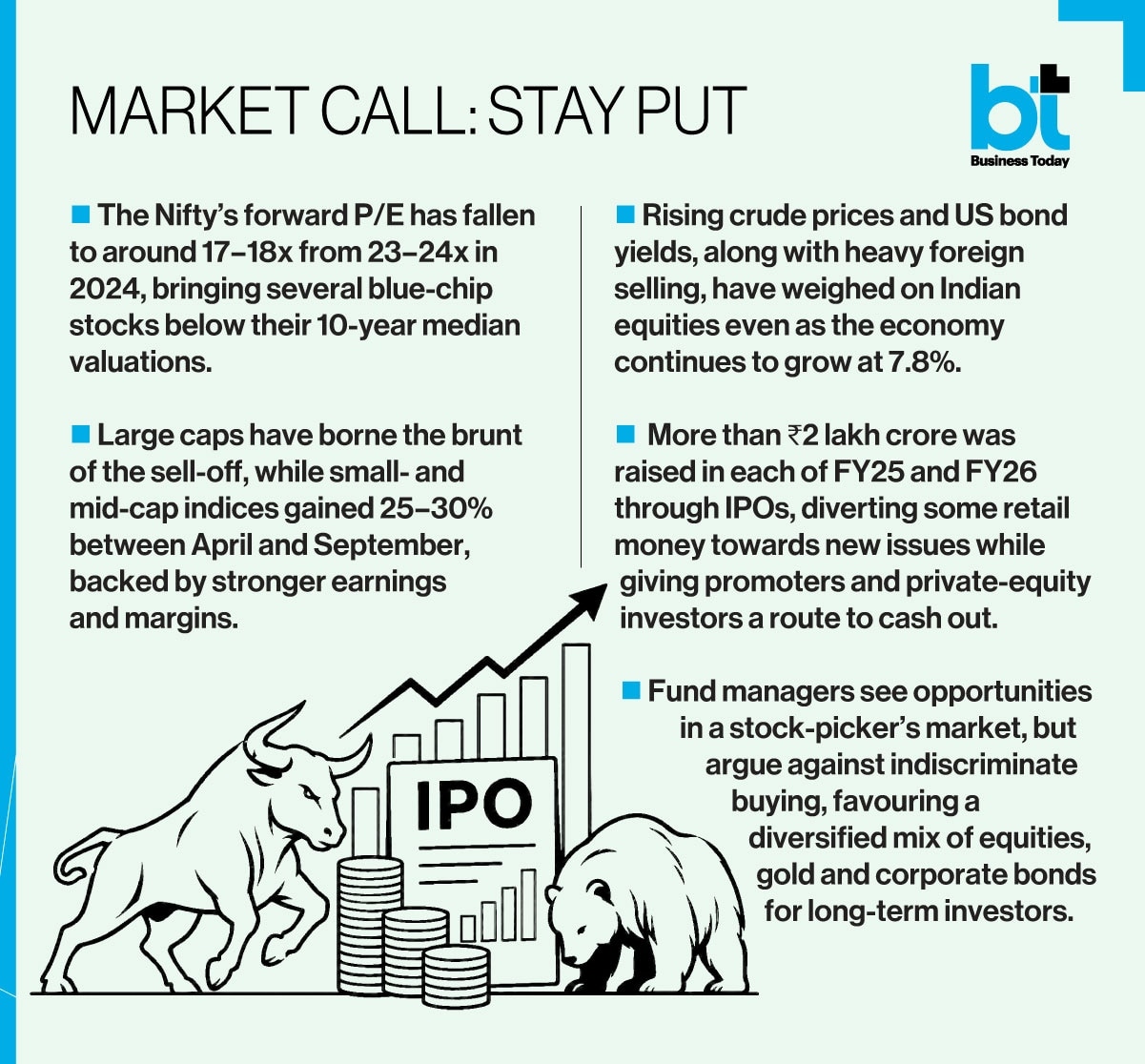
The Nifty is now trading at around 17-18 times one-year forward earnings, compared with 23-24 times in 2024. Consequently, several blue-chip stocks, including HDFC Bank and Tata Consultancy Services, have been de-rated and are trading substantially below their 10-year median valuation multiples on price-to-earnings and price-to-book ratios.
To be sure, the risks of the market falling further are very real, but the low valuations are prompting fund managers to say this is precisely why investors need to distinguish between what is happening to the market and what is happening to the Indian economy.
“The Nifty is not India,” says Ashish Chaturmota, Managing Director for the PMS business at JM Financial. “The market is now segmented into two halves: large caps were overvalued and showed just 6-8% earnings growth. Therefore, they got sold. On the other hand, small-caps and mid-caps had lots of strong themes running, plus sustainable earnings growth in excess of 20%.”
The distinction is important. The broad market may look bruised, but it has not moved as one.
While large caps have been battered, small- and mid-cap indices rallied 25-30% between April and September, helped by strong earnings growth during the first quarter, expanding margins and relatively low equity floats. Fund managers rode that rally, even as foreign investors focused their selling on large caps.
According to Irani, who runs top-performing mid-cap and small-cap equity funds, those standing on the sidelines are missing the broader picture. He says Dalal Street’s fall is mainly because of two factors – rising oil prices and surging US bond yields — on which investors, corporates and the government have little or no control.
“These are imported problems. Focus instead on GDP expansion and strong credit growth,” he says. “This is a stock picker’s market, and there are plenty of good stories.”
That seems to be the investment case emerging from the correction: the market may be falling, but not every stock is falling for the same reason—and not every fall represents a deterioration in fundamentals.
The problem is that investors have been conditioned by a very different market. For two years, many have continued investing through SIPs even as returns have increasingly lagged fixed deposits.
At the same time, Dalal Street has seen an explosion of primary-market fundraising over the past two years – Rs 2,09,344 crore in FY25 (highest in three decades) and Rs 2,04,713 in FY26, according to data from Prime Database. In the current fiscal, Rs 1,49,572 crore has been raised till September 30, including the bumper listing of the National Stock Exchange, with issue size of Rs 22,568.9 crore.
Retail investors, attracted by spectacular listing gains in several of these IPOs, have increasingly diverted money from existing equity holdings to participate in new issues.
The IPO rush has also allowed private-equity funds, promoters and pre-IPO investors to monetise holdings at valuations that would have been difficult to achieve in the secondary market.
The local bottling unit of Coca-Cola is the latest example, preparing to raise about $1 billion through a sale of shares by existing investors as bankers tap into strong demand for quality companies.
The result is a market where the headline Nifty number masks a much more complicated picture.
Foreign investors have pulled out about ₹4 lakh crore so far this year, with selling concentrated in large caps, as money moved towards the AI-led technology trade in markets such as South Korea, Taiwan and Japan, where major indices surged.
In this tumultuous backdrop, both Irani and Chaturmota believe the India story remains relevant and that investors, especially those in large caps, need to ride the correction out.
Their message is not to buy everything simply because prices have fallen. The message is that a judicious mix of small-cap and mid-cap funds with a sprinkling of gold and corporate bonds in the overall mutual fund basket will help investors achieve long-term wealth creation goals.
For investors like Saraswat, that requires something harder than finding the right fund or stock. It requires staying invested when the chips are down and the market is awash in red.













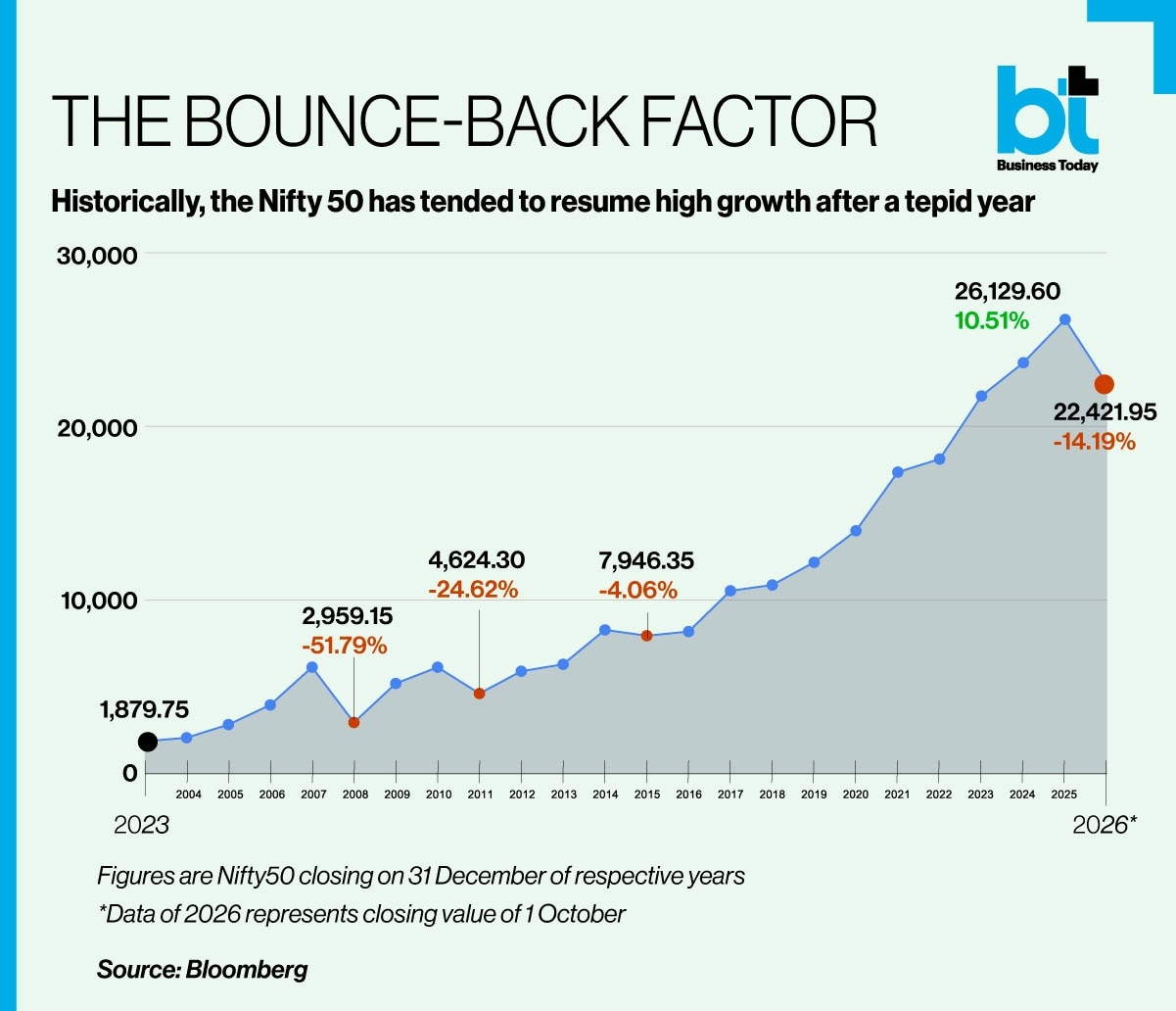



 Compared to its previous peak of 26,277 in September 2024, the Nifty 50 has fallen about 15% to date
 GST Council meeting rescheduled to October 8: What's on the agenda
 India's UPI is going global again. Zimbabwe is now in talks to adopt it
 Airlines need urgent liquidity, but banks delay release of sanctioned funds; FIA writes to Centre
 India-US trade talks 'reached a plateau', compromise difficult: FM Sitharaman
 Hardeep Puri, 7 other sitting MPs dropped: BJP's surprise Rajya Sabha picks from UP
 Varmora Granito IPO: How Management Plans To Reduce Morbi Concentration Risk
 Value Buying, Short Covering Pushes Stocks Higher; BSE, ITC Shine
 Future Of MBA: ISB Dean Madan Pillutla On AI, Skills, Careers And Lifelong Learning
 How Amaravati Plans To Become A Quantum Hub
 MBA In The AI Era:IIM Ahmedabad Director On The Changes In Management Education
 Nifty outlook: Analyst sees buy-on-dips opportunity; Aequs, Aditya Vision among stocks to watch
 Raymond shares jump 10% to hit record high; Raymond Realty gains 7%: What analysts say
 Marico shares rise 3% on Q2 business update; Nuvama bullish on volume growth
 Sensex, Nifty snap 4-session losing run; can markets sustain recovery amid caution?
 Vodafone Idea, Bharti Airtel: Q2 results preview, share price targets
 Small finance vs private vs PSU banks: The October 2026 senior FD rate gap explained ahead of RBI rate meet
 India among five countries where doctors warn extreme heat is harming pregnancy and newborn health
 These 40 cities generate the most GDP per person, check the full list here
 Durga Puja, Diwali spending raises home insurance concerns as families buy gold, jewellery, valuables
 Financial Horoscope Today, October 6, 2026: Cancer Sign Will See an Increase in Wealth, Find Out How the Day Will Be for Your Sign