








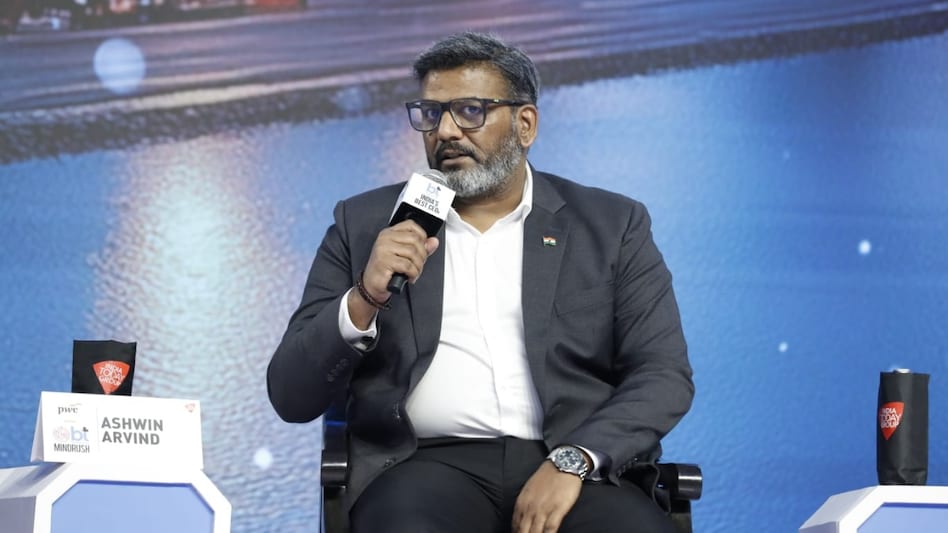
 Ashwin Arvind, Deputy Executive Director, PSA Mumbai.

 Ashwin Arvind, Deputy Executive Director, PSA Mumbai.
India’s maritime sector is navigating a complex mix of disruption and opportunity as geopolitical tensions reshape global supply chains, turning ports from mere infrastructure assets into strategic nodes of trade.
During the panel discussion at the Business Today MindRush & India’s Best CEOs Awards being happening in Mumbai, Ashwin Arvind, Deputy Executive Director, PSA Mumbai, says that at the operational level, the impact has been immediate. Arvind, representing global terminal operator PSA at Jawaharlal Nehru Port (JNP), described the situation as a dual-edged sword.
“This crisis and this current disruption is both an opportunity and a challenge for us,’ he said, explaining that on one hand, disruptions in key shipping routes, particularly cargo movement to the Middle East, have hit exports during a critical agricultural window, including the peak grape export season from Maharashtra. On the other, the same disruption has unlocked new opportunities.
Terminals have rapidly adapted by pivoting to transshipment models. Cargo that would typically move directly to ports in the Persian Gulf is now being rerouted through Indian ports and then shipped onward via feeder networks to less-affected destinations such as Salalah and Jeddah. This shift has led to a visible uptick in volumes across major west coast ports, underscoring India’s growing relevance as a logistics intermediary.
The episode has also stress-tested operational agility. According to Arvind, terminals have had to quickly build capacity, reconfigure processes, and deploy technology to transition from gateway handling to transshipment operations. For global operators like PSA, such volatility is embedded into strategy frameworks that track geopolitics alongside factors like AI, labour, and environment.
From a regulatory standpoint, the response has been equally intense. Captain Bipin Kumar Dhiman, Nautical Surveyor & DDG (Tech), GoI highlighted that the government’s role has expanded beyond compliance into crisis management. A key priority has been the repatriation of nearly 21,000 Indian seafarers stranded in the Gulf region, alongside managing safety protocols for vessels operating in high-risk zones.
Regulators have issued continuous advisories, enforced dynamic safety norms, and coordinated with multiple ministries to maintain supply chain continuity. The crisis has also accelerated decision-making on critical issues such as insurance for vessels transiting conflict zones, reflecting a more responsive governance approach.
Structurally, the disruption is reinforcing India’s long-term maritime ambitions. While the country still lags behind established hubs like Singapore and Dubai in transshipment dominance, ongoing capacity expansions, such as the upcoming Vadhavan port and projects in Great Nicobar and Vizhinjam signal intent to close the gap.
However, challenges remain. As trade routes normalize, ports will face a surge of backlog cargo, testing their ability to manage congestion and turnaround times efficiently.
The broader takeaway is that the geopolitical shocks are no longer episodic risks but structural forces. For India, the ability to convert these disruptions into sustained capacity, policy agility, and global competitiveness will define whether this moment becomes a lasting inflection point.
 BPCL, HPCL and IOC: OMCs still not out of the woods? Share price targets
 Now, Trump is talking of Hormuz tolls if US-Iran deal collapses. What's his proposal?
 How Reliance's focus on battery storage, solar manufacturing can cut Chinese dependence?
 90-day LPG compliance deadline ends: Do this tonight or lose your gas supply
  Transfers, promotions to go digital? Centre plans major HR overhaul at PSU banks
 Why Do AI Data Centres Use So Much Water ? | Explained
 Why Is India’s Cruise Market Just Getting Started?
 Versailles Peace Deal Explained: How U.S.-Iran War Moved From Missiles To MoU
 Power Bags ₹5,000 Crore Karnataka Project, Unveils Big Mumbai Expansion Plan
 U.S.-Iran War Explained: From Operation Epic Fury To Strait Of Hormuz Crisis And Peace Deal
 Tata Motors Passenger Vehicles: TMPV price targets and cues for the auto sector stock
  Defence stocks to buy: Brokerage firms go bullish on this multibagger for strong gainsBPCL, HPCL and IOC: OMCs still not out of the woods? Share price targets
 BSE, Hyundai, Pine Labs, Ather & others: Top 12 fresh brokerage picks with upto 64% upside
 Are mid- and small-caps poised to lead the next leg of the market rally? Experts explain why