










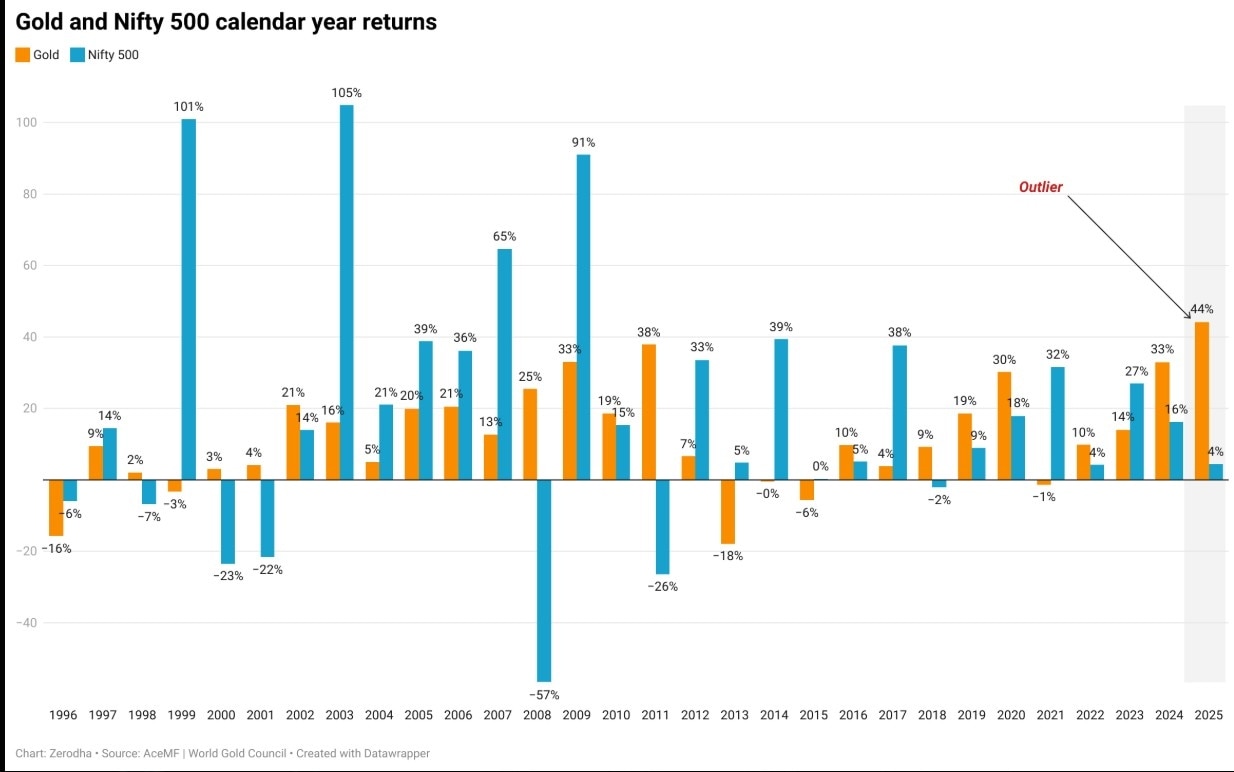



 Nithin Kamath's comment has renewed the attention on how the yellow metal performed compared to equities in recent years.
As India enters the festive season, gold once again takes centre stage — both in jewellery stores and in conversations about wealth. With international gold prices breaching $4,000 per ounce and domestic rates crossing Rs 1.2 lakh per 10 grams, the yellow metal has outshone most asset classes in 2025. Yet, amid this glittering rally, Zerodha CEO Nithin Kamath has raised an important question: can India make its massive gold holdings work harder for the economy?
In a post on X (formerly Twitter), Kamath pointed out that Indian households collectively hold around $3 trillion worth of gold, according to World Gold Council data. “While equities fund business growth, most of this gold remains locked away, earning nothing,” he wrote. “We need better ways to financialize this gold beyond just gold loans.”

 HDFC Bank shares in focus: MD, CFO, Group Head fined in MSRDC case; warning letters issued
 'AI is a profound civilisational shift': N Chandrasekaran says software companies won't be left behind
 Parliament set for first major debate of Monsoon Session on Anti-paper leak bill; Here's what the bill proposes
 'Create jobs, do not replace them': Satya Nadella calls for community-first AI growth
 Beyond Strait of Hormuz & Red Sea: This Asian waterway is the world's most critical trade chokepoint
 DCB Bank Management | Q1 Earnings, Loan Growth, Margins & Asset Quality Explained
 Infosys Fined In France: 70-Hour Work-week Debate Returns After €175,000 Labour Penalty
 I.T. Sector Outlook: Is the Worst Over for Indian I.T. Stocks After Long Underperformance?
 France And Spain Wildfires Threaten Cap Ferret Mansions And Bordeaux Wine Country
 Maruti Suzuki Eyes 25-30% SUV Growth, Says CNG Demand Has Overtaken Diesel
 Nifty, Sensex, Nifty Bank outlook for today: GIFT Nifty down 53 pts; key levels to watchHDFC Bank shares in focus: MD, CFO, Group Head fined in MSRDC case; warning letters issued
 Suzlon, Ambuja Cements, Radico Khaitan: Stocks to trade— Key levels, target, stop loss
 Top stocks in news: Meesho, IndiGo, Suzlon, Coal India, BEL, Tata Power, Adani Energy, TMPV
 Tata Power Q1 profit rises 11% to Rs 1,176 crore; revenue up 6%, capex tops Rs 5,300 crore
 Samsung Galaxy Z Fold 8 First Impression: The foldable we've been waiting for?
 Petrol, diesel prices today, July 28: Check latest rates in Delhi, Mumbai, Chennai & more'AI is a profound civilisational shift': N Chandrasekaran says software companies won't be left behindNifty, Sensex, Nifty Bank outlook for today: GIFT Nifty down 53 pts; key levels to watchHDFC Bank shares in focus: MD, CFO, Group Head fined in MSRDC case; warning letters issued