












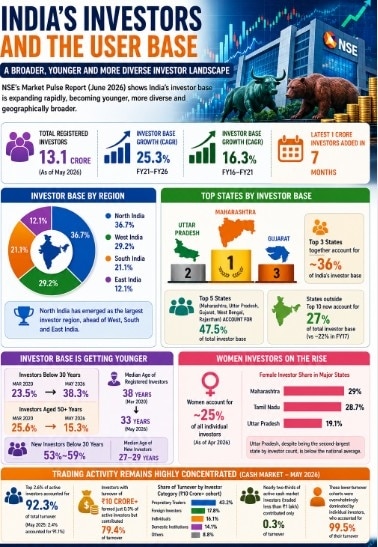



 NSE's registered investor base reached 13.1 crore in May 2026, with the latest one crore investors added in just seven months.
India's retail investing landscape is undergoing a geographic shift, with North India overtaking other regions to become the country's largest investor hub even as Maharashtra, Uttar Pradesh and Gujarat continue to dominate at the state level.
According to the National Stock Exchange's (NSE) Market Pulse report for June 2026, North India accounted for 36.7% of the country's 13.1 crore registered investors as of May 2026, ahead of West India at 29.2%, South India at 21.1% and East India at 12.1%.

 Govt starts buffer onion releases as festive demand nears
 India to divert 3.5 lakh tonnes of export sugar to local market as prices surge
 AI boom is helping offset oil shock, but global economy still faces risks, warns IMF
 Apple may manufacture iPads, MacBooks in India, but local components take priority
  'Kirana Hills strike was inadvertent': Ex-Army chief says escalation control could get harder in future
 YouTube, Insta Earnings Are Not Tax-Free: What Freelancers & Content Creators Must Know About Tax
 What’s Hot: Stocks, Gold & Big Money Moves | Daily Markets Show | August 26 | Business Today TV
 Nifty Rally Gets A Boost From Falling Oil: Vaishali Parekh On What Comes Next
 IIT Delhi Protests Over Student Death As Students Demand Accountability And Independent Probe
 How This Fund Manager Turned ₹1 Cr Into ₹7.6 Cr | Abhay Agarwal On Beating The Market by 8.8% A Year
 Tata Capital shares: Nuvama ups target price; says Tata Motors Finance drag largely behind
 ICICI Prudential AMC: Promoter Prudential to sell 2% stake; stock slips
 Adani-backed Cemindia Projects may raise up to Rs 5,000 crore through QIP: Report
 Why did Sensex, Nifty erase gains to settle lower today?
 Piper Serica exits CDSL, CAMS shares; adds Gland Pharma, Astra Microwave
 Nepal flood may have begun with landslide near China border, satellite images show
 India emerges as Kenya’s new fuel lifeline as West Asia supply disruptions deepenGovt starts buffer onion releases as festive demand nears'Kirana Hills strike was inadvertent': Ex-Army chief says escalation control could get harder in future
 India’s REIT, InvIT market could unlock ₹11.6 lakh crore of fresh capital by 2030: Report


