












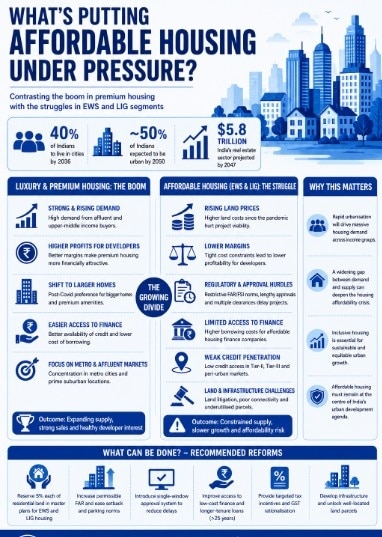



 According to the KPMG-NAREDCO report, rising land prices since the pandemic have significantly affected the commercial viability of projects aimed at EWS and LIG.
India's housing market is witnessing a growing divide. While premium and luxury residential projects are enjoying strong demand and attracting developers with higher margins, affordable housing for lower-income households is facing mounting challenges, raising concerns over the inclusiveness of the country's urban growth story.
According to a joint report by KPMG in India and the National Real Estate Development Council (NAREDCO), this divergence could become more pronounced as rapid urbanisation drives demand for housing over the coming decades. The report estimates that nearly 40% of India's population will live in urban areas by 2036, with almost half expected to reside in cities by 2050. It also projects the country's real estate sector to reach $5.8 trillion by 2047.

 NSE IPO: Exchange raises Rs 6,746 crore from 189 anchor investors; LIC, GIC, Fidelity among buyers
 India’s chip push goes global: Semiconductor heavyweights deepen footprint ahead of SEMICON 2026
 NSE IPO opens tomorrow: Brokerage weighs growth prospects, valuation; what GMP indicates
 UPI MDR: No rollback of 0.4% fee above Rs 2,000; govt says move will make UPI self-sustainable
 From Rs 300 to Rs 25,000: How the wage ceiling under EPFO has increased over the years
 “Onion Prices Down 9% In 9 Days”: Nidhi Khare On Availability And ₹35/Kg Retail Sales
 Indian Markets At A Crucial Juncture: Nifty, Crude, Fed & Smallcaps | Jaipuria
 Nifty At 23,200: Crude Oil, U.S. Fed Rate Hike Fears & Market Outlook Explained
 “7.8% Growth Is Not Random”: FM Sitharaman Credits India’s People, Industry And MSMEs
 Indian I.T. Stocks: Why AI Disruption & Weak Growth Are Making Investors Rethink Their Bets
 NSE IPO: Exchange raises Rs 6,746 crore from 189 anchor investors; LIC, GIC, Fidelity among buyersNSE IPO opens tomorrow: Brokerage weighs growth prospects, valuation; what GMP indicates
 Paytm, KRN Heat Exchanger, Ather Energy, Vishal Mega Mart: Expert shares key entry levels, targets
 FOMC outcome: How stock market may react if Fed rate is hiked by 25 bps today
  Exit PTC India shares on rally, average L&T Technology Services on dips: Market expert
 'There is no boundary between Pakistan and China': India rejects joint commission over Indian territory
 ‘Do it without borrowing money’: Nithin Kamath recalls how a ₹25,000 credit card debt changed his money habitsNSE IPO: Exchange raises Rs 6,746 crore from 189 anchor investors; LIC, GIC, Fidelity among buyers
 'Govt subsidy wasn't enough': MobiKwik co-founder explains why UPI needs MDR
 Massive gold mine collapse in Sudan kills at least 67, dozens still missing: What we know


