












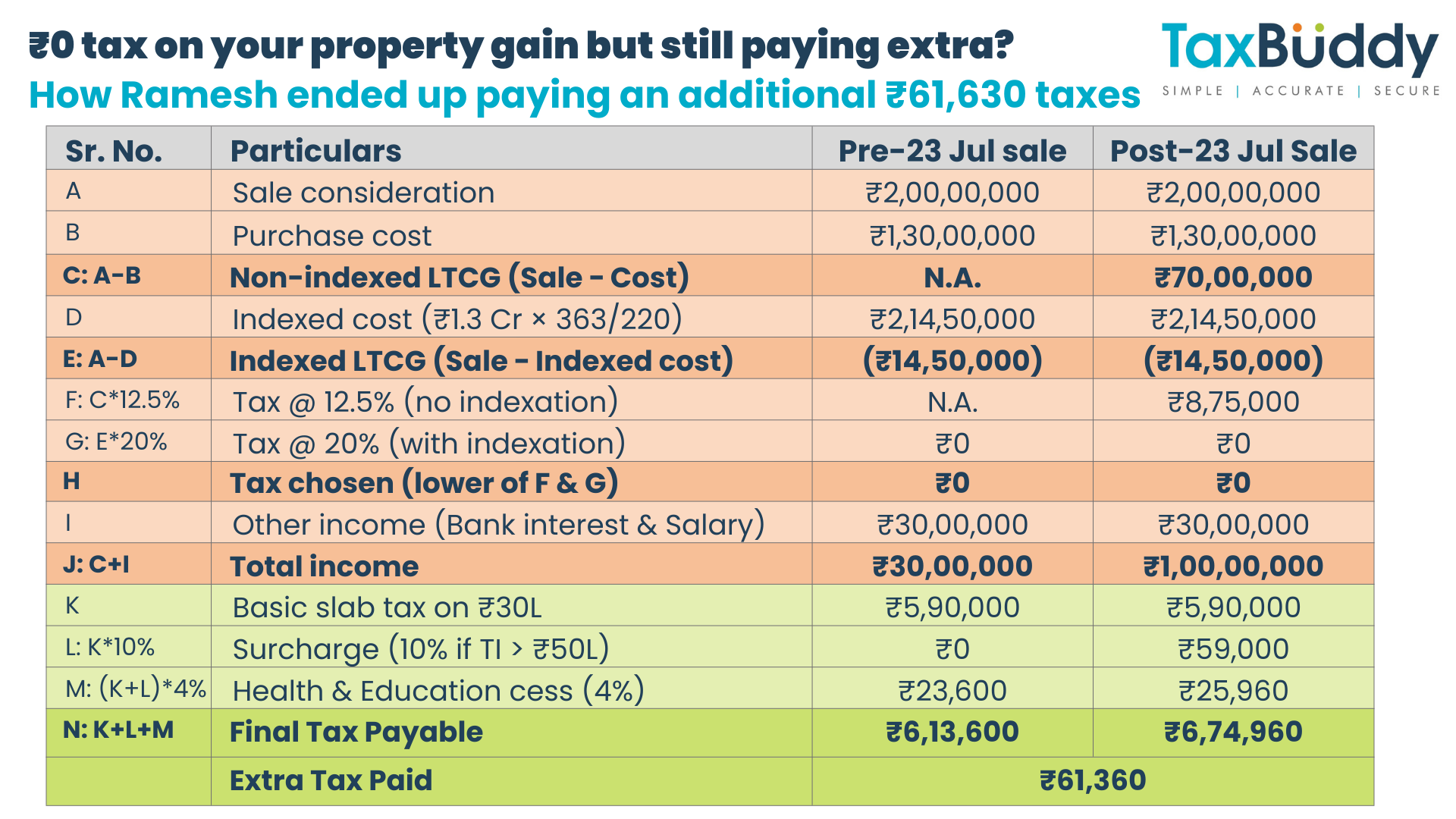



 Surcharge is an additional tax on income tax payable, not directly on capital gains. It applies once total income (including capital gains) crosses ₹50 lakh.
When Ramesh sold his property in early 2025, he was shocked to see an additional Rs 61,630 tax liability, even though his sale price generated no real gains after indexation. The reason? Surcharge on property sale transactions, a tax trap many property owners don’t anticipate. For property sellers, the date of transfer now matters more than ever. Two people selling the same house at the same price could end up in very different surcharge brackets depending on whether their sale was before or after July 2024.
Tax advisory platform Tax Buddy explains what happened in Ramesh’s case and how the surcharge rules apply.

 'AI ending humanity is nonsense': Ex-Infosys CEO Vishal Sikka rejects growing doom warnings
 'Majority among two is two': Tata Trusts says Chandrasekaran reappointment failed AoA condition, has no legal effect
 ICAI plans further reforms to scale up homegrown accounting firms
 'Modi admin has done a phenomenal job': Blackstone's Jon Gray on what changed in India
 'SC/ST Act is being weaponised': Tech CEO backs IIT Bombay Professor, calls for case withdrawal
 Gold Price Target 2026: Expert Sees MCX Gold At ₹1.8 Lakh By Year-End Amid Strong Demand
 Health Insurance: Why Pre-Existing Diseases And Waiting Periods Matter For Buyers
 Crude Oil Above $100: How High Energy Prices And Rupee Weakness Impact Gold Prices In India
 CEA On India’s Manufacturing Rise, Atmanirbhar Bharat And Modi’s Economic Policy
 Health Insurance Buying Guide: 7 Things First-Time Buyers Must Check Before Choosing A Policy
 SpaceX weight in Nasdaq 100 to jump to 2.82% following quarterly index rebalance: Report
 Tata Motors or Ashok Leyland? Analyst reveals his preferred auto stock for near-term gains
 Maharashtra Scooters, Dixon Tech, Bharat Dynamics, Jai Corp among stocks to turn ex-dividend on Monday
 Jindal Supreme, SS Retail, Hero Motors IPOs subscribed up to 181 times on final day; details here
 Sensex, Nifty post sixth weekly loss; TCS, Titan among top laggards, slip up to 4%
 New e-commerce rules: How online discounts and search rankings will change
 555-day FD rates: City Union Bank tops at 7.25%; check rates from 5 other banks
 LPG refill without Aadhaar authentication: What changes from October 1 and how to get subsidy
 From terrace Wi-Fi to IIT Delhi: How this Mumbai student secured AIR 2,456 in JEE Advanced
 Hormuz crisis exposed the world's energy weak spots: Why the next shock could hurt more


