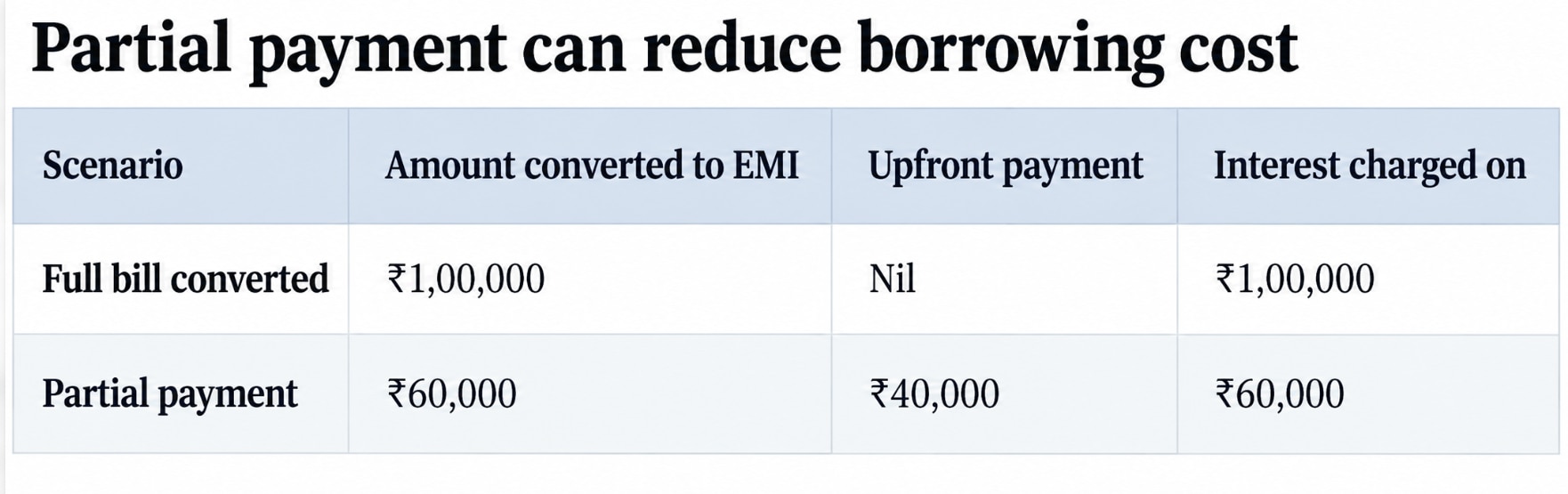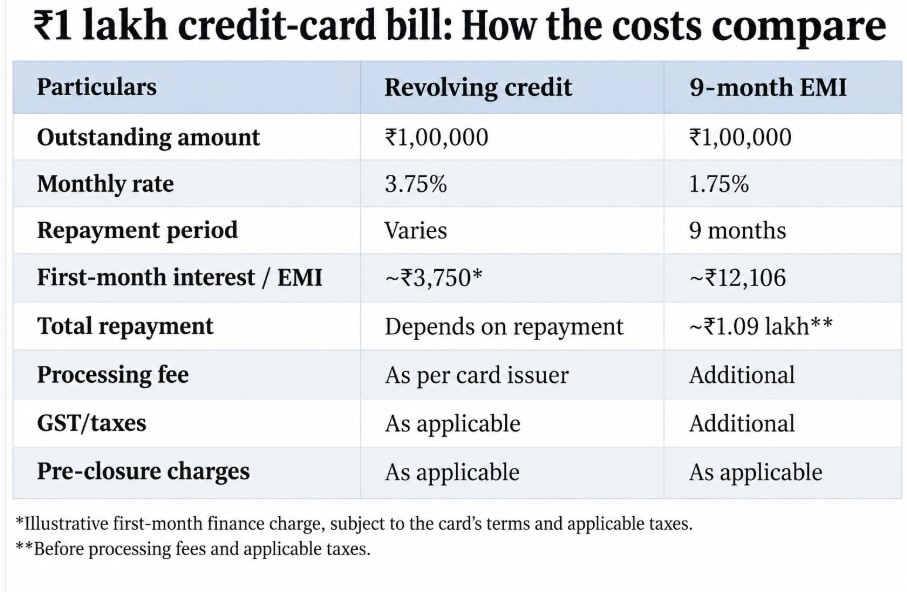



 Check the interest rate, processing fee, GST, tenure, pre-closure charges and total repayment. Also see whether the EMI reduces your available card limit.
A credit-card bill can become easier to manage when converted into an EMI, but a lower monthly instalment does not necessarily mean lower borrowing costs. Consumers should assess the complete repayment burden before converting an outstanding balance.
For a ₹1 lakh credit-card bill, the first question should be whether the consumer can pay the entire amount by the due date without disrupting essential expenses, emergency savings or other financial commitments. Paying the bill in full can avoid interest and EMI-related costs. However, carrying the balance as revolving credit can be significantly more expensive.

 Lack of US-India deal will not have an adverse impact on India’s growth, says Panagariya
 Sebi receives 20,000 comments on proposed CAS changes; framework to follow soon
 Apple removes Jack Dorsey’s Bitchat from India App Store, cites MeitY order under IT act
 Nvidia shares approach record high as AI optimism revives investor demand
 FM Sitharaman: Need to keep building resilience, not a one time exercise
  Mira Kapoor On Dhun Wellness, Clinical Longevity And The Dhun Intelligence Method
 Tech Gear EP 19 | iPhone 18 Pro Series, Apple Pay & Redmi Note 17 Pro Max | Business Today
 Mira Kapoor On Dhun Wellness, $4 Million Funding And Building Its Competitive Edge
 How To Transfer Data From Old iPhone To New iPhone | Easy Guide
 How Mira Kapoor Became An Investor And Decides Which Brands To Invest In
 Nvidia shares approach record high as AI optimism revives investor demandSebi receives 20,000 comments on proposed CAS changes; framework to follow soon
 Stock market sell-off: Nifty, Sensex log 8th straight weekly loss; key levels & top triggers now
 IPO boom: 69 Indian companies raise Rs 90,500 crore in Q3 despite stock market sell-off; what's next
 TCS, Infosys, HCL Tech, TechM, Wipro, LTM, Coforge, HEXT: Fresh target, Q2 previews for IT stocks
 RBI repo rate: Crisil says India Inc can absorb 50-bps rate hike as corporate balance sheets remain strong
 AI’s $4.7 trillion global opportunity: What it could mean for Indian companies and investors
 How much do government documents cost in India? Check PAN, Passport, Aadhaar and DL fees
 Financial Horoscope Today, October 4, 2026: Pisces Should Pay Attention to Budget, Know the Status of Other Signs
 Europe’s €3.2 billion grain loss: What it means for India’s food inflation outlook