










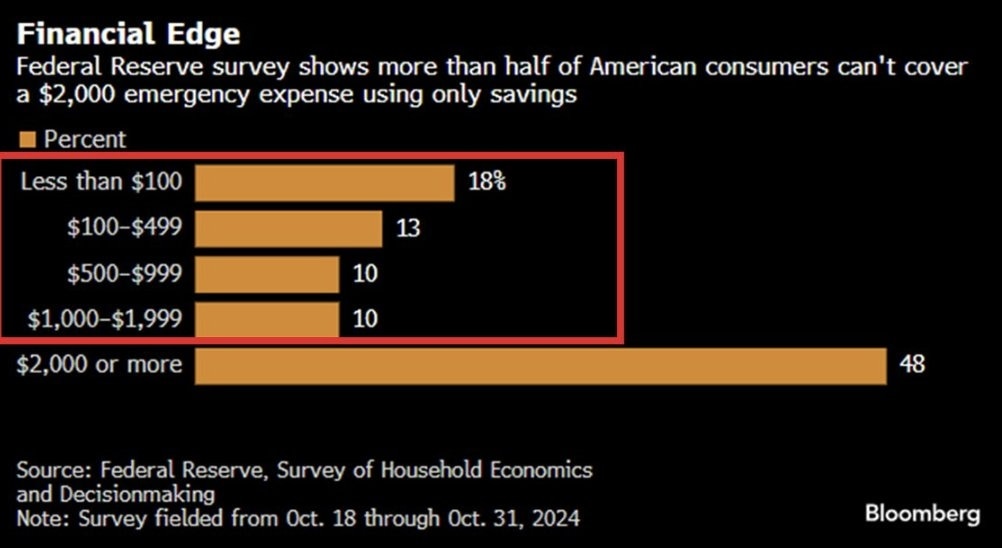



 According to experts, savings have dried up, costs keep rising, and most Americans are one shock away from disaster.
The financial foundation of millions of Americans is far shakier than it seems. According to recent data from the Federal Reserve, only 48% of Americans could cover a $2,000 emergency with their savings. More alarmingly, one in three can’t even manage a $500 setback. This isn’t simply a matter of poor budgeting — it’s a warning siren for a deeply rooted economic problem.
In a social media post, market observer StockMarket.New noted that Americans are grappling with a deepening financial crisis that has been years in the making. Wages have remained stagnant even as the cost of living continues to climb, particularly in housing, where prices and rents have soared beyond affordability. At the same time, consumer debt has reached record levels, while emergency savings have been depleted for a large portion of the population. Rising interest rates have further strained household budgets, making borrowing increasingly expensive.

 How Indian investment overseas is gathering momentum
 10-year jail, ₹50 lakh fine: Lok Sabha approves anti-paper leak bill; key details inside
 ITR filing 2026: Confused by the 'reason for filing ITR' question? Here's what taxpayers need to know
 'Hindu daughters not entitled if...': Madras HC's key ruling on ancestral property rights
 The world is now opting for ‘human responsive cities’ over smart cities; here’s what it means
 Why Are Markets Rallying? Ajay Bagga Explains | Fed, Oil Prices & FII Flows
 Strong Q1 Helps Paradeep Phos Clock 17.3 Cr Shares In Trade
 Mumbai Elite Clubs Face FDA Action | Food Licences Suspended Over Hygiene Violations
 10 Tax Jargons Every First-Time Taxpayer Must Know | Tax Guide | Personal Finance | Money Today
 FIFA's $4.2 Billion Gamble: Infantino, Trump And The Battle Over Football's Future
 Dabur India Q1 results: Profit up 15% at Rs 591 crore YoY; revenue climbs 11%
 FIIs could return to market in six months, says Ajay Bagga
  Sensex, Nifty climb over 1% each; investors add Rs 4 lakh crore in wealth
 Banks, IT, defence, power stocks likely to lead FY27 earnings upgrades, says Ajay Bagga
 Vedanta Oil and Gas Q1 earnings: Net profit at Rs 945 crore, revenue rises 9% Why Are Markets Rallying? Ajay Bagga Explains | Fed, Oil Prices & FII FlowsStrong Q1 Helps Paradeep Phos Clock 17.3 Cr Shares In TradeMumbai Elite Clubs Face FDA Action | Food Licences Suspended Over Hygiene Violations
 Alpine Texworld Shares Hit Lower Circuit For 7th Straight Day Since Market Debut
  What's Fueling The Rally In Bluestone Jewellery?