








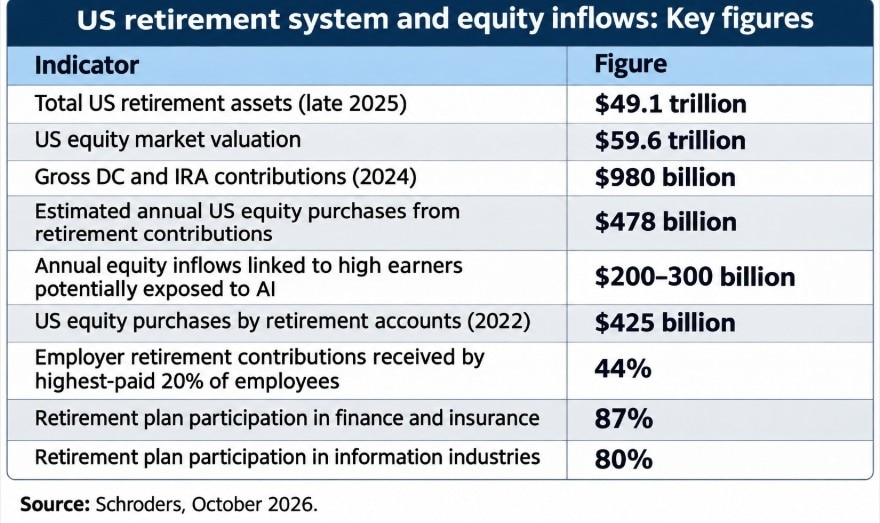



 According to Schroders, US retirement assets reached approximately $49.1 trillion in late 2025, approaching the $59.6 trillion valuation of the country's stock market.
Artificial intelligence may be transforming corporate productivity, but its impact on employment could create an unexpected risk for US stock markets. A new report by global asset manager Schroders warns that job displacement among highly paid professionals could disrupt the steady retirement contributions supporting Wall Street.
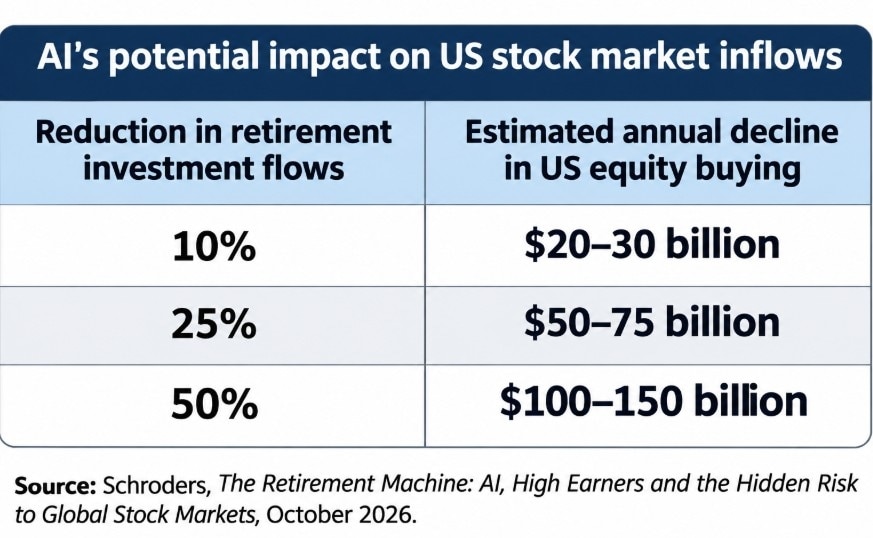
The October 2026 report, The Retirement Machine: AI, High Earners and the Hidden Risk to Global Stock Markets, authored by Duncan Lamont, Head of Strategic Research Unit at Schroders, estimates that high-income workers channel approximately $200–300 billion annually into US equities through retirement accounts.

 Ruchir Sharma warns investors against buying the dip in Taiwan, South Korea
 Raghuram Rajan questions India Inc: 'Why is India's private sector not more ambitious?'
 Noel Tata questions execution of Tata Group's mega projects amid tussle with Chandrasekaran
 'Extinction-level drop': Sanjeev Sanyal warns of Ukraine's population collapse
 'Stop foreign trips, visit Indian villages': Amit Shah's advice to Rahul Gandhi on returning to power
 PM Modi Highlights 5 Agricultural Revolutions Transforming India's Farming Sector
 FDs Vs Equity: Should Women Rethink Their Investment Strategy To Achieve Long-Term Financial Goals?
 Gold Jewellery vs Gold ETFs: Which Is Better for Investment? Mrin Agarwal Explains
 PM Modi Criticises Past Governments Over Farmers’ Welfare At Agriculture Conclave
 SIP Strategy: Should You Continue, Increase Investments Or Rebalance Your Mutual Fund Portfolio?

 Earnings growth to drive 19% Asian equity rally in 2027 despite AI volatility risks: Goldman Sachs
 Markets Next Week: Key triggers that could move Dalal Street — Return of FIIs, Nvidia earnings, inflation and US trade deal
 Anthropic's $1.4 trillion IPO faces a $901 billion question: Can AI revenues justify its compute bill?
 What happens if a trader defaults on Sunday? The hidden risks behind 24/7 stock market trading
 Buying stocks based on tips? 7 financial checks every retail investor should make before investing
 China's auto industry profit margin crashes from 9% to 3.6%: Is the world's largest car market in crisis?Ruchir Sharma warns investors against buying the dip in Taiwan, South KoreaRaghuram Rajan questions India Inc: 'Why is India's private sector not more ambitious?''Extinction-level drop': Sanjeev Sanyal warns of Ukraine's population collapse'Stop foreign trips, visit Indian villages': Amit Shah's advice to Rahul Gandhi on returning to power