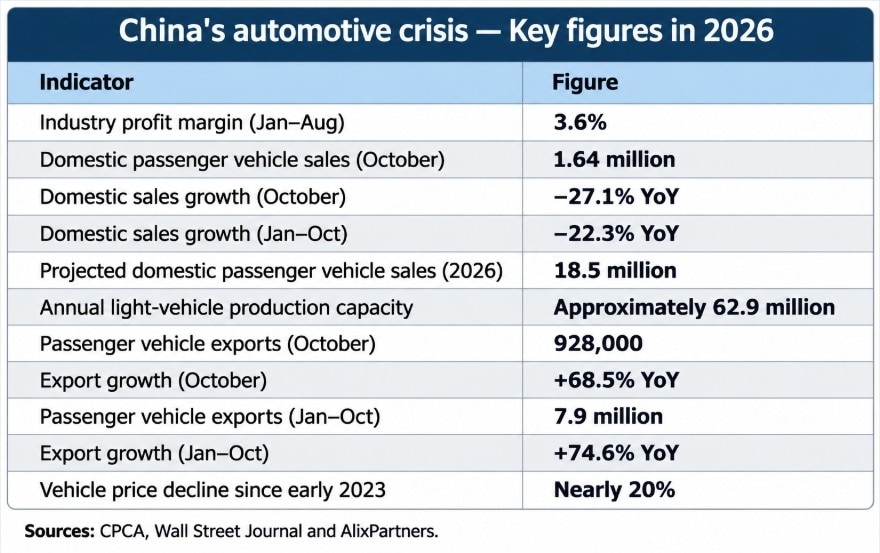












 According to CPCA, domestic passenger vehicle sales plunged 27.1% to 1.64 million units in October 2026, marking the 12th consecutive monthly decline.
China's automotive industry is grappling with one of its most prolonged profitability squeezes, as years of aggressive capacity expansion collide with weakening domestic demand and intensifying competition.
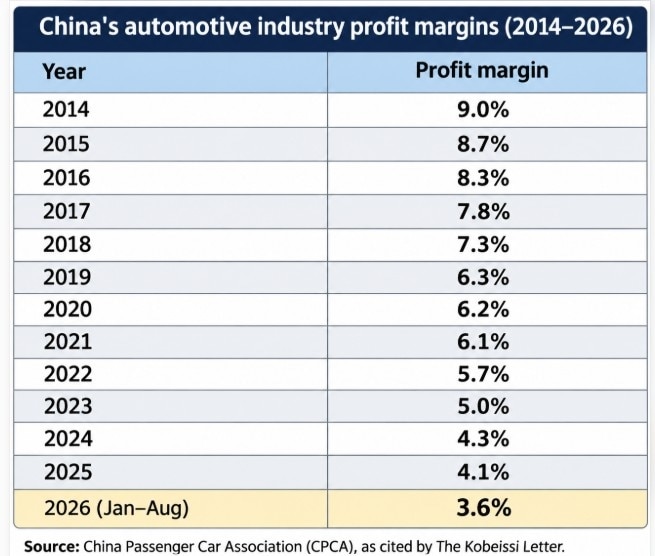
According to China Passenger Car Association (CPCA) data cited by The Kobeissi Letter, the industry's profit margin declined to 3.6% during January–August 2026, its lowest level in at least 12 years.

 Ruchir Sharma warns investors against buying the dip in Taiwan, South Korea
 Raghuram Rajan questions India Inc: 'Why is India's private sector not more ambitious?'
 Noel Tata questions execution of Tata Group's mega projects amid tussle with Chandrasekaran
 'Extinction-level drop': Sanjeev Sanyal warns of Ukraine's population collapse
 'Stop foreign trips, visit Indian villages': Amit Shah's advice to Rahul Gandhi on returning to power
 PM Modi Highlights 5 Agricultural Revolutions Transforming India's Farming Sector
 FDs Vs Equity: Should Women Rethink Their Investment Strategy To Achieve Long-Term Financial Goals?
 Gold Jewellery vs Gold ETFs: Which Is Better for Investment? Mrin Agarwal Explains
 PM Modi Criticises Past Governments Over Farmers’ Welfare At Agriculture Conclave
 SIP Strategy: Should You Continue, Increase Investments Or Rebalance Your Mutual Fund Portfolio?

 Earnings growth to drive 19% Asian equity rally in 2027 despite AI volatility risks: Goldman Sachs
 Markets Next Week: Key triggers that could move Dalal Street — Return of FIIs, Nvidia earnings, inflation and US trade deal
 Anthropic's $1.4 trillion IPO faces a $901 billion question: Can AI revenues justify its compute bill?
 What happens if a trader defaults on Sunday? The hidden risks behind 24/7 stock market trading
 Buying stocks based on tips? 7 financial checks every retail investor should make before investingRuchir Sharma warns investors against buying the dip in Taiwan, South KoreaRaghuram Rajan questions India Inc: 'Why is India's private sector not more ambitious?''Extinction-level drop': Sanjeev Sanyal warns of Ukraine's population collapse'Stop foreign trips, visit Indian villages': Amit Shah's advice to Rahul Gandhi on returning to power
 Prince William, Kate Middleton to visit India from November 16; meeting with PM Modi planned