











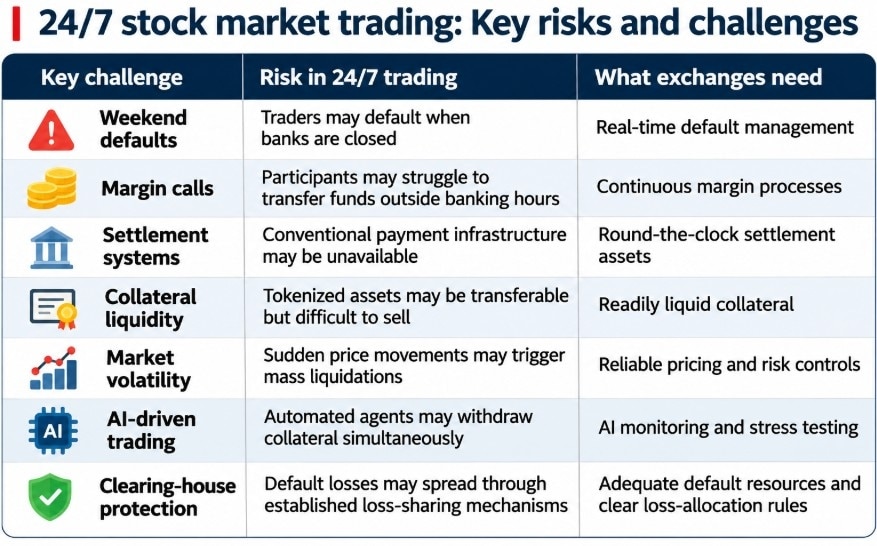



 Under conventional arrangements, margin payments, collateral transfers and default-management processes often depend on banking hours and established settlement windows.
The prospect of stock markets operating 24 hours a day, seven days a week, is gaining attention as cryptocurrency platforms, tokenized assets and artificial intelligence reshape global trading. However, a new research report warns that extending trading hours without strengthening clearing and settlement infrastructure could create significant financial stability risks.
According to Raevel Advisory Services' 2026 report, The Second Exchange Revolution: Designing the Markets of Tomorrow, exchanges must prepare for a financial ecosystem where trading, collateral management and risk monitoring operate continuously.

 'My worry is that listing will change the Tata way': Noel Tata fears profit over philanthropy
 Sheikh Hasina's return now hinges on India as Bangladesh says legal formalities are complete
 What made India’s net power capacity addition fall to its lowest in a year?
 Trump considers delaying fresh Iran strikes as Saudi Arabia, Turkey urge restraint: Report
 Air India flights to US remain on schedule despite nationwide ground stop, says airline
 PM Modi Criticises Past Governments Over Farmers’ Welfare At Agriculture Conclave
 SIP Strategy: Should You Continue, Increase Investments Or Rebalance Your Mutual Fund Portfolio?
 How Should Women Invest In Their 20s, 30s, 40s & 50s To Build Long-Term Wealth?
 Samvat 2083: How Should Investors Rebuild Portfolios After Market Correction? Expert Advice
 PM Modi: Govt Limits Diesel Price Hike To ₹7, Absorbs ₹43 Burden To Protect Farmers

 Buying stocks based on tips? 7 financial checks every retail investor should make before investing
 AI trade losing momentum? Jefferies says India could emerge as a big winner of global market rotation
 Coinbase halts INR withdrawals in India amid banking outage; Unocoin, ZebPay users also face disruptions
 FII buying at 5-year high, Nifty profits up 22% and valuations ease: Is India's bull market back?
 Recent market rally proved time in the market and not timing delivers better outcomes: Navneet Munot of HDFC AMC
 Beyond Diwali and Navratri: Is Mumbai's property market becoming less dependent on festive buying?
 Pakistan could become world's sixth-largest economy before 2050, says PM Shehbaz Sharif
 Elon Musk warns Nvidia's handshake deals are at risk without Jensen Huang as its CEO amid turmoil
 Trump, Xi, Putin set for unprecedented trilateral talks at APEC summit in Shenzhen
 India's pharma industry shifts to high-value drugs, advanced manufacturing to cut China dependence: Report


