












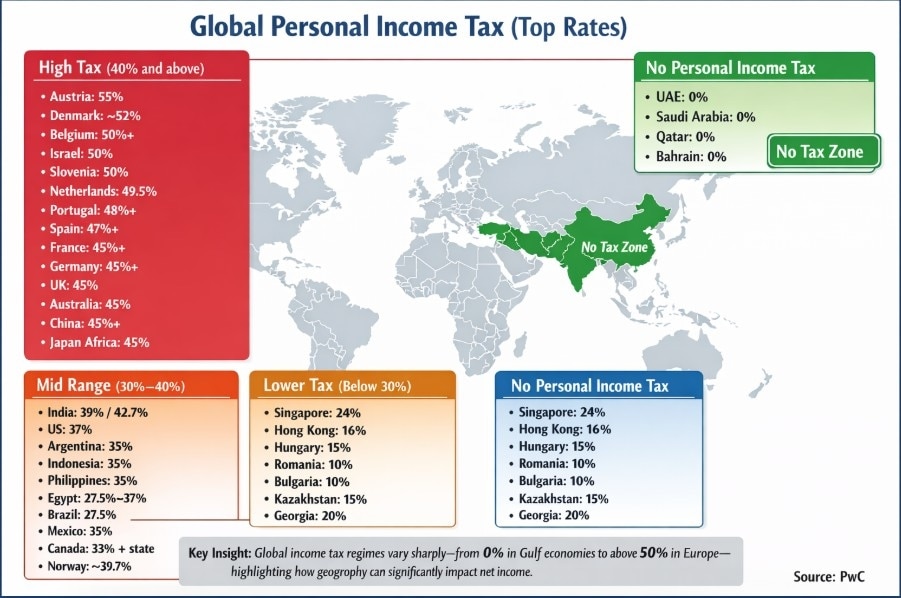



 India sits mid-spectrum, with ₹1 crore yielding about ₹70 lakh post tax, while in tax-free hubs like Saudi Arabia and the UAE, the full amount is largely retained.
A ₹1 crore annual income may signal affluence, but what you actually take home varies widely depending on where you live. Differences in tax structures, marginal rates, and public policy priorities mean that identical incomes translate into sharply different post-tax outcomes across countries.
Zero Tax Regimes

 The GDP conundrum: Economists split over India's faster-than-expected 7.8% GDP growth rate
 Subhash Chandra insolvency case: 'I've been vilified across country over ₹6.5 crore repayment plan,' says media baron
 Mukesh Ambani's ₹10 power play: From Campa Cola to ice cream, why Reliance is betting big on India’s middle class
 After TCS, Wipro installs employee productivity tracker: Inactive days could trigger leave
 'No serious economist will complain': PM's advisor Sanjeev Sanyal defends India's 7.8% GDP growth
 Exclusive: FSSAI CEO Rajit Punhani On Red Labels, Misleading Food Ads & India's Obesity Crisis
 America At SCO Spotlight? Sergio Gor's Clever Central Asia Diplomacy Raises Big Questions
 Paper Leak Protests: Supreme Court Quashes FIRs, CJP Calls Off September 5 March
 Gland Pharma, Caplin Point, Nephrocare: These 3 Pharma Stocks See Strong Growth Potential Ahead?
 Russia Returns To G20 Talks As U.S. Engages Moscow, Europe Pushes Back
 Nykaa rally: Planning to buy fashion retailer stock after recent up move? Here's what analyst says
  Paytm, Eternal, Lenskart, Nykaa, Honasa: New age stocks gain up to 49% in 3 months; worth a buy?
 Coal India arm Mahanadi Coalfields filed DRHP to launch its IPO; check all key details
 IFCI, NIACL stocks jump up to 14%; NSE IPO buzz lifts focus: Analysts share outlook
 Pranav Constructions IPO opens on Sept 7: Check price band, issue size and other key details
  Apple CEO John Ternus education: His college, degree and early career
 Sonos Play coming to India: Sonos launches Sonos 27 AI audio OS, Beam Ultra and Ace UltraNykaa rally: Planning to buy fashion retailer stock after recent up move? Here's what analyst says Exclusive: FSSAI CEO Rajit Punhani On Red Labels, Misleading Food Ads & India's Obesity CrisisAmerica At SCO Spotlight? Sergio Gor's Clever Central Asia Diplomacy Raises Big Questions


