












 Some ridges appear as isolated segments, while others extend for hundreds of kilometers and rise tens of meters above the terrain.
 Some ridges appear as isolated segments, while others extend for hundreds of kilometers and rise tens of meters above the terrain.
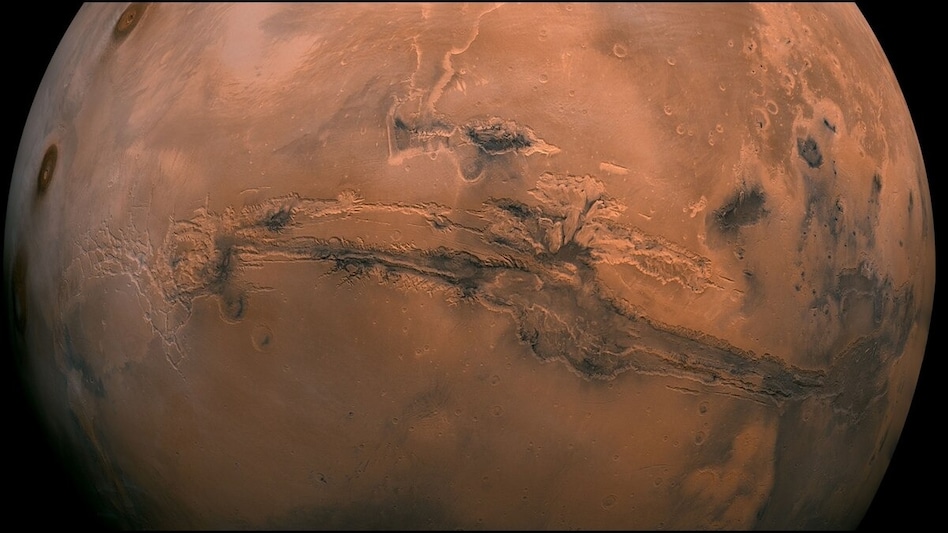
Mars’ dusty plains may once have rippled with rivers. Scientists have traced over 15,000 kilometers of ancient riverbeds across the planet’s southern highlands, hinting that the Red Planet was far wetter — and perhaps more Earth-like — than once believed.
Researchers focused on fluvial sinuous ridges, or inverted channels, winding through Noachis Terra, a region in Mars’ southern highlands. These features likely formed when river sediments solidified into rock and became exposed as surrounding material eroded.
Similar ridges appear across varied Martian landscapes, suggesting widespread flowing water in Noachis Terra, with precipitation as the probable source.
The new research, led by Adam Losekoot, a Ph.D. student at the Open University, was presented today at the Royal Astronomical Society’s National Astronomy Meeting 2025 in Durham.
Findings indicate surface water may have remained stable in Noachis Terra during the Noachian-Hesperian transition around 3.7 billion years ago — a period marked by major geological and climate changes.
Unlike other Martian regions, Noachis Terra has been less studied, partly because it lacks valley networks, the branching features traditionally used to infer past rainfall and runoff. Instead, the team turned to fluvial sinuous ridges as alternative evidence of ancient surface water.
“Studying Mars, particularly an underexplored region like Noachis Terra, is really exciting because it’s an environment which has been largely unchanged for billions of years. It’s a time capsule that records fundamental geological processes in a way that just isn’t possible here on Earth,” said Losekoot.
The team mapped ridge locations, lengths, and shapes using data from three orbital instruments: the Context Camera (CTX), the Mars Orbiter Laser Altimeter (MOLA), and the High Resolution Imaging Science Experiment (HiRISE).
Some ridges appear as isolated segments, while others extend for hundreds of kilometers and rise tens of meters above the terrain. Their broad distribution and morphology suggest they formed over long periods under relatively stable surface conditions.
The spatial patterns of these features point to precipitation as the likely water source.
“Our work is a new piece of evidence that suggests that Mars was once a much more complex and active planet than it is now, which is such an exciting thing to be involved in,” said Losekoot.
The interconnected ridges imply long-lived watery conditions, challenging the notion that Mars was mostly cold and dry with only short bursts of melting that carved a few valleys.
 ‘WORLD’S MOST POWERFUL RESET’: Trump’s cryptic message raises stakes ahead of Iran talks
 'If they’re gonna try and play us...': JD Vance warns Iran ahead of Islamabad negotiations
  RBI proposes Rs 1 lakh crore asset mark for classifying upper layer NBFCs
 Why 15 lakh engineers aren’t enough for India’s AI economy
 RBI suggests cooling-off period for UPI, bank transfers — what it means for you
 Taigun Facelift Push: Volkswagen Targets Market Outperformance
 No Fuel Crisis: Govt Assures LPG, Petrol & Gas Supply Stability
 #Podcast | #Episode10 | Exclusive: William Bissell, MD, Fabindia On Journey, AI-Transfomation & More
 Market Rally Continues! Nifty Near 24,000, Bank Nifty’s Best Week Since 2021
 Tonight At 7 PM: Fabindia MD William Bissell On Brand’s Success Story & Future Plans
 ITC, HUL shares offer up to 31% upside: Why brokerage sees a 'Buy' opportunity
 'Buy' Suzlon Energy, Paytm & GE Vernova shares: PL's analyst; check price targets
 70% dividend stock: Rs 7/share - Check record date, returns | Do you own?
 Coforge, Persistent Systems, Happiest Minds: Should you buy these IT stocks ahead of Q4 earnings?
 RIIL Q4 results 2026 date and time: Check quarterly earnings schedule of Reliance Group firm