


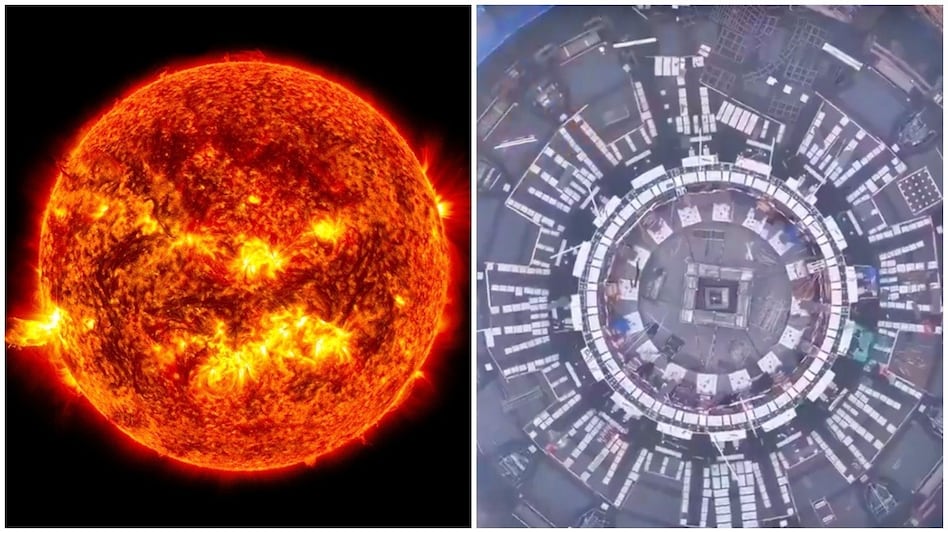
 China has laid out a three-stage roadmap for commercial fusion. (Photo: X/@STANLEES4)
China has completed and tested a 582-tonne superconducting magnet, marking a major engineering milestone in its ambitious pursuit of nuclear fusion and its so-called “Artificial Sun” programme. The development could strengthen Beijing’s push to demonstrate fusion-based electricity generation by around 2030.
Built by the Institute of Plasma Physics in Hefei, the giant magnet is reportedly the largest fusion-reactor magnet constructed so far. The toroidal-field magnet measures around 21 metres in length and is designed to generate the powerful magnetic fields required to confine the extremely hot plasma inside a fusion reactor, according to Forbes.

 'Whoever wins AI, wins': Trump rejects tech bosses' slowdown call, warns of China
 Iran, Oman agree on new Hormuz routes: What it means for oil, ships and global trade
 'Stop knocking out diesel facility, it's causing shortage': Trump tells Zelensky to halt strikes on Russia
 The next time govt takes a financial risk, ISB professor says it should be on start-ups
 India is the second-best BRICS performer, but that is not enough: Economist Surjit Bhalla
 Amit Shah Hails India’s Rise From Fragile Five To Top Five, Politics Of Performance Since 2014
 MEA Details BRICS Summit Outcomes as India Pushes Practical and People-Centric Cooperation
 Modi@25: Amit Shah Highlights 25 Years Of Leadership, Governance And 2047 Vision
 “Development And Environment Are Complementary”: PM Modi On Sustainability At BRICS
 Modi@25: Amit Shah Announces Seva Sankalp Campaign From Sept 17 To Mark Modi’s 25 Years Of Service
 Avoid jewellery; stick to ETFs, bars and coins for investment this festive season: Navneet Damani
 SEBI’s CAS proposals: Expert weighs in on new expiry-day settlement price methodology
 Large caps stocks under pressure as rising US bond yields, crude prices weigh on foreign flows
  SEBI proposes bringing unexecuted Iceberg orders into closing auction
 SEBI proposes new expiry-day settlement formula for derivatives after CAS concerns
 BRICS needs a Traditional Knowledge Alliance, not just de-dollarisation: Why it matters
 From Italy to India: Here are the countries with the most UNESCO World Heritage Sites in 2026
 From ₹1 lakh lots to ₹100 crore masterpieces: How India’s art market is broadening
 From meteor showers to a supermoon: 5 spectacular night sky events to watch out for this autumn'Whoever wins AI, wins': Trump rejects tech bosses' slowdown call, warns of China












