








 China’s lunar programme is widely seen as a symbol of its scientific prowess and geopolitical aspiration to match — or surpass — the United States in space exploration.
 China’s lunar programme is widely seen as a symbol of its scientific prowess and geopolitical aspiration to match — or surpass — the United States in space exploration.
China reaffirmed its ambitious goal of landing astronauts on the Moon by 2030 as it introduced its latest crew of taikonauts on Thursday — marking another significant stride in the country’s rapid ascent as a global space power.
Zhang Jingbo, spokesperson for the China Manned Space Program, said all components of the lunar mission are progressing “smoothly,” with development work advancing on the Long March 10 rocket, moon landing suits, and lunar exploration vehicles.
“Our fixed goal of China landing a person on the moon by 2030 is firm,” Zhang declared, emphasizing that the project’s research and development phases were yielding “fruitful results.”
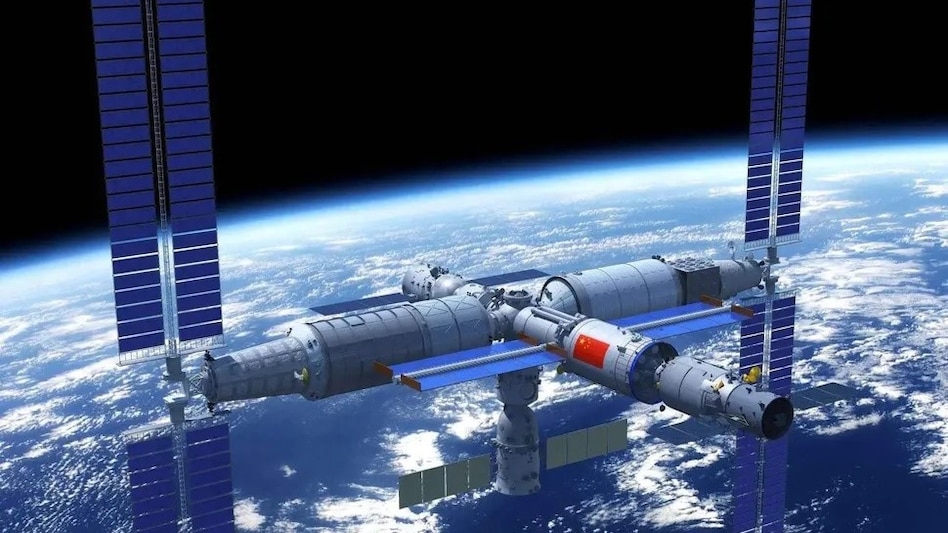
The announcement came as China prepared to launch its latest Shenzhou mission to the Tiangong space station, the country’s orbiting outpost built after being barred from the International Space Station due to US national security concerns.
The new crew — Zhang Lu, Wu Fei, and Zhang Hongzhang — will lift off from the Jiuquan Satellite Launch Center at 11:44 pm local time on Friday. Zhang Lu, a veteran of the Shenzhou-15 mission, returns to orbit alongside first-time astronauts Wu and Zhang Hongzhang.
During their six-month stay aboard Tiangong, the crew will conduct scientific experiments and maintain station systems. In a unique twist, they will also be accompanied by four mice — two male and two female — as part of biological studies examining how microgravity and confinement affect living organisms.
Building the ‘Heavenly Palace’
China began constructing the Tiangong (“Heavenly Palace”) space station in 2021 as a self-reliant platform for scientific research and long-duration human spaceflight. The modular station now serves as a vital step toward Beijing’s broader ambitions — including lunar and eventually Martian exploration.
Each astronaut rotation typically lasts half a year, with crews performing experiments in fields ranging from medicine to material science. The upcoming mission continues a steady cadence of launches that demonstrate China’s growing confidence and technical capability in space operations.
Growing space rivalry
China’s lunar programme is widely seen as a symbol of its scientific prowess and geopolitical aspiration to match — or surpass — the United States in space exploration. While NASA aims to return astronauts to the Moon under its Artemis program, Beijing’s 2030 goal signals a parallel race for lunar leadership.
In recent years, China has achieved several milestones, including landing the Chang’e-4 probe on the Moon’s far side and bringing back lunar samples with Chang’e-5. Its next steps, analysts say, could involve establishing a joint lunar base with international partners, potentially in collaboration with Russia.
For now, however, all eyes are on the Tiangong space station — and the three astronauts preparing to represent the next chapter of China’s celestial journey.
 US-Israel-Iran war LIVE Updates: 'India ready to cooperation, strengthen lasting stability, security' — Jaishankar tells Araghchi
 West Asia War: Here’s why RBI may keep benchmark interest rate on hold in April MPC meet
  Only 54 km at its narrowest, 20 million barrels per day: The Strait of Hormuz’s incomputable significance
  LPG supply concerns: Centre brings back kerosene, coal as cooking fuel amid West Asia conflict
 Oil shock, China’s ‘slow bull market’, and a possible US ‘Suez moment’: Jefferies flags shifting global market risks
 Rahul Gandhi Vs Hardeep Puri In Lok Sabha Over India’s Oil Security
 Induction Cooktop Sales Jump 300% In Delhi-NCR Amid LPG Supply Concerns
 Market Fall Deepens | Oil Hovers Near $100, Nifty Slips - Sanjay Sinha Explains What Next
 Market Crash Amid Oil Surge? Devang Shah Decodes | Live Market Commentary
 #Podcast | #Episode09 | From Bollywood Icon To Entrepreneur: Malaika Arora On Food, Fashion & Fitness
 Suzlon Energy, Inox Wind, BEL, Mazagon, Tata Power & IndusInd Bank shares: MOFSL's Ruchit Jain weighs in
 Geopolitical volatility boosting user activity; Upstox not in rush for IPO: CEO Ravi Kumar
 Renewable energy stocks: Vikram Solar, Emmvee Photo offer upto 53% gains, says Anand Rathi
 Varun Beverages, HDFC Bank, Trent, Tata Motors PV among 357 stocks that hit 52-week low as Sensex, Nifty extend losses
 TCS, Eternal, Tech Mahindra, HDFC Bank, VBL shares oversold on charts; do you own any?