









 This experiment is pivotal in understanding how plants develop in space, especially for future long-term missions.
 This experiment is pivotal in understanding how plants develop in space, especially for future long-term missions.
An excited ISRO announced that cowpea seeds it launched into space aboard the PSLV-C60 POEM-4 platform have successfully germinated under microgravity conditions. The seeds began sprouting just four days after the mission’s launch.
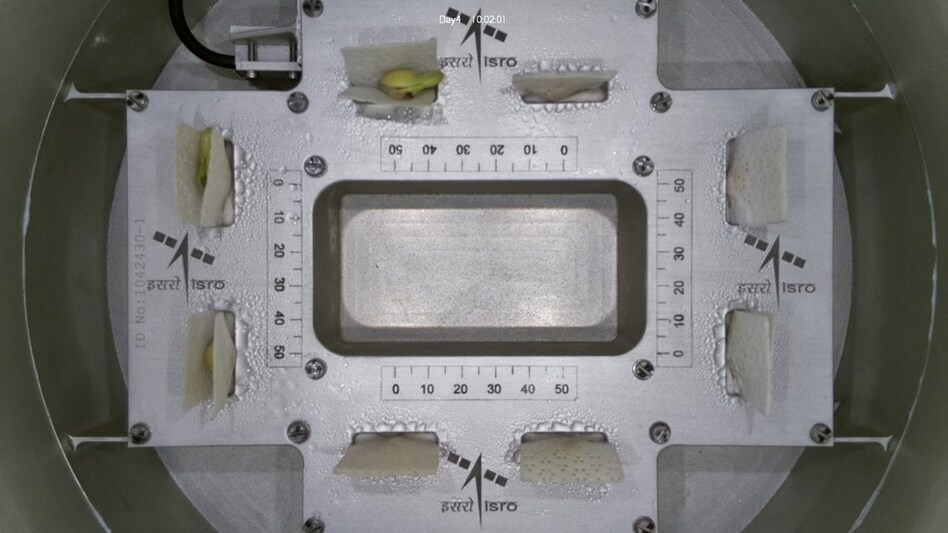
As part of the Compact Research Module for Orbital Plant Studies (CROPS) experiment conducted by the Vikram Sarabhai Space Centre (VSSC), eight cowpea seeds were sent to space to explore plant growth in microgravity. This experiment is pivotal in understanding how plants develop in space, especially for future long-term missions.
“Life sprouts in space!” ISRO shared in a post on X on January 4, confirming that the cowpea seeds had sprouted within four days and that leaves were expected soon.
The PSLV-C60 mission, which launched on the night of December 30, successfully placed two SpaDeX satellites into orbit. The fourth stage of the rocket, carrying the POEM-4 platform, has been orbiting Earth at an altitude of 350 km since December 31, 2024, with 24 onboard experiments.
The CROPS experiment aims to examine how plants adapt and grow in the unique conditions of space, which is crucial for sustaining plant life on extended space missions. The controlled environment, with active thermal regulation, simulates the conditions plants might face during long-duration space travel.
The experiment, which spans five to seven days, is designed to demonstrate seed germination and plant growth to the two-leaf stage in microgravity. The cowpea seeds are housed in a closed-box system with active thermal control, where passive measurements — such as camera imaging, oxygen and carbon dioxide levels, temperature, relative humidity, and soil moisture — are being monitored.
In a separate update, ISRO also shared a ‘selfie video’ from the chaser satellite involved in the space docking experiment, which is currently orbiting Earth at an altitude of 470 km. The chaser satellite is expected to dock with the target satellite on Tuesday, a significant milestone that would make India only the fourth country to achieve this advanced space technology, joining Russia, the US and China.
The Space Docking Experiment is a pivotal mission for India, showcasing orbital docking technology vital for future human spaceflights and satellite servicing. The SpaDeX mission serves as a cost-effective demonstration of in-space docking with two small spacecraft launched by PSLV.
 Meet Bangladeshi-origin Robin Khuda, whose firm AirTrunk announced ₹3 lakh crore investment in India
 Tata Trusts refutes 1989 share transfer claims, says transaction was fully lawful
 RBI's 5 Big Moves To Attract Foreign Capital Amid U.S.-Iran War & Rupee Pressure
 What makes Delhi airport the country’s largest aviation hub?
 RBI holds repo rate at 5.25%: What it means for home loan borrowers and homebuyers
 Hindalco Eyes ₹1,000-Cr Revenue From Eternia Business By 2028; New Copper Recycling Plant Soon
 Govt's Big Tax Gift To FIIs! Will Global Money Flood Back Into Indian Markets?
 What’s Hot: Stocks, Gold & Big Money Moves | Daily Market Show | Business Today TV
 Daily Calls LIVE: Ask Your STOCK MARKET TODAY QUERIES | Market Update LIVE | Share Market News Today
 TMC Rebellion Deepens: After MLAs, Are MPs Next To Leave Mamata Banerjee's Party?
 CMR Green Tech IPO attracts over Rs 56,200 crore bids, subscribed 127 times; check GMP, listing timeline
 IFCI shares gain 31% in nine days: Key factor behind the rally and price targets
  IT stocks to ‘Buy’ amid AI push: Infosys, TCS among nine names – Check target prices
 BT Closing Bell | Sensex settles 474 pts lower from day’s high, Nifty below 23,400; Tata Group trio lead index losers
 Rajesh Exports latest news: 'Confident that Sebi will … ' - Another clarification from Rajesh Mehta-led company | 10 points