


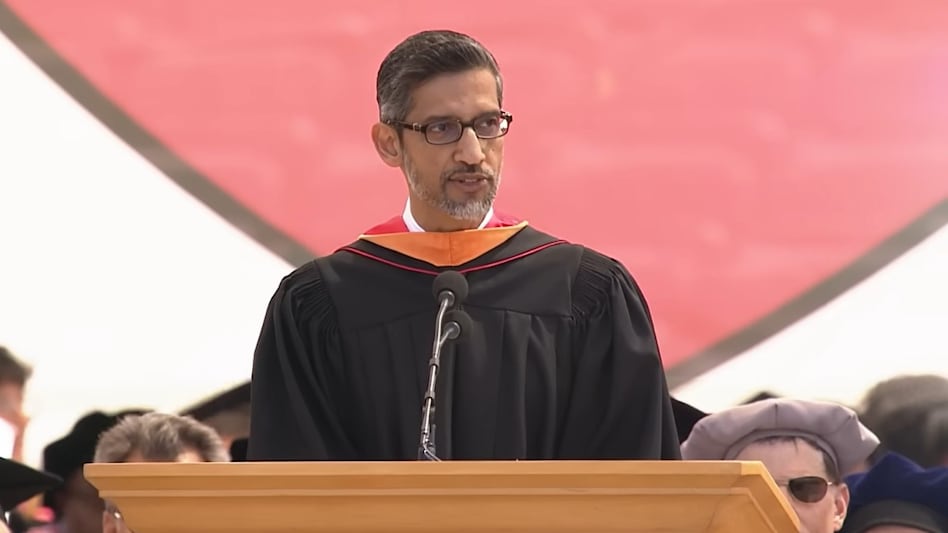
 Google CEO Sundar Pichai
Google CEO Sundar Pichai used his commencement address at Stanford University's graduation ceremony for the Class of 2026 to share what he called the three simple "filters" that have helped him navigate life, career choices and moments of uncertainty.
Drawing from his journey from Chennai to Silicon Valley, his decision to leave a doctoral programme, his early years at Google and even an impromptu road trip to Las Vegas as a student, Pichai told graduates that most decisions in life are far less consequential than they appear.
"You're gonna face a lot of moments in your life. Only a few of them are really important, and you need to get them right," he said.
While choices such as selecting a life partner, starting a family or making a major career pivot require careful thought, many other decisions that seem huge at the time rarely determine the course of a person's life, he said.
Against that backdrop, Pichai outlined the three filters he uses to "get more moments right than wrong."
Don't Miss: Alphabet’s Google revenue jumps 22%, Google Cloud crosses $20 billion milestone
Filter 1: Choose optimism
Pichai said optimism is not about ignoring problems but about reframing challenges and seeing possibilities where others see obstacles.
The Google chief acknowledged that today's graduates are entering a world shaped by geopolitical conflicts, economic uncertainty and rapid technological change.
"It's easy to look at the news of the day and think that we are living in uniquely challenging times," he said.
Recalling his childhood in Chennai, Pichai spoke about growing up amid water shortages and limited access to technology. His family waited years for a telephone, television and refrigerator. Yet, he said, his parents never allowed those constraints to limit his imagination.
"My parents never let the constraints limit my imagination of what was possible," he said.
Pichai recounted arriving in California for the first time after his father spent the equivalent of a year's salary on an airline ticket. Looking out of the window, he remarked that the landscape appeared brown rather than the lush green he had expected.
His host family gently corrected him.
"We prefer to call it golden," she told him.
For Pichai, that became a lasting lesson.
"That's exactly what I mean by choosing optimism. It's about reframing for the positive."
The same mindset helped him when he abandoned plans for a PhD and instead completed a master's degree at Stanford. "I could have seen it as the end of a dream," he said. "In that moment, I chose optimism."
Must Read: Sundar Pichai praises Tim Cook’s ‘Deep commitment’ as Apple enters new era
Filter 2: Gravitate towards hard things
The second filter, Pichai said, is deliberately choosing difficult challenges.
He rejected the idea that his career progressed smoothly after Stanford, saying it took years before he found the right path.
That opportunity came at Google.
Pichai recalled interviewing at the company on April 1, 2004 — the same day Gmail was launched.
At the time, one gigabyte of free email storage seemed almost impossible, he said.
A few years later, he became involved in another ambitious project: building Google's web browser.
The proposal faced skepticism internally, with many believing it would require hundreds of engineers. The team had only around 10 people. "The consensus was right. It was going to be really hard," Pichai said.
Despite early excitement following Chrome's launch in 2008, growth soon stalled. After a year, the browser had only around 2 per cent market share.
Pichai recalled then-Microsoft CEO Steve Ballmer dismissing Chrome as a "rounding error."
Rather than becoming discouraged, he used it as motivation.
"We kept going," he said, describing how the team pushed aggressive goals and released updates every six weeks.
The experience reinforced a lesson that has stayed with him.
"Working on hard things has taught me a lot. It typically attracts other great and optimistic people."
Even when ambitious goals are missed, meaningful progress is still achieved, he said.
"So when you have the choice to work on something hard, say yes."
Filter 3: Do the thing that excites you
The final filter, Pichai said, is to pursue what genuinely excites you when all other factors are equal.
For him, that passion was technology.
Growing up in India, he had limited access to computers. When he arrived at Stanford in 1993 and saw rows of computers available to students, he realised technology's transformative power.
"I saw it as a fundamental enabler of human progress," he said.
That belief guided several major career decisions, including joining Google and later working on products such as Chrome, Chromebooks and Android.
Pichai said some of his most rewarding moments came from seeing technology improve people's lives, whether it was women in rural India using smartphones to learn new skills or students benefiting from digital tools in classrooms.
As graduates chart their own futures, he urged them not to be driven by external expectations.
"Don't focus on the thing your parents want you to do or the thing all your friends are doing or that society expects of you."
Instead, he encouraged them to pursue the interests that naturally energise them. "Think about the things that keep you chatting excitedly with your roommate late into the night and go do those things."
'The important thing isn't to get them all right'
Pichai also shared a lighter lesson from his Stanford years, recounting how a spontaneous road trip to Las Vegas with a classmate helped him realise that not every decision carries life-altering consequences.
"For the first time, I realised the world won't end if I relaxed a little," he said.
Closing his address, Pichai told graduates that life would present thousands of moments and decisions, but perfection should not be the goal. "The important thing isn't to get them all right, it's to find a way to keep moving forward."
For Unparalleled coverage of India's Businesses and Economy – Subscribe to Business Today Magazine

 India's solar push hits a manufacturing hurdle. Here's why the cell mandate was delayed
 Pakistan trade crashes. Afghanistan pitches deeper economic ties with India
 Monsoon regains strength as clouds cover India. IMD issues alert for Delhi & other cities
 Global outage hits Instagram and Facebook. Accounts on Meta platforms face login errors
 Why Iran won't give up control over Hormuz: West Asia expert explains Tehran's strategy
 U.S.-Iran War’s 3 Phases Explained: From Khamenei’s Killing To Battle For Strait Of Hormuz
 China’s Helium Export Ban Triggers Global Tech Alarm As Hormuz Crisis Chokes Critical Supply
 CEAT Stock Impact: Why The Company Took A ₹50 Crore Forex Loss | CFO Breaks It Down
 Caliber Mining IPO Opens: Should You Subscribe? Price Band, GMP & Key Risks Explained
 Trump Threatens Iran’s “Pickaxe Mountain”: Why This Nuclear-Linked Bunker Is Hard To Hit
 Federal Bank rally may limit fresh upside; Bandhan Bank shares offer better valuation comfort: Expert
  ICICI Bank, SBI, HDFC Bank, PNB, BoB, Kotak Bank: Price targets for top banking stocks
 RIL Q1 results: O2C recovery drives broadly in-line quarter, says Equirus Securities
 IDBI Bank Q1 results: Net profit rises 5% to Rs 2,115 crore; NIM falls 54 bps QoQ
  Adani Ports: Post 30% rally in six months, more upside likely for the Adani Group stock?









