








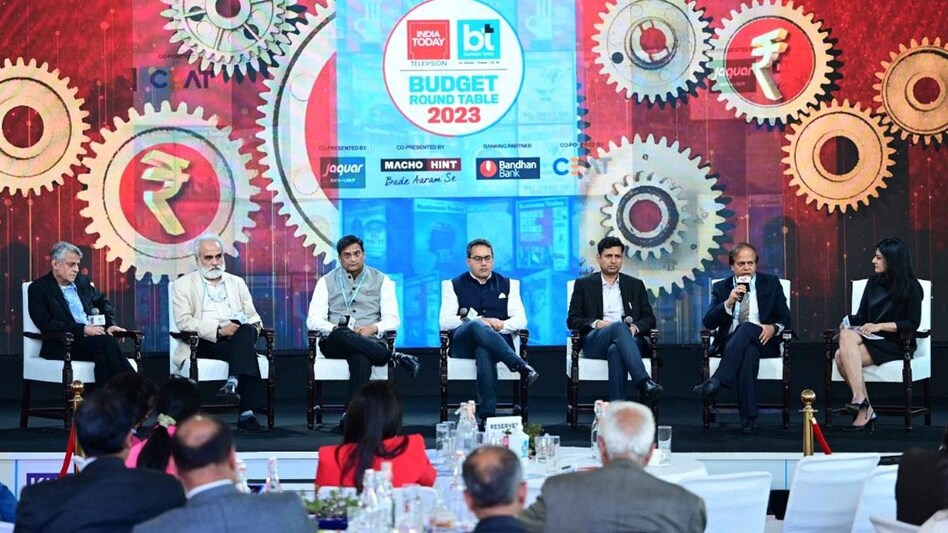
 Navneet Munot, MD and CEO, HDFC Mutual Fund, for example said that he would "use three words to describe the Budget -- credible, continuity and conviction.”
 Navneet Munot, MD and CEO, HDFC Mutual Fund, for example said that he would "use three words to describe the Budget -- credible, continuity and conviction.”
Industry leaders have lauded the recently-delivered Budget 2023. Speaking at the Business Today Budget Roundtable 2023, Navneet Munot, MD and CEO, HDFC Mutual Fund, said that he would "use three words to describe the Budget -- credible, continuity and conviction.”
He said the Budget showed continuity in terms of enhancing the tax to GDP for simplification, and had the conviction that over the next 25 years India has a real opportunity of becoming a large economy, not only in terms of per capita GDP increase but also an example of a sustainable and inclusive society.
“The Budget was obviously conservative given the global market conditions, but at the same time there was enough across sectors. Manufacturing, of course, got a lot of focus. Overall it was very positive,” added Kunal Bahl, CEO, Snapdeal.
Parvesh Minocha, Chairman, Feedback Infra, who was also on the panel, pointed out that while there were a lot of positives he could not understand why the government had to sacrifice InvITs (Infrastructure Investment Trust) and insurance. InvITs were earlier exempted but have now been included in the taxation bracket. The Budget has also scrapped tax benefits for large-ticket traditional life insurance plans while making rebate-linked savings unattractive for the average taxpayer.
Reflecting on this, Prashant Tripathy, MD & CEO, Max Life Insurance said the insurance is a long-term saving with people trying to save for retirement so with a cap of only Rs 5 lakh, it impacts savings. The industry as a whole is requesting for a revision of this guideline. “Insurance is the most trusted vehicle,” he said.
On being asked if easing out of the Angle Tax would have helped the start-up ecosystem, Rahul Garg, Founder & CEO, Moglix said while he hoped the tax would be eased, he was excited that till a few years back, start-ups were not a part of the budget conversation. “The fact that the government and the states are encouraging start-ups is a big positive.” He added, “So, the way I look at it for startups, right access to money is very important and angels play a very important role in it. And the second thing is, I would also want to expand the question, which is a piece of taxation at the point of exercise. So, I think these two things, remain a recurring task for last several years, we continue to hope that it will come soon.”
Added Bahl: “When I started 15 years ago, startup was not even part of the parlance in India, where it was like, either you got a job, or may be started a company. What was a start-up. But obviously, now, it's part of the national parlance.” He said that start-ups now got the recognition they deserved. “As an ecosystem, I think we, we feel abundantly recognised.” However, one ask of the start-up industry which impacts the flow of capital into startups is the equalisation of the long term capital gains tax on unlisted equities. “If you invest as an overseas investor in an Indian company, you get a lower tax rate when you sell your shares in a startup versus if I invest in a company as a domestic investor. It sounds a bit inconsistent with what we would want to do as a country where we want to have the same level of tax so that there is no disincentive for domestic investors to invest in startups, which is the case today unfortunately.”
Patanjali Keswani, CMD, Lemon Tree Hotels, was extremely bullish on the hospitality sector. “My view is that in the next three to four years, till more supply comes in, you're going to have a period where every hotel company in India is going to make some crazy money,” he said. He added that unless there was another Black Swan event, the next 4-5 years, the hotel industry would be in an upstate. Maximum growth will come from the retail sector, with the services industry growing. “The hotel industry grows 1.5 times the services sector,” he added.
 Exclusive: Adani Group to start coal gasification work this year, expand MRO operations, says Jeet Adani
 Suzlon Energy price target cut by 33%, order inflows at risk; here's why
  HbA1c-only diagnosis may misclassify diabetes in India, Lancet warns
 Tata Steel shares hit record high on Q3 earnings; here's what brokerages say
  YES Bank shares snap two-day fall; analysts advise caution on near-term outlook
 India-U.S. Trade Deal Triggers Political Storm As Congress Says Trump Wins, Modi Loses On Farmers
 US Map On Trade Deal Shows Full J&K As India, Sending Sharp Signal To Pakistan And China
 “India’s Trade Policy Has Shifted Fundamentally After The US Deal,” Says Piyush Goyal
 Govt Scraps Small Car Concessions In Emission Norms; Maruti Seen Most Impacted
 Bhaijaan Meets Bhagwat: Salman’s RSS Appearance Triggers Political Firestorm
 Kalyan Jewellers, Vaibhav Global, Thangamayil, Senco, PN Gadgil & Goldiam jump up to 15%; here's why
 Shipping Corp shares zoom 14% on Q3 earnings, dividend; check details YES Bank shares snap two-day fall; analysts advise caution on near-term outlookTata Steel shares hit record high on Q3 earnings; here's what brokerages say Suzlon Energy price target cut by 33%, order inflows at risk; here's why